Apartment Balcony Gardening: A Beginner’s Guide to Growing in Small Spaces
Apartment balcony gardening can turn even a small outdoor space into a place for growing herbs, flowers, leafy greens, compact vegetables, and other plants. But a balcony doesn’t behave exactly like a backyard garden.
Sunlight can be intense or blocked by nearby buildings. Wind can dry containers surprisingly quickly. Hard surfaces can increase heat, and containers filled with wet potting mix can become much heavier than they look.
That means successful apartment balcony gardening should start before you buy plants or planters. First, learn how sunlight, wind, drainage, weight, and your building’s rules affect the space you have.
This guide walks you through gardening on an apartment balcony step by step, from evaluating your growing conditions to choosing containers, watering correctly, using vertical space, and maintaining your plants.
If you’re still deciding how you want to use the growing space available in your apartment, our apartment gardening ideas guide covers several other approaches for growing in small spaces.
Affiliate Disclosure: This article may contain affiliate links. If you purchase through one of these links, we may earn a commission at no additional cost to you.
In This Guide
What Is Apartment Balcony Gardening?
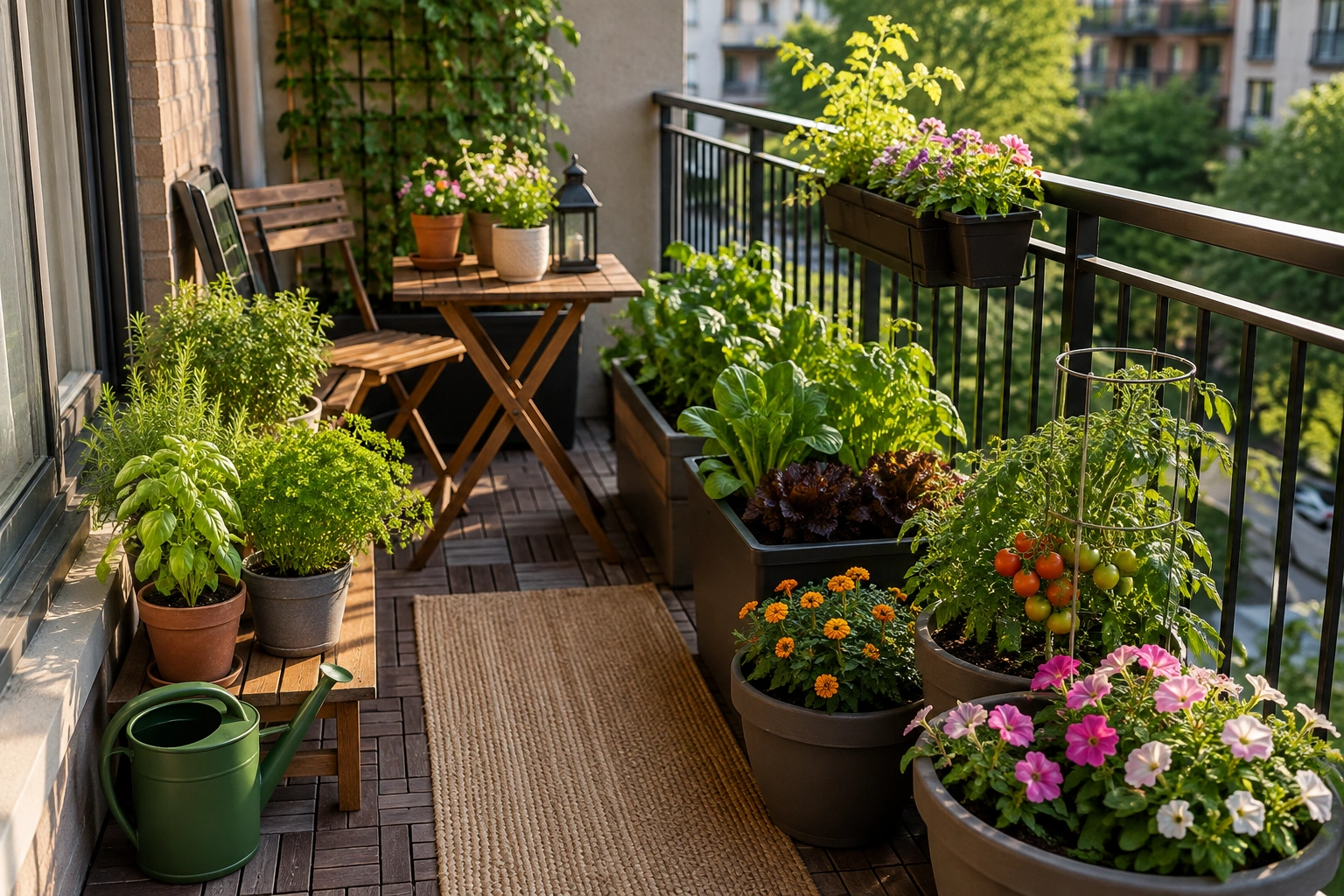
Apartment balcony gardening means growing plants in containers or other supported growing systems on an apartment balcony instead of planting them directly in the ground.
Because there is no traditional garden bed, containers become the foundation of the garden. They hold the roots, growing medium, water, and nutrients that plants need.
Depending on your growing conditions, a balcony may provide space for herbs, flowers, leafy greens, compact vegetables, and ornamental plants.
The challenge is that a container provides a much smaller root environment than an in-ground garden. It can lose moisture quickly, heat up in direct sunlight, and become waterlogged if drainage is poor.
Balconies can make some of those challenges even more noticeable. The Royal Horticultural Society identifies strong wind and sunshine as important challenges for roof and balcony gardens, particularly because exposed containers can dry quickly and plants may suffer wind damage.
This is why gardening on an apartment balcony should begin with understanding the balcony itself.
Is Your Apartment Balcony Suitable for Gardening?
You don’t need a huge balcony to grow plants, but you do need to understand what the space can realistically support.
Before buying containers or plants, evaluate:
- usable floor space
- hours of direct sunlight
- wind exposure
- shade from nearby buildings or overhangs
- access to water
- where excess water will drain
- building restrictions
- potential weight limitations
Don’t worry if your balcony doesn’t receive full sun all day. Different plants have different light requirements. A balcony receiving a few hours of direct sunlight may simply require different plants than one exposed to strong sun for most of the day.
The goal isn’t to create perfect growing conditions.
It’s to identify the conditions you already have and choose plants and equipment that work with them.
Check Your Balcony Rules and Safety Limits First
One major difference between backyard gardening and gardening in an apartment balcony space is that the outdoor area may come with rules and structural limitations.
Those are worth checking before you start filling containers.
Check Your Lease, Building, or HOA Rules
If you rent, review your lease or ask your property manager whether there are restrictions involving balcony gardening.
If you own a condo, check applicable building or association rules.
Pay particular attention to rules concerning:
- attaching planters to railings
- attaching trellises or hooks to walls
- installing privacy or wind screens
- hanging baskets
- water runoff
- exterior appearance
RHS guidance for renters recommends getting permission before attaching anything to a wall or fence or making alterations.
A freestanding container garden may be easier to manage in a rental because it generally requires fewer permanent changes.
Think About Wet Weight, Not Just Empty Pot Weight
Large containers can become much heavier after you add potting mix, plants, and water.
For perspective, University of Maryland Extension notes that a 20-inch container filled with moist potting mix and plants can weigh about 100 pounds.
That’s an example, not a universal container weight or balcony weight limit. But it demonstrates why balcony gardeners need to consider more than the weight of an empty planter.
Don’t assume your balcony can safely support a certain amount of weight based on a general number you find online. Balcony construction varies, and the research for this article did not identify a universal residential balcony weight limit appropriate for every building.
If you’re considering numerous large or unusually heavy containers and aren’t sure about the limits, check with your building management or an appropriate building professional first.
Secure Containers and Supports
Wind doesn’t only affect plants. It can move lightweight containers, too.
A container with a wide, stable base may make more sense in an exposed location than a tall, narrow planter that tips easily.
Hanging baskets, window boxes, screens, and trellises also need appropriate supports capable of handling their filled weight, including the additional weight after watering.
How Much Sun Does Your Balcony Get?
Sunlight is one of the most important things to measure before choosing plants.
Don’t assume you know how much sun your balcony receives simply because you know which direction it faces.
If you’re unsure how to measure it, our guide to how much sun a balcony garden needs explains how to track direct sunlight and what different light levels mean for the plants you can grow.
A neighboring building, balcony above you, roof overhang, wall, tree, or privacy screen can dramatically change the amount of direct sunlight reaching your plants.
Full Sun, Partial Sun, and Shade
Plant labels commonly use terms such as full sun, partial sun, partial shade, and shade.
Definitions vary somewhat among horticultural sources, but full sun generally means around six or more hours of direct sunlight per day.
The exact label matters less than matching a plant’s needs to the actual conditions on your balcony.
A plant requiring full sun probably isn’t a good choice for a balcony receiving only an hour of weak direct light. Likewise, a plant adapted to shade may struggle in intense afternoon sun.
Measure Your Actual Sunlight
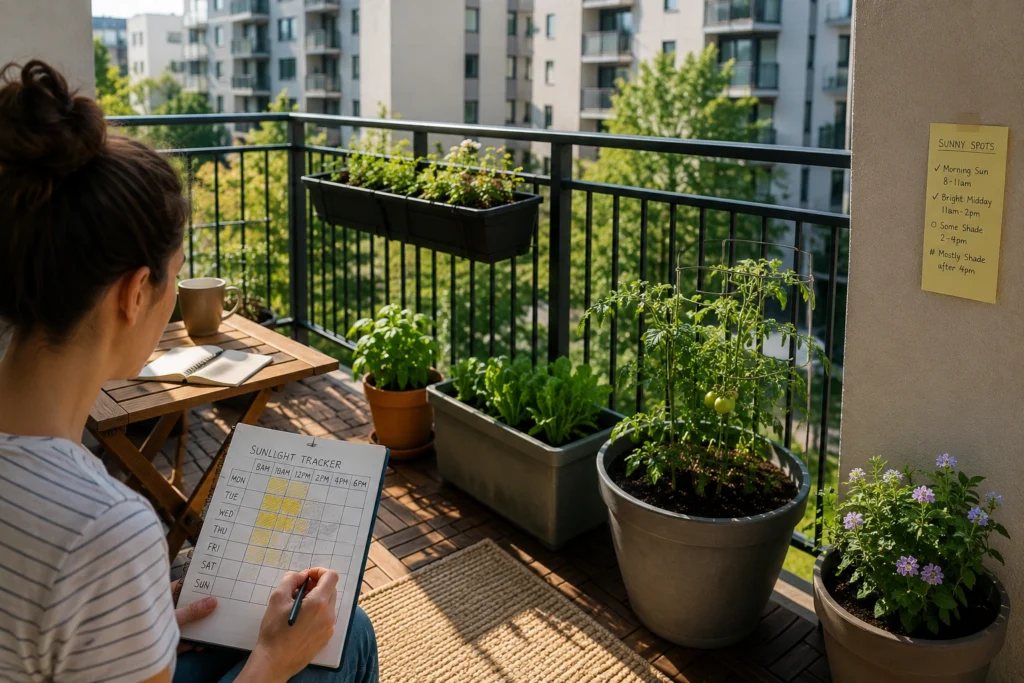
One simple approach is to observe your balcony throughout the day.
Start in the morning and periodically record whether the growing area is receiving direct sunlight or shade. You can make notes or take time stamped photos from approximately the same location.
Alabama Cooperative Extension suggests photographing the area every two or three hours throughout the day as a practical way to assess direct sunlight.
Sun exposure can also change with the seasons, so a balcony that receives plenty of sun during one part of the year may become shadier during another.
Does Balcony Direction Matter?
Yes, but direction should be treated as a starting point rather than a guarantee.
Southern and western exposures generally tend to be sunnier and warmer, while northern and eastern exposures tend to be cooler and shadier. Western exposure brings stronger afternoon sun, while eastern exposure generally receives gentler morning sunlight.
A simple starting point is:
| Balcony exposure | Typical conditions |
|---|---|
| East | Morning sun, generally cooler afternoon |
| South | Often longer, stronger sun exposure |
| West | Strong afternoon sun and heat |
| North | Usually less direct sunlight |
Nearby buildings, overhangs, walls, and neighboring balconies can change those conditions considerably.
Measure the sunlight on your balcony before choosing plants.
Why Wind Matters in Apartment Balcony Gardening
Sunlight gets most of the attention when people choose plants, but wind can be just as important on an exposed balcony.
Wind increases moisture loss from leaves and containers. It can also contribute to leaf scorch, damaged stems, one-sided plant injury, and containers tipping over.
The effect can become particularly noticeable when wind combines with hot weather.
Signs Wind May Be Stressing Your Plants
Possible signs include:
- leaves repeatedly drying or scorching
- damage concentrated on the exposed side of a plant
- broken or bent stems
- containers drying unusually quickly
- lightweight pots repeatedly shifting or tipping
Not every brown leaf means wind damage, so check the growing medium and the rest of the plant before assuming wind is responsible.
Create a More Sheltered Growing Area
Sometimes moving a container closer to an existing wall or into a sheltered corner can help.
Where building rules allow, a slatted or mesh screen can also reduce exposure.
A completely solid barrier isn’t necessarily better. RHS recommends semi-permeable windbreaks that filter wind because solid barriers can create turbulence on the sheltered side.
Whatever you use, make sure the screen and its supports are appropriate for your balcony conditions and permitted by your building.
 How to Choose Containers for a Balcony Garden
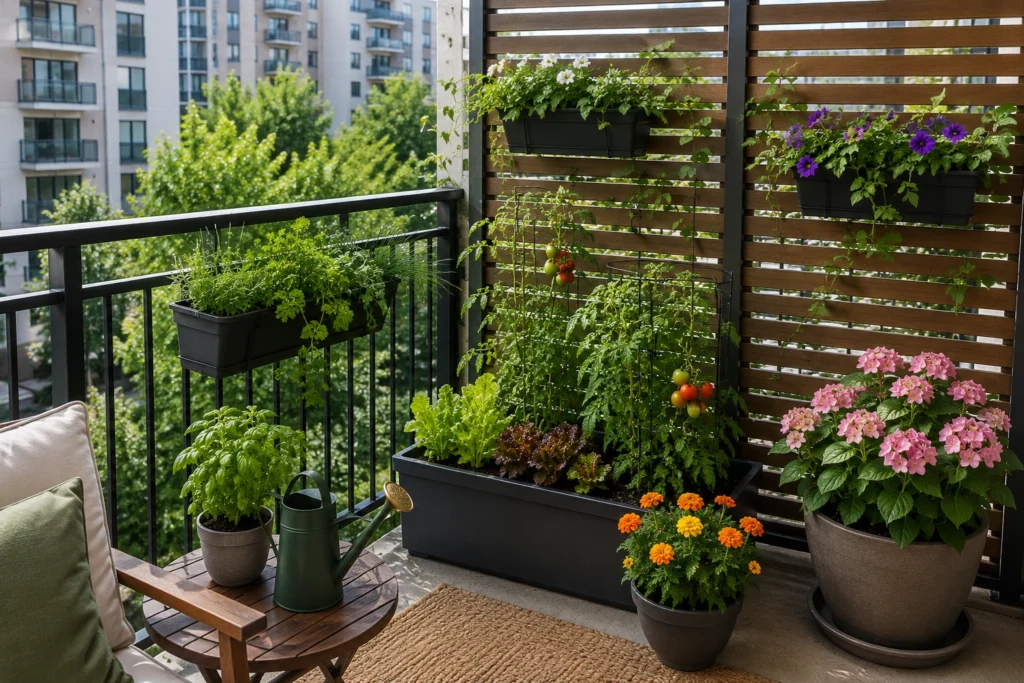
You can grow plants in many types of containers, but the right choice depends on the plant, exposure, available space, weight, and how often you’re able to water.
The most important starting point is simple:
Match the container to the mature plant, not the tiny plant you bring home.
Match Container Size to the Plant
Plants with larger root systems generally need more growing medium.
Small herbs and compact greens may perform well in relatively modest containers, while larger plants such as tomatoes and cucumbers generally require substantially more root space.
For balcony gardening, there is always a trade-off.
Larger containers generally provide more growing medium and hold more water.
But larger containers also become considerably heavier when wet.
Choose enough root space for the plant without automatically buying the largest planter you can fit.
Consider Container Material
Container material affects moisture, temperature, durability, and weight.
Clay and terra-cotta are porous, allowing moisture to evaporate through the sides. That can mean more frequent watering.
Plastic and resin are generally lighter and don’t lose moisture through the container wall in the same way clay does.
Wood can work well but may become heavy depending on its size and construction.
Metal can be durable, but exposed metal containers may become hot in strong sunlight.
Fabric grow bags are lightweight and portable, although their exposed sides may also contribute to faster drying.
Think About Container Color and Heat
Dark containers sitting in intense sunlight can become significantly hotter than lighter containers.
You don’t need to avoid every dark planter. Just recognize that container color, direct sun, watering, and placement can influence the root environment.
Bigger Containers Are Often Easier to Keep Moist
Tiny pots can be appealing on a small balcony, but they hold less growing medium and less water.
A somewhat larger container provides a larger moisture reserve and more root space.
Again, balance that advantage against weight.
A Lightweight Planter Option
A plastic planter such as the Quarut 12-Inch Whiskey-Barrel-Style Planter Set can be a practical option when you want outdoor containers with drainage without adding the weight of heavy ceramic or concrete pots.
The included saucers may also help manage runoff, although collected water should still be emptied when necessary.
Check the Quarut 12-Inch Planter Set on Amazon →
Drainage Is Essential
No matter which container you choose, excess water needs somewhere to go.
Plant roots need both moisture and oxygen. When a conventional container remains waterlogged, roots can be deprived of oxygen and become more vulnerable to poor growth and root problems.
That’s why containers need an appropriate drainage system.
Don’t Add Gravel to the Bottom of Pots
This is one of the most persistent container-gardening myths.
Putting a layer of rocks or gravel underneath potting mix does not improve drainage.
Research-based container guidance explains that water does not simply rush from the finer potting medium into the coarse gravel underneath it. Instead, adding gravel reduces the usable depth of the growing medium and can leave the saturated zone closer to the plant’s roots.
Use appropriate potting mix and functional drainage holes instead.
Manage Runoff From an Upstairs Balcony
Drainage creates another challenge when you’re gardening above someone else’s balcony.
You don’t want every thorough watering to become a shower for the neighbor below.
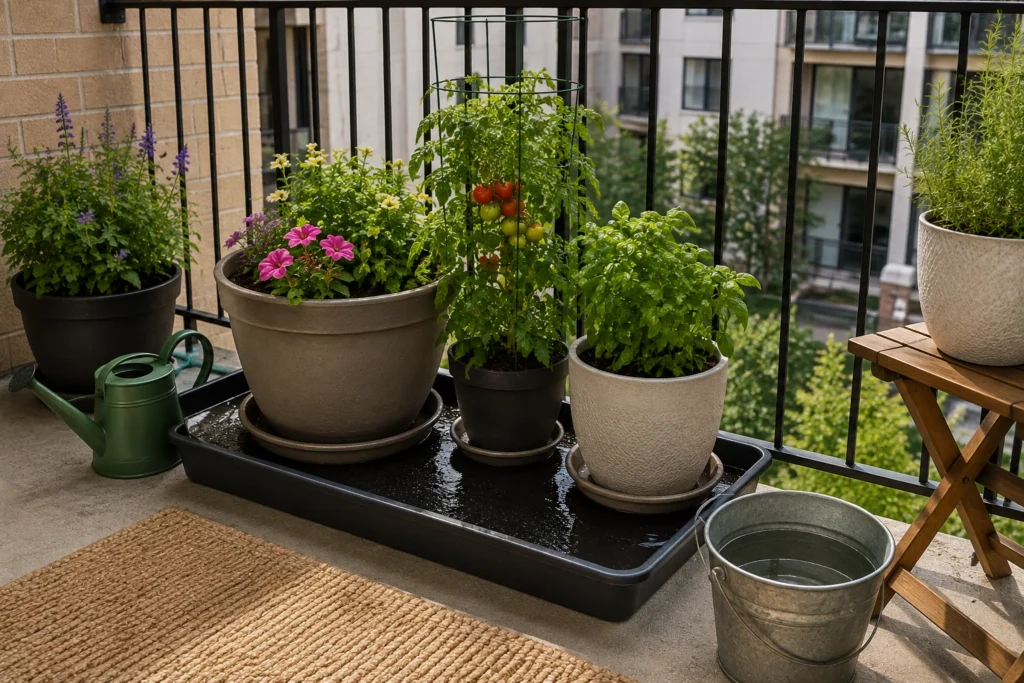
Saucers or appropriately sized trays can catch runoff where needed.
But don’t leave conventional pots sitting indefinitely in collected water. Empty saucers as necessary so roots aren’t left in standing water and stagnant water isn’t allowed to accumulate.
What Potting Mix Should You Use?
Regular garden soil may seem like the obvious thing to put into a planter, but it usually isn’t the best choice for container gardening.
Garden soil can compact when confined inside a pot, reducing the movement of air and water around plant roots.
Instead, look for a quality potting mix or container-growing mix appropriate for the plants you’re growing.
Commercial soilless mixes commonly use ingredients that help balance moisture retention with drainage and aeration.
For a balcony, an appropriate container mix can have another advantage: it is generally lighter than ordinary mineral garden soil, which can help reduce unnecessary container weight.
Avoid tightly packing the mix into the container. Roots benefit from pore spaces that allow air and water to move through the growing medium.
How to Choose Plants for an Apartment Balcony
It’s tempting to start by asking which plants are “best” for a balcony.
A better first question is:
Which plants fit my balcony?
The answer depends on your sunlight, local climate, wind exposure, container size, and available space.
Once you know those conditions, use our guide to the best balcony plants for apartments to compare 25 plants that work well in different balcony environments.
Match Plants to Sunlight
If your balcony receives long periods of direct sun, you’ll generally have more options for sun-loving herbs, flowers, and fruiting crops.
With fewer hours of direct sun, leafy crops and plants adapted to partial shade may be more realistic.
The important thing is matching the plant to the conditions rather than trying to force a sun-loving plant into a shaded location.
If growing vegetables is your main goal, our apartment balcony vegetable garden guide explains how to match crops to your balcony’s sunlight, space, wind, and heat while planning containers, watering, and drainage.
If you’re working with a limited amount of container space, you can also compare vegetables you can grow in a 5-gallon bucket to see which crops are practical for this common container size.
Consider Wind and Heat
A plant that thrives on a sheltered ground-level patio may behave differently on an exposed apartment balcony. If your outdoor growing space is a patio, our apartment patio gardeningguide covers containers, hard-surface heat, drainage, watering, and other patio-specific considerations.
Look for plants suited to your actual conditions and local climate.
On especially exposed balconies, prioritize stable containers and sheltered placement rather than assuming you simply need a plant marketed as a “balcony plant.”
Choose Plants That Fit the Available Space
Check a plant’s mature size before buying it.
A compact seedling can eventually become a plant requiring a large container, support structure, and considerably more horizontal or vertical space.
Consider:
- mature height
- mature width
- root space
- support requirements
- access for watering and harvesting
Starting with a manageable number of plants is usually easier than filling every available inch immediately.
Before you start choosing containers and plants, it helps to think through the overall layout. These balcony garden design ideas can help you make better use of limited floor space, railings, walls, and vertical growing areas.
How to Start Gardening on an Apartment Balcony: Step by Step
Once you understand your growing conditions, starting the actual garden becomes much simpler.
1. Check Your Building Rules
Find out what is permitted before buying hanging planters, wall systems, screens, or equipment that might require attachment.
2. Measure Your Sunlight
Observe the balcony across the day instead of relying only on compass direction.
Record the approximate hours of direct sunlight.
3. Identify Wind and Heat Exposure
Notice whether certain areas are more sheltered and whether walls or hard surfaces create particularly hot locations.
4. Decide What You Want to Grow
Start with a goal.
Do you primarily want herbs? Flowers? Leafy greens? A few compact vegetables? A mixture?
You don’t need to fill the entire balcony at once.
5. Choose Appropriate Containers
Match container size to the plants while considering drainage, stability, and wet weight.
6. Add Quality Potting Mix
Use an appropriate container mix instead of filling pots with dense garden soil.
7. Plant at the Appropriate Depth
Follow the planting instructions for the particular seed, seedling, or transplant you’re growing.
8. Position Your Containers
Place each plant where its light requirements best match the conditions you’ve measured.
Also consider wind exposure and whether you’ll be able to reach the container easily for watering and maintenance.
9. Water Thoroughly
When watering is needed, apply enough to moisten the growing medium thoroughly and allow excess water to leave through the drainage holes.
Manage the runoff appropriately.
10. Establish a Simple Care Routine
Check your plants regularly rather than waiting until something looks seriously wrong.
Pay attention to:
- growing-medium moisture
- leaf color
- wilting
- insects or disease symptoms
- wind damage
- drainage
- weather changes
- loose supports
Gardening on an apartment balcony becomes easier when these small checks become part of your routine.
How to Water Balcony Plants
Watering is one area where fixed rules can cause beginners problems.
You may hear that container plants should be watered every day, but actual watering frequency depends on the plant, container size and material, growing medium, weather, and exposure.
A small container exposed to hot, windy weather can dry much faster than a large container in cooler, sheltered conditions.
For a more detailed breakdown, see our guide to how often you should water balcony plants, including how heat, wind, container size, and pot material affect watering frequency.
Check Moisture Before Watering
Instead of automatically watering because it’s a particular day or time, check the growing medium.
For many container plants, inserting a finger roughly 1–2 inches into the mix can help you determine whether moisture remains near the root zone.
Iowa State Extension recommends checking the growing medium rather than watering on a fixed schedule, because container watering needs can vary significantly with conditions.
Water Thoroughly
When watering is needed, avoid giving only the surface a quick splash.
Apply water thoroughly enough to reach the root zone and, for conventional containers, allow excess water to begin leaving through the drainage holes.
Then manage collected runoff appropriately.
Expect Watering Needs to Change
Your spring watering routine may not work during a hot, windy week in midsummer.
Pay attention to:
- temperature
- wind
- rainfall
- container size
- container material
- plant size
- sunlight
- season
Plants may need more frequent attention as they grow larger or weather becomes hotter and windier.
Observation is more useful than memorizing one schedule.
A Self-Watering Option
A self-watering planter can be helpful on a balcony where containers tend to dry quickly.
The UOUZ 12-Inch Self-Watering Planters use a removable bottom reservoir that stores additional water for the growing medium to draw from as needed.
A reservoir can reduce how quickly the container runs out of available water, but it doesn’t eliminate the need to check your plants and adjust for heat, wind, rainfall, and the needs of the plant you’re growing.
Check the UOUZ 12-Inch Self-Watering Planters on Amazon →
How to Fertilize Balcony Container Plants
Container plants have access to a limited amount of growing medium, and repeated watering can carry soluble nutrients out through drainage.
That means container plants may eventually need supplemental fertilizer even if the potting mix contained nutrients when you planted.
You don’t need to turn fertilizing into a chemistry lesson.
Choose a fertilizer appropriate for the plants you’re growing and follow the product label for application rate and frequency.
Some products release nutrients slowly over time, while water-soluble fertilizers make nutrients available more quickly.
Avoid doubling the recommended amount because you want faster growth.
Excessive fertilizer can contribute to soluble-salt buildup and plant damage.
With fertilizer, more isn’t automatically better.
How to Use Vertical Space Safely
When floor space is limited, growing upward can make better use of an apartment balcony.
Virginia Cooperative Extension specifically discusses vertical gardening as a way to maximize limited growing space on balconies, decks, patios, and other small areas.
Depending on your plants and building rules, options may include:
- free standing trellises
- containers with integrated supports
- hanging baskets
- freestanding vertical planters
- wall-mounted systems where attachment is permitted
Vertical supports can help some plants use less floor area and may also improve airflow and accessibility.
But don’t sacrifice stability just to fit another plant onto the balcony.
Any structure needs to support the mature plants and withstand the conditions on your balcony. Hanging baskets and mounted containers also become considerably heavier when watered.
If you’re renting, don’t permanently attach a trellis or planter to a wall without checking whether you’re allowed to do so.
A Freestanding Vertical Option
A freestanding vertical planter is one way to add growing space without attaching containers to the balcony wall or railing.
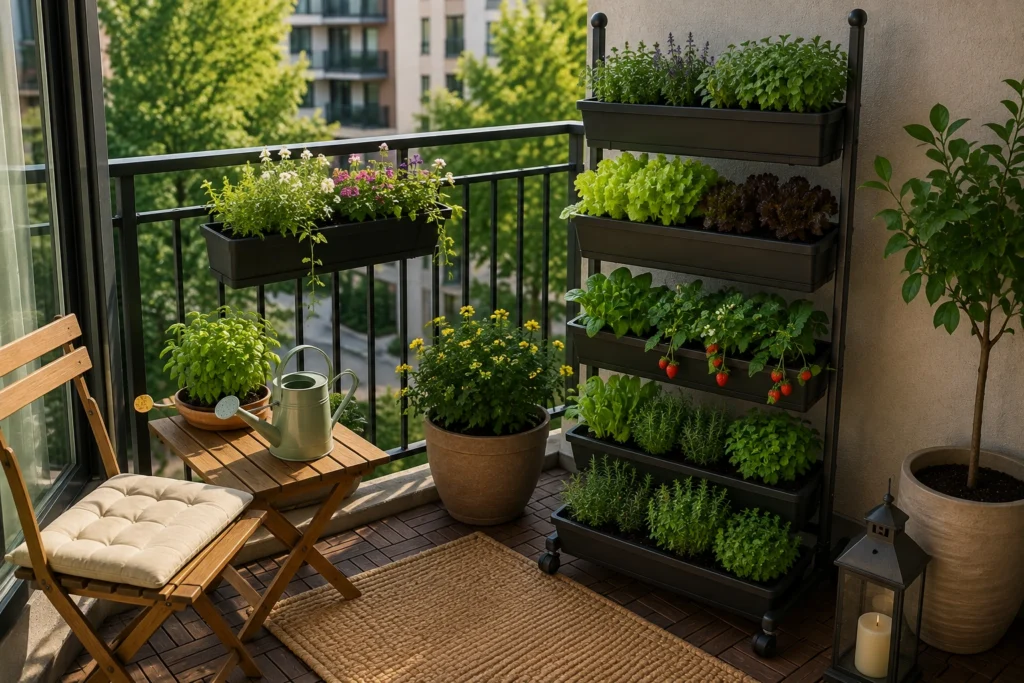
The VECELLO 5-Tier Vertical Garden Bed uses stacked planter boxes on a freestanding frame, allowing several compact plants to grow vertically while using less floor space than placing the same number of individual containers side by side.
As with any balcony planter, consider the unit’s filled weight, stability, wind exposure, available floor space, and your building’s rules before setting it up.
Check the VECELLO 5-Tier Vertical Garden Bed on Amazon →
Protecting Balcony Plants From Heat and Weather
Balcony conditions change throughout the year.
A sunny location that feels pleasant in spring can become much hotter during summer, particularly when sunlight reaches walls, concrete, or other hard surfaces.
Containers can also heat more rapidly than in-ground soil, and dark containers exposed to strong sun deserve particular attention.
You don’t necessarily need elaborate equipment. Depending on the situation, simple adjustments may include:
- moving portable containers away from intense afternoon exposure
- grouping plants where existing structures provide some shelter
- checking moisture more frequently during heat and wind
- providing appropriate temporary shade
- moving sensitive containers to a protected location before severe weather
- adjusting watering as seasons change
Don’t assume watering alone solves every heat problem. Exposed foliage can still experience heat and sun damage even when the growing medium contains adequate moisture.
7 Common Apartment Balcony Gardening Mistakes
Avoiding a few common mistakes can make your first balcony garden much easier to manage.
1. Buying Plants Before Measuring Sunlight
A beautiful full-sun plant won’t become a shade plant because that’s where you have room for it.
Measure first. Buy second.
2. Using Containers That Are Too Small
Tiny containers hold less growing medium and moisture and may restrict larger root systems.
Choose containers based on the mature plant’s needs.
3. Filling Pots With Ordinary Garden Soil
Garden soil can become dense and compacted inside containers.
Use a growing medium designed for container use.
4. Ignoring Drainage
A decorative planter isn’t automatically a suitable growing container.
Make sure excess water has an appropriate way to escape.
5. Adding Gravel to “Improve” Drainage
It sounds logical, but research-based container guidance doesn’t support the practice.
Use adequate drainage and appropriate potting mix instead.
6. Watering on a Fixed Schedule
Conditions change.
Check the growing medium and the plant rather than automatically watering at the same interval throughout the year.
7. Ignoring Wind, Wet Weight, and Building Rules
The perfect-looking balcony garden isn’t useful if containers keep tipping, runoff bothers the neighbor below, or your building doesn’t permit the way you’ve installed it.
Treat the balcony itself as part of the gardening system.
How to Maintain Your Balcony Garden
Once the garden is established, maintenance doesn’t need to become complicated.
The key is noticing small problems before they become large ones.
Several times each week—or more frequently during demanding weather—check the growing medium for moisture and look over your plants.
Watch for:
- unexpected wilting
- yellow or damaged leaves
- insects
- broken stems
- blocked drainage
- standing water
- loose supports
Periodically remove dead or damaged plant material and inspect trellises, baskets, screens, and other supports.
Also reevaluate your conditions as the seasons change.
Sun angles shift. Temperatures rise and fall. Plants grow larger. A watering routine that worked a month ago may need to change.
A balcony garden works best when you observe it and respond to its conditions rather than trying to run everything on a rigid calendar.
Is Apartment Balcony Gardening Worth It?
For someone without a traditional yard, a balcony can provide genuinely useful growing space.
It may give you room for fresh herbs, flowers, leafy greens, compact food crops, or simply more greenery outside your window.
But balcony gardening isn’t effortless.
Containers need monitoring. Wind and heat can increase watering demands. Building rules may limit what you can attach or install. Large containers can become surprisingly heavy.
If you’d rather explore gardening throughout your apartment—not only on the balcony—our complete beginner’s guide to apartment gardening covers the broader options for growing indoors and in other small spaces.
For beginners who enjoy working with plants, those limitations can be manageable when they’re considered from the beginning.
Start small. Learn how your balcony behaves. Then expand the garden as you gain experience.
Key Takeaways
- Successful apartment balcony gardening begins with evaluating the balcony before choosing plants.
- Measure actual sunlight rather than relying only on balcony direction.
- Wind can increase moisture loss and damage exposed plants.
- Check building rules before attaching planters, screens, or trellises.
- Consider the wet weight of containers, not just their empty weight.
- Match container size to the mature plant.
- Use containers with appropriate drainage, and don’t add gravel to the bottom in an attempt to improve drainage.
- Use quality container or potting mix rather than ordinary garden soil.
- Check growing-medium moisture instead of watering on a rigid schedule.
- Start with a manageable number of plants and expand as you learn your balcony’s conditions.
Frequently Asked Questions
Can you garden on an apartment balcony?
Yes. Many apartment balconies can support container gardens when building rules, space, sunlight, wind, drainage, and structural limitations are taken into account.
Start by evaluating those conditions before buying plants or containers.
How much sunlight does an apartment balcony garden need?
It depends on what you’re growing.
Full sun generally means around six or more hours of direct sunlight per day, while plants adapted to partial sun or shade can grow with less.
Because buildings and overhangs affect exposure, measure the actual direct sunlight reaching your balcony rather than relying only on its direction.
What type of containers are best for balcony gardening?
There isn’t one container material that’s best for every balcony.
Choose containers with adequate root space and appropriate drainage while considering weight, wind stability, heat exposure, and how quickly the material loses moisture.
Can I use regular garden soil in balcony pots?
Regular garden soil generally isn’t the best choice for containers because it can compact and restrict drainage and aeration.
A quality potting or container mix is usually a better choice and is often lighter, which can also be useful on a balcony.
How often should I water plants on an apartment balcony?
There is no universal schedule.
Check moisture in the growing medium. Small pots in hot, sunny, windy conditions may dry quickly, while larger containers in cooler conditions may remain moist much longer.
Water thoroughly when the plant needs it rather than automatically watering according to the calendar.
How do I protect balcony plants from wind?
Start by using the more sheltered parts of the balcony and stable containers that are less likely to tip.
Where permitted and appropriately secured, a slatted or mesh screen may help filter wind. Don’t assume a completely solid barrier is always better because solid surfaces can create turbulence.