25 Balcony Garden Ideas for Small Apartments
A small apartment balcony may not look like much gardening space at first. But with the right approach, even a compact balcony can become a place to grow herbs, vegetables, flowers, or simply a few plants that make the space more enjoyable.
The best balcony garden ideas aren’t necessarily the ones that squeeze in the most plants. A better approach is choosing an idea that fits the space you actually have, the sunlight your balcony receives, and the amount of time you want to spend caring for it.
You might grow herbs near the kitchen, create a container garden for pollinators, use vertical growing to conserve floor space, or keep things simple with a few larger pots. Renters can also choose freestanding and movable setups that don’t require permanent changes to the building.
Before choosing an idea, make sure your balcony can support the containers and setup you have in mind. Sunlight, wind, drainage, filled container weight, and building rules can all affect what will work. Our apartment balcony gardening guide explains those beginner basics in detail.
Balconies can also experience strong wind, intense sunshine, and other growing challenges that aren’t as noticeable at ground level. The Royal Horticultural Society identifies strong winds and sunshine as two of the main limitations affecting roof gardens and balconies.
With those basics in mind, here are 25 realistic ideas to help you decide what kind of garden could work on your apartment balcony.
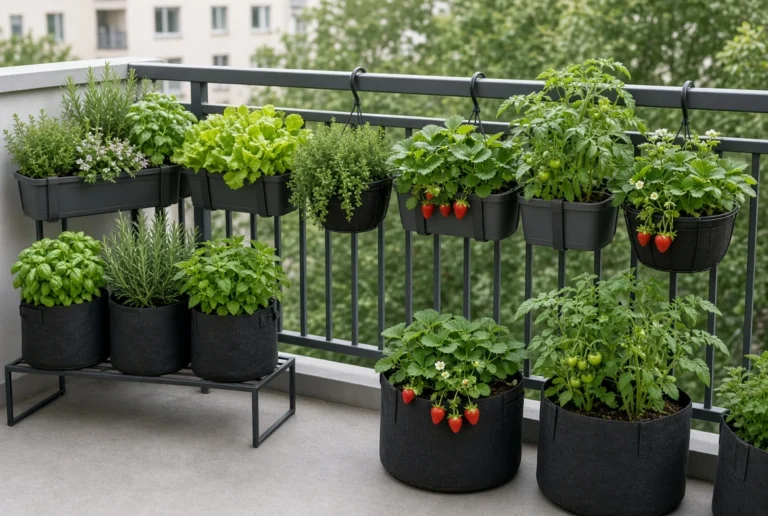
In This Guide
Small Balcony Garden Ideas That Save Floor Space
When space is limited, the goal isn’t to cover every available inch with plants. A small balcony garden should still leave enough room to move around while putting otherwise unused areas to work.
1. Create a Slim Garden Along One Side
On a long, narrow balcony, try placing containers along one side instead of lining both edges.
A row of rectangular planters or appropriately sized pots can create a useful growing area while leaving the opposite side open. This works especially well on narrow balconies where containers on both sides would quickly crowd the walkway.
You don’t need every container to match. Using pots with similar proportions can make the garden look organized without turning the project into a complicated balcony-design exercise.
Keep the containers on the balcony floor rather than assuming the railing can support them.
2. Turn an Empty Corner Into a Tiered Garden
A corner that isn’t useful for seating can become valuable growing space with a freestanding tiered plant stand.
Instead of spreading several pots across the floor, a tiered stand places plants at different heights within a relatively small footprint.
For apartment renters, the key word is freestanding. A self-supporting tiered or ladder-style stand doesn’t require drilling into an exterior wall.
Wind still matters. Place heavier containers toward the bottom and avoid creating a top-heavy arrangement.
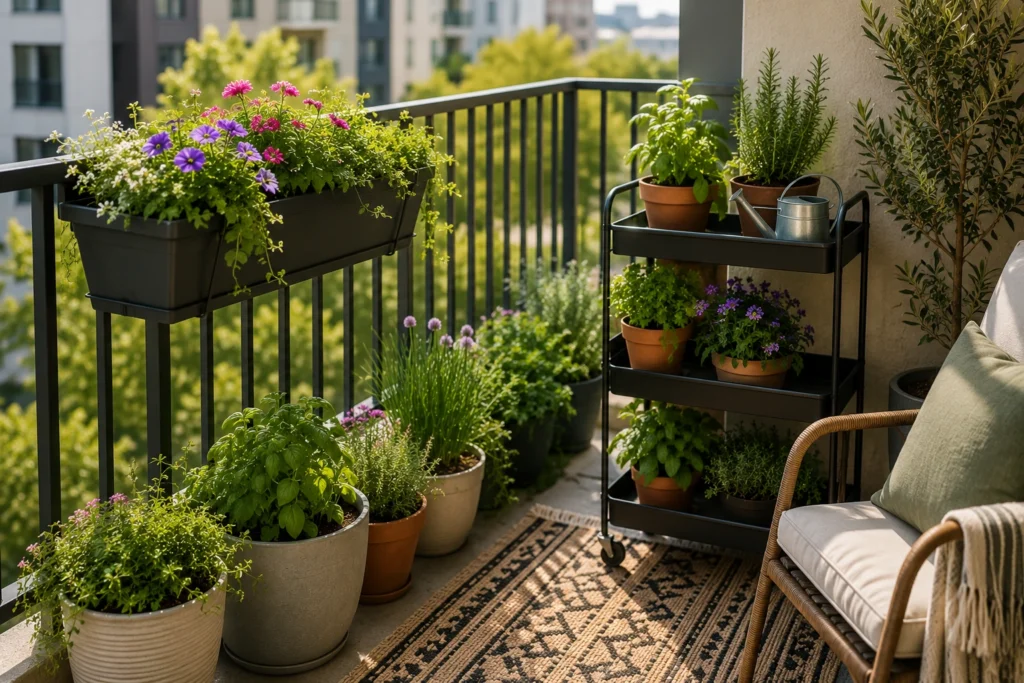
3. Build a Mobile Garden on a Rolling Cart
A narrow rolling cart can hold several small pots while giving you the ability to reposition the entire group.
That can be useful when you need more walking room, want easier access for cleaning, or need to move plants temporarily to a more protected location.
Container gardens are naturally flexible because individual containers can be repositioned as sunlight, temperature, or other growing conditions change.
If possible, use a cart with locking casters so it stays securely in place once positioned.
4. Grow Up With a Freestanding Vertical Tower
A vertical tower stacks several planting areas above one another, allowing you to grow more plants within a small floor footprint.
Some towers use individual planting pockets, while others consist of several stacked sections. Either approach can be useful when horizontal space is scarce.
However, taller isn’t automatically better on a balcony. A fully planted and watered tower can become heavier than it appears, and its height makes stability more important in windy conditions.
Keep the tower freestanding, stable, and away from the open edge of the balcony.
5. Create a Freestanding Privacy Garden With a Trellis Planter
Plants can provide some visual screening without attaching a trellis directly to the building.
One option is a floor-standing container with its own integrated trellis or plant support. A climbing plant can grow upward while the entire setup remains self-contained.
This can soften the view between neighboring balconies while adding greenery vertically instead of using more floor space.
Remember that a trellis covered in foliage can catch considerable wind. Choose a stable container and keep the setup in a protected position whenever possible.
If you want to move from inspiration to a more organized setup, our balcony garden design guide walks through planning the space step by step.
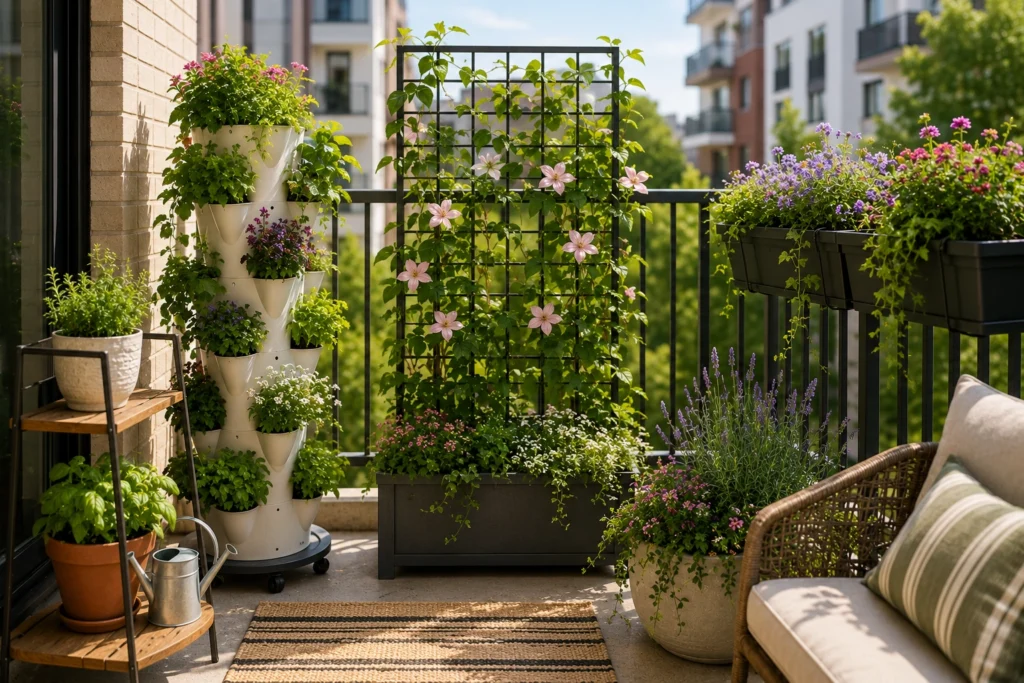
Want more small balcony inspiration? This short video from Balcony Garden Web shows how hanging and vertical planters can help make better use of limited balcony space.
Flexible Container Garden Ideas for Apartment Balconies
Containers are especially useful for apartment gardening because you can select them to fit the available space instead of trying to make the space accommodate a traditional garden.
6. Create a Self-Watering Balcony Garden
If keeping containers consistently watered is one of your concerns, consider a self-watering planter.
These containers typically hold water in a reservoir beneath the growing medium. Moisture moves from the reservoir into the potting mix, giving plant roots access to stored water.
University of Maryland Extension explains that self-watering containers reduce maintenance by conserving water and nutrients.
However, “self-watering” doesn’t mean “never water.” The reservoir still needs to be checked and refilled, especially during hot weather.
The advantage is having a stored supply of water rather than depending entirely on the moisture held in a conventional potting mix.
7. Try a Fabric Grow-Bag Garden
Fabric grow bags offer another alternative to traditional rigid containers.
They’re particularly useful when portability and storage matter. Empty grow bags take up much less storage space than a collection of bulky ceramic pots and can be moved as your balcony garden changes.
Fabric bags are also recognized as a legitimate container option for growing food.
Don’t assume fabric automatically makes a garden low-maintenance, though. Container material affects how quickly moisture is lost, so plants should be checked according to their actual growing conditions rather than watered according to a rigid schedule.
8. Put a Large Container on a Rolling Plant Caddy
Sometimes the container you want is exactly the container you don’t want to lift.
A rolling plant caddy solves that problem by placing one large pot on a low platform with casters. This gives you some of the growing volume and stability of a larger container while making it easier to reposition.
NC State Extension even recommends a rolling platform as a way to make a heavy container easier to move.
Make sure any caddy is appropriate for the container’s filled and watered weight, not merely the weight of the empty pot.
9. Repurpose an Appropriate Container
A balcony garden doesn’t have to begin with an expensive collection of decorative planters.
Many objects can potentially become growing containers when their material, size, stability, and drainage are appropriate. University of Maryland Extension notes that containers can be practical or decorative, expensive or free, and provides examples of unconventional containers being used for food gardening.
A sturdy bucket, for example, may sometimes work just as well as a decorative planter when it provides enough growing space and drainage for the plant.
Repurposing shouldn’t mean using anything that happens to hold soil. Avoid questionable materials and don’t sacrifice drainage simply to save money.
One related drainage tip is worth remembering: adding gravel or rocks to the bottom of a container does not improve drainage. University of Maryland Extension instead recommends sturdy supports such as bricks or pot feet when containers need to be raised off the ground to encourage drainage.
Edible Balcony Garden Ideas
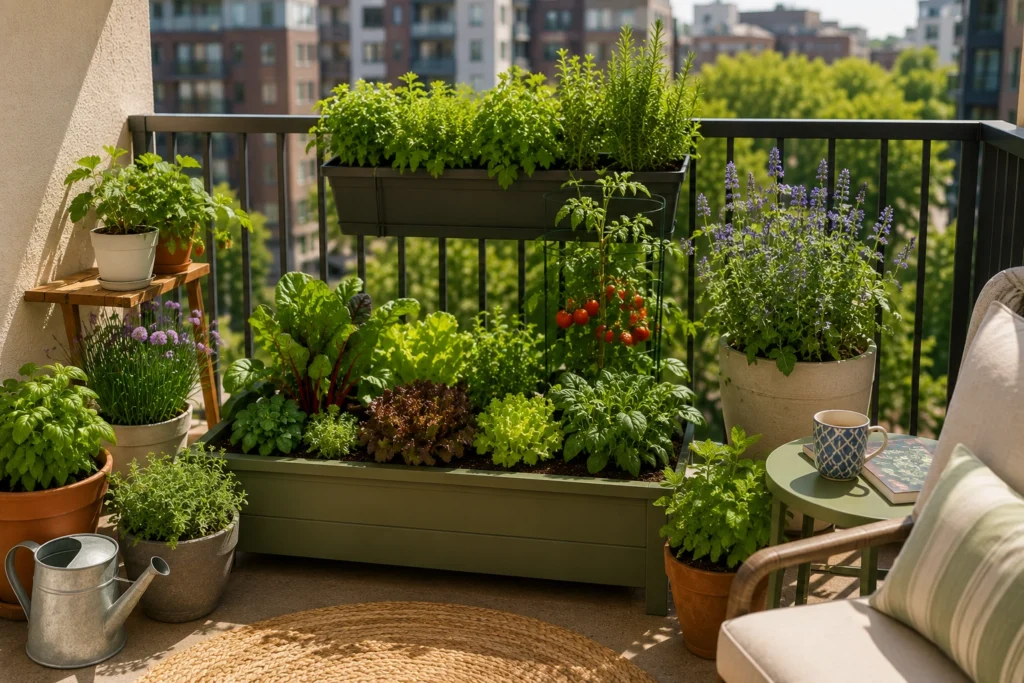
Growing something you can eat doesn’t require turning your entire balcony into a vegetable garden. An edible balcony garden can be as simple as one herb container or a compact box of salad greens.
10. Grow a Dwarf Fruit Garden in Containers
A dwarf fruit tree or container-grown berry plant can create a very different balcony garden from the usual collection of annual flowers.
The key is choosing fruit actually suited to container culture rather than assuming any fruit tree can remain permanently confined to a pot.
Perennial fruit plants may also require larger containers, which means additional filled weight. Check your balconies requirements before committing to a large container.
Think of container fruit as an option rather than something appropriate for every apartment balcony. Climate, sunlight, available space, pollination requirements, and the individual plant all matter.
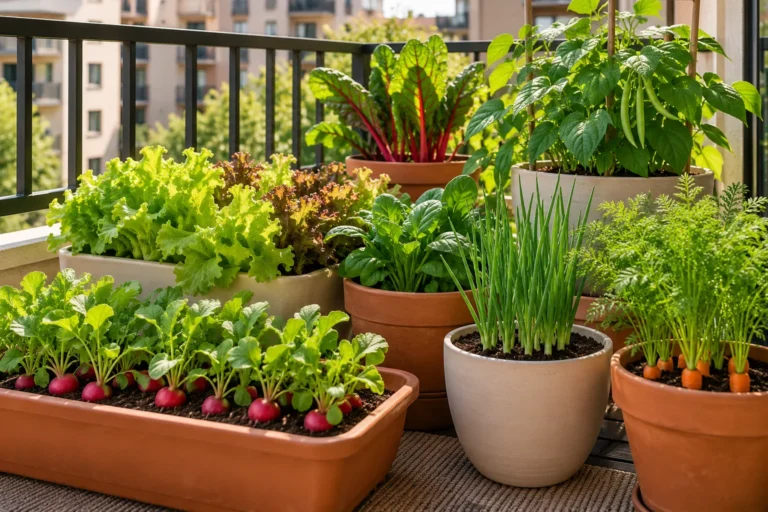
11. Create a Small Salad Box Garden
One of the more interesting small-space ideas is the Salad Box developed by University of Maryland Extension.
A Salad Box is a shallow growing container designed primarily for salad greens. The standard University of Maryland version measures about 21 inches by 15 inches, making it much more practical for a compact space than a traditional raised garden bed.
This is an interesting option for someone more interested in harvesting leafy greens than growing large fruiting vegetables.
A Salad Box can also be moved when seasonal changes alter the amount of sunlight reaching the balcony. University of Maryland Extension specifically describes the system as portable and notes that it can be repositioned according to seasonal sun and heat.
12. Grow Vining Vegetables Up a Container Trellis
Instead of allowing a vining vegetable to spread horizontally, provide support that encourages it to grow upward.
Cucumbers, peas, and pole beans are examples of crops that can make use of vertical support when their other growing requirements are met.
For an apartment balcony, keep the support inside the container or use a self-contained freestanding system rather than assuming a railing or exterior wall can support it.
Keep the setup proportional to the available space. A vigorous vine plus a tall trellis can eventually create a considerable amount of foliage and catch more wind than a small container plant.
13. Create a One-Pot Culinary Herb Garden
If you cook with fresh herbs, one larger mixed container can sometimes be more practical than keeping a collection of tiny individual herb pots.
The important part is choosing herbs with compatible growing requirements rather than combining plants simply because they’re all used in the kitchen.
For example, herbs that prefer somewhat drier conditions shouldn’t necessarily share a container with plants that need consistently moist growing media.
A thoughtfully planned herb container can provide several useful herbs without occupying much balcony space.
If herbs are your main goal, our indoor herb garden guide provides much more detailed information about growing fresh herbs in an apartment.
14. Create a Fresh-Salad Container Garden
You don’t have to grow every vegetable you eat.
Another approach is dedicating a few containers to ingredients you regularly use in fresh salads. Leafy greens and herbs can form the foundation, with additional crops added only when your sunlight and available container space support them.
This is different from trying to maximize vegetable production. The goal is creating a small, useful edible garden centered on foods you’ll actually harvest.
Keeping the concept simple also prevents a small balcony from becoming overcrowded with containers.
Balcony Garden Ideas for Flowers and Pollinators
Not every balcony garden needs to produce food. Containers can add color while also providing floral resources for visiting pollinators when appropriate plants are selected.
15. Create a Pollinator-Friendly Container Garden
A balcony container filled with flowering plants can provide pollen and nectar while adding color to a small outdoor space.
Rather than selecting flowers solely by appearance, look for plants appropriate for your region and growing conditions that provide useful resources for pollinators.
One larger pollinator container can also be easier to fit onto a small balcony than scattering many individual flowerpots around the floor.
Keep in mind that a sunny flowering container isn’t automatically low-maintenance. Containers exposed to sun and wind can require regular moisture checks.
16. Combine Culinary Herbs and Pollinator Plants
A small balcony sometimes works best when plants serve more than one purpose.
Some culinary herbs can provide flowers for visiting pollinators when allowed to bloom. That creates an opportunity to combine cooking and pollinator value within a limited growing area.
The important limitation is compatibility. Don’t combine plants simply because they’re all herbs. Their sunlight, moisture, mature size, and container requirements should work together.
This can be an effective way to give a tiny balcony garden a clear purpose without adding many additional containers.
17. Create a Butterfly-Friendly Container Garden
You can also create a flowering container with butterflies in mind.
A butterfly-friendly garden may include nectar-producing flowers for adult butterflies and, when appropriate, host plants used by caterpillars.
Plant selection should be appropriate for your region. Avoid assuming that one particular milkweed or flowering species is the correct choice everywhere.
This type of garden is also different from maintaining a perfectly untouched ornamental display. If caterpillars use a host plant, some chewed foliage may simply mean the plant is doing the job you selected it to do.
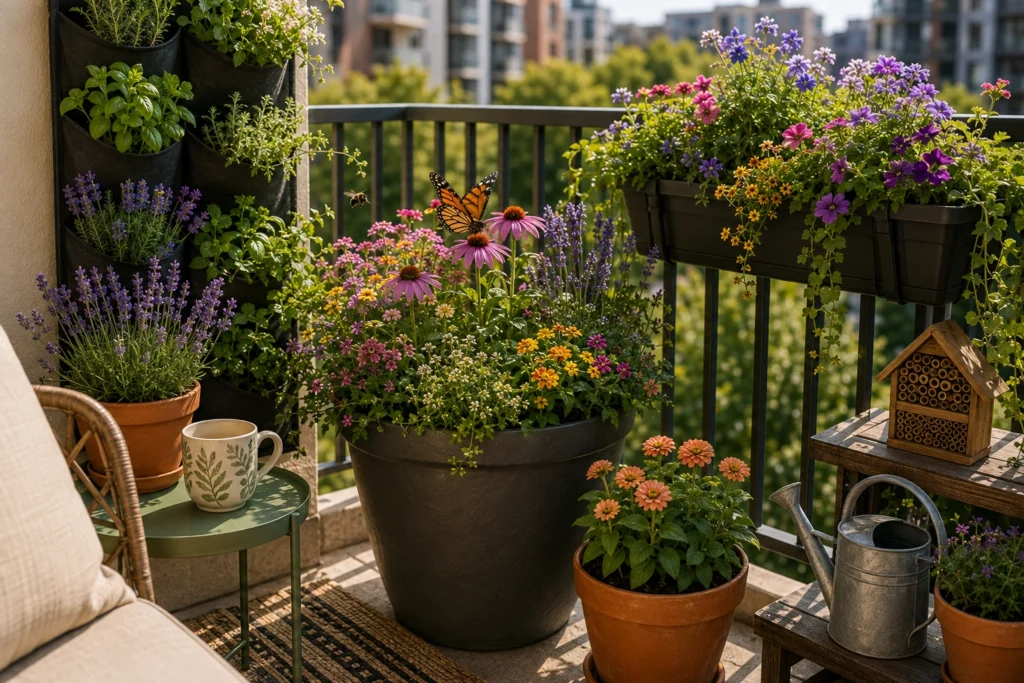
18. Make One Large Flower-Filled Statement Container
If you want plenty of color without filling the entire balcony with pots, consider concentrating several compatible plants in one larger container.
This creates a focal point while leaving more floor space open.
There can be a practical advantage as well. NC State Extension notes that larger containers don’t dry out as quickly and require less frequent watering than smaller ones.
The tradeoff is weight. A large container becomes much harder to move once filled and watered, so decide where it belongs before planting.
Low-Maintenance Balcony Garden Ideas
If you’re looking for low-maintenance balcony garden ideas, one distinction is important: low-maintenance doesn’t mean no-maintenance.
Plants growing in containers still depend on you for care. The goal is choosing plants and setups that can reduce unnecessary work.
19. Create a Drought-Tolerant Succulent Garden
A shallow container filled with appropriately selected succulents can be a simpler alternative to maintaining several thirsty flowering annuals.
Succulents such as sedums are adapted to tolerate periods with less available moisture, making them an interesting choice for a sunny balcony when the growing conditions are appropriate.
Drainage remains important, and not every succulent has the same sunlight or cold tolerance.
Think of this as lower-maintenance, not maintenance-free.
20. Group Containers With Similar Water Needs
One of the simplest improvements doesn’t require buying anything.
Instead of scattering containers randomly, place plants with similar moisture requirements near one another. This makes it easier to check and water them as a group rather than remembering the needs of pots scattered around the balcony.
Grouping containers can also help create a slightly more sheltered environment around the plants.
The important part is grouping plants based on compatible needs rather than appearance alone.
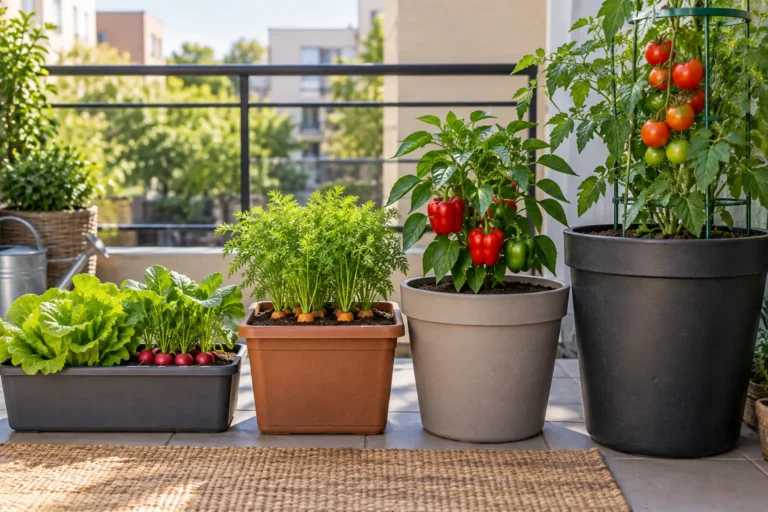
21. Use Fewer, Larger Containers Instead of Many Tiny Pots
A large collection of tiny pots may look charming, but every container becomes another one you need to monitor.
Using a smaller number of larger containers can simplify the garden while providing more growing-medium volume.
As discussed above, larger containers generally dry more slowly and require less frequent watering than smaller ones.
The downside is concentrated weight and reduced portability. That’s another reason to consider filled container weight and building requirements before setting up the garden rather than after everything has been planted.
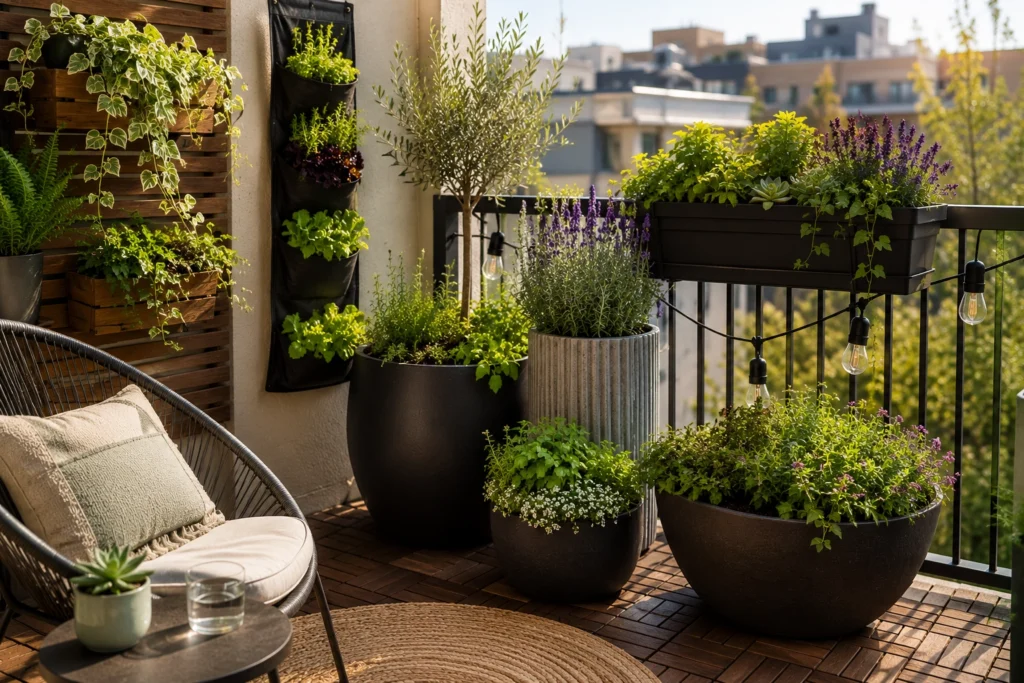
Balcony Garden Ideas for Different Light Conditions
One of the easiest ways to struggle with a balcony garden is to create the garden you want without considering the light you actually have.
Instead, let your balconies’ conditions help determine the type of garden you create.
22. Create a Shade-Friendly Balcony Garden
A north-facing balcony or one shaded by another building doesn’t have to remain empty.
Rather than trying to force sun-loving plants to perform there, make shade part of your garden idea. Plants adapted to lower-light outdoor conditions can create an attractive garden without depending on all-day direct sun.
Northern and eastern exposures generally tend to be shadier and cooler, while southern and western exposures receive more sun and warmth. However, buildings, trees, overhangs, and other obstructions can dramatically change the light that actually reaches a balcony.
The exact plants will depend on your climate and actual light exposure. Detailed balcony plant selection belongs in our dedicated balcony-plants guide rather than turning this article into another plant list.
23. Create a Heat-Tolerant Garden for a Sunny Balcony
At the other extreme, a south- or west-facing balcony may receive long periods of strong sun and considerable heat.
Instead of treating those conditions as a problem to overcome, build the garden around them.
Plants adapted to sunny, warmer conditions may be appropriate, but the containers matter too. NC State Extension notes that dark-colored containers absorb more heat, causing the growing medium to dry faster and temperatures inside the pot to rise.
A sunny balcony can support an excellent garden. It simply shouldn’t be planted as though it were a shaded porch.
24. Build a Morning-Sun Balcony Garden
An east-facing balcony often provides a useful middle ground: morning sunlight followed by more protection later in the day.
This can create opportunities for plants that don’t require the long, intense exposure associated with a full-sun location.
Still, don’t choose plants based solely on the direction your balcony faces. Nearby buildings, trees, overhangs, and seasonal changes can affect the actual hours of direct sunlight.
Observe the space itself before making final plant choices.
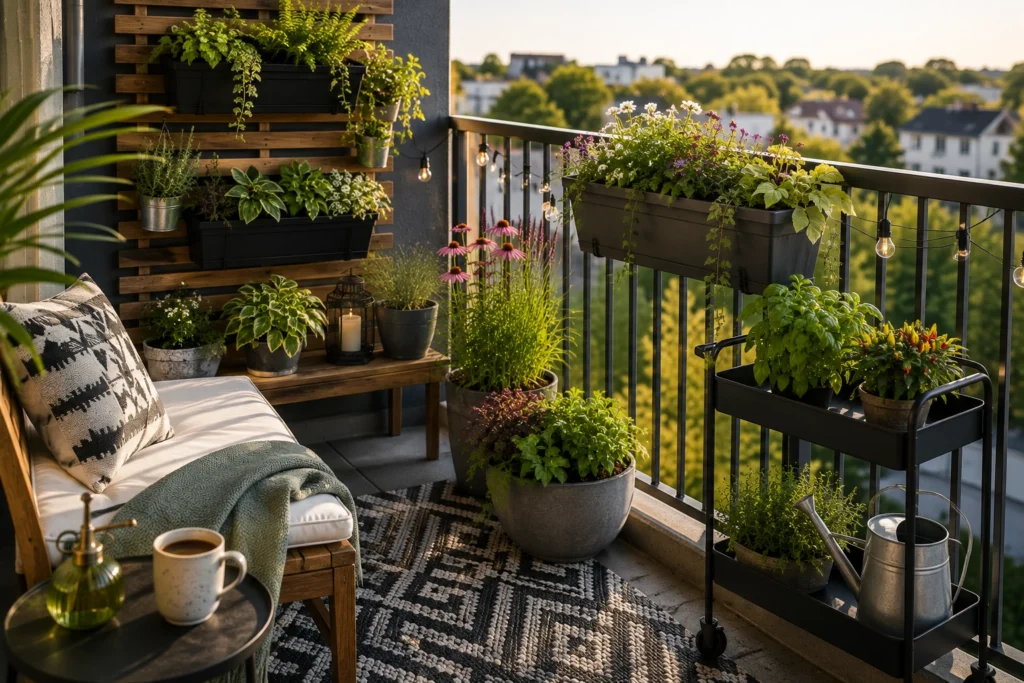
25. Create a Movable Garden That Can Adapt to Changing Conditions
Our final idea brings several of the earlier concepts together: don’t make every part of your garden permanent.
Individual containers, rolling carts, plant caddies, and other movable setups give you the ability to make adjustments when conditions change.
Mobility is one of the useful advantages of container gardening. Containers can be repositioned when a different location provides more suitable sunlight, shade, temperature, or protection.
That doesn’t mean moving plants around every afternoon. Instead, mobility gives you options when seasonal sunlight changes, severe weather approaches, or you discover that the original location isn’t working as well as expected.
For renters, there’s another obvious advantage: when you move, a freestanding garden can usually move with you.
Which Balcony Garden Idea Is Right for You?
You don’t need to use all 25 ideas. Trying to do so would probably make a small balcony less useful rather than more productive.
Start with the limitation or goal that matters most.
If floor space is extremely limited, consider a tiered stand, tower, or another freestanding vertical approach. If you want something edible, an herb container, Salad Box, or compact edible garden may make more sense.
If reducing routine watering is important, consider self-watering containers, drought-tolerant plants, grouping plants with similar moisture needs, or using fewer, larger containers.
Renters may want to prioritize freestanding and movable systems. And if sunlight is the biggest limitation, let your actual light conditions guide the garden rather than fighting against them.
The best idea isn’t necessarily the most impressive one. It’s the one that fits your balcony well enough that you’ll actually enjoy maintaining it.
Key Takeaways
Small apartment balconies can support many different types of gardens, from a single large container to vertical towers, herbs, salad greens, flowers, pollinator plants, and movable container gardens.
When choosing among these balcony garden ideas, focus first on your available space, sunlight, wind exposure, building rules, and how much maintenance you realistically want.
Freestanding systems are especially useful for renters because they avoid many of the complications that come with permanent attachments. Larger and self-watering containers may help reduce watering frequency, while vertical approaches can make better use of limited floor space.
Most importantly, you don’t need to transform the entire balcony at once. Start with one idea that solves a real problem or supports something you genuinely want to grow.
A balcony is only one place you can grow in an apartment. Our complete beginner’s guide to apartment gardening covers additional ways to grow indoors and throughout a small living space.
Frequently Asked Questions About Balcony Garden Ideas
What is the easiest balcony garden for a beginner?
A few appropriately sized containers are usually easier to manage than filling the balcony with many small pots. Start with plants suited to your actual sunlight and choose a setup that doesn’t require complicated permanent installation.
How can I garden on a very small balcony?
Look for ways to use vertical space without sacrificing the entire floor. A freestanding tiered stand, vertical tower, narrow row of containers, compact Salad Box, or a few carefully positioned pots can provide growing space while keeping the balcony usable.
What are some low-maintenance balcony garden ideas?
Drought-tolerant succulent containers, self-watering planters, grouping pots with similar moisture requirements, and using fewer larger containers can reduce some routine work. None of these eliminates plant care entirely.
Can I grow vegetables on an apartment balcony?
Yes. Many vegetables can be grown in containers when their requirements for sunlight, container size, water, and other growing conditions are met. Container gardening is particularly useful for people with limited outdoor growing space.
What can I grow on a shaded balcony?
The best choices depend on how much light the balcony actually receives, your climate, and the individual plant. Instead of treating shade as a failure, build the garden around plants adapted to lower-light outdoor conditions.
How can I garden on a balcony without drilling into walls?
Use freestanding solutions such as tiered plant stands, floor containers, vertical towers, rolling carts, grow bags, or containers with integrated trellises. These can provide many of the space-saving benefits of vertical gardening without permanently attaching hardware to the building.
How many containers can I put on my apartment balcony?
There is no universal number that’s safe or appropriate for every balcony. Container size, filled weight, balcony construction, available walking space, building rules, and other factors all matter. Check the requirements for your particular building rather than assuming another balcony’s setup is safe for yours.