How to Start an Apartment Balcony Vegetable Garden
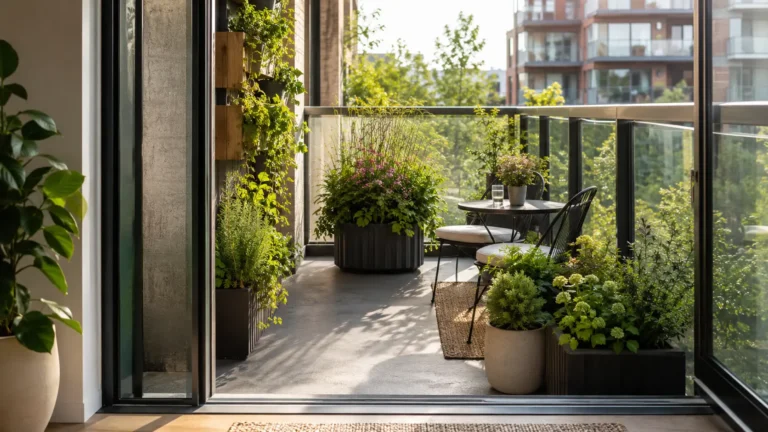
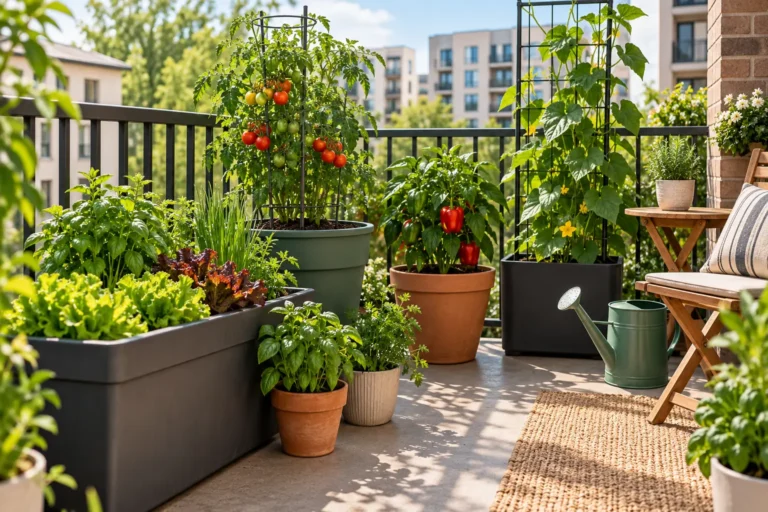
You don’t need a backyard to grow fresh vegetables. A sunny balcony can provide enough room for tomatoes, peppers, leafy greens, cucumbers, and other crops—as long as you choose plants that fit the conditions you actually have.
The biggest challenge with an apartment balcony vegetable garden isn’t usually the lack of square footage. It’s working around the balcony itself. Direct sunlight may change dramatically from one end to the other. Wind can dry containers quickly. Concrete and brick can make an already-hot afternoon even hotter. Large containers can become surprisingly heavy once they’re filled and watered.
That means the best place to start isn’t at the garden center. It’s on your balcony, figuring out what the space can realistically support.
This guide will walk you through that process, from measuring sunlight and choosing vegetables to handling containers, watering, wind, heat, and runoff.
In This Guide
Can You Grow Vegetables on an Apartment Balcony?
Yes. Many vegetables grow well in containers on balconies when they receive enough light, root space, water, and nutrients.
The limitations are different from those in a backyard garden. Your vegetables can’t send roots farther into the soil when a container dries out, and a building can block several hours of sunlight even when the balcony seems bright.
Success usually comes from matching the garden to the space instead of trying to squeeze a traditional vegetable garden onto a balcony.
If you’re still deciding where and how to grow food at home, our guide to apartment vegetable gardening covers the broader basics of growing vegetables in a limited living space.
Check Your Balcony Before You Buy Plants
Before choosing vegetables, spend a little time observing the balcony.
You want to answer five questions:
- How many hours of direct sunlight does it receive?
- How exposed is it to wind?
- Does the space become unusually hot?
- Where will excess water drain?
- Are there restrictions on what you can put or attach to the balcony?
Those answers will influence almost every decision that follows.
Measure How Much Direct Sun You Actually Get
Don’t estimate sunlight based only on which direction the balcony faces. Measure what reaches the plants.
A south- or west-facing balcony can still be shaded by an overhang or neighboring building. A balcony that looks bright all afternoon may receive plenty of ambient light but only a few hours of direct sun.
Observe the space several times throughout a clear day and note when direct sunlight begins and ends.
University of Maryland Extension recommends about 6 to 8 hours of direct sun for warm-season crops such as tomatoes, peppers, eggplant, and squash, compared with about 3 to 5 hours for cool-season crops such as lettuce, spinach, and Asian greens
Treat those ranges as planning guidelines, not hard cutoffs. Recommendations can vary somewhat because the crop, season, climate, and intensity of the available light all affect plant performance.
The important part is knowing what your balcony actually receives before buying plants.
Not sure how to measure or interpret your balcony’s sunlight? Our guide to how much sun a balcony garden needs explains direct sunlight, partial-sun conditions, balcony direction, and what you can grow at different light levels.
Look for Wind and Reflected Heat
Balconies can create growing conditions that aren’t obvious from the weather forecast.
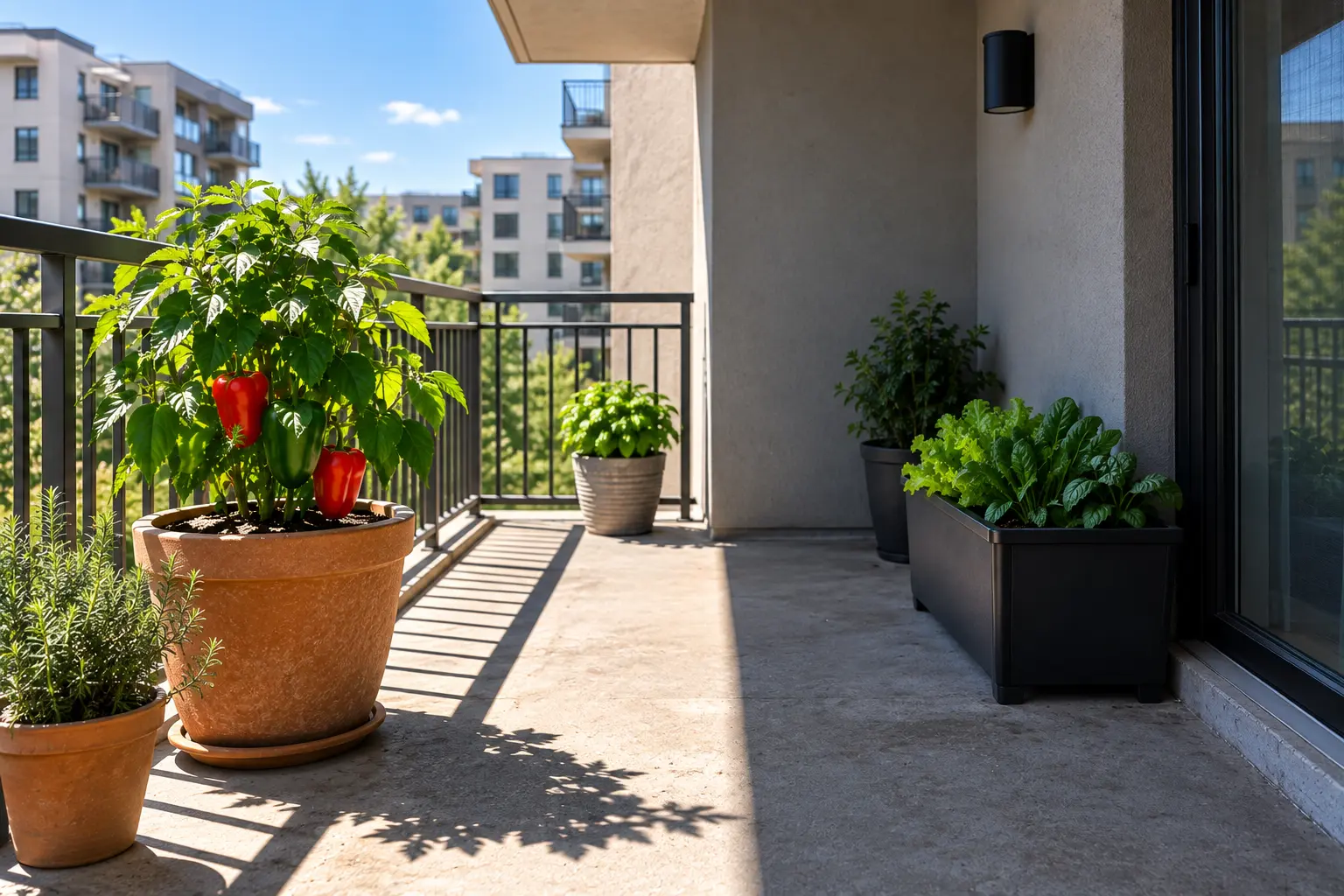
An exposed upper-floor balcony may funnel wind around a building, while a recessed balcony a few floors below may be relatively protected. Wind can increase moisture loss from containers and become a physical problem for tall vegetables, loaded tomato plants, and trellised vines.
Heat can be just as easy to underestimate. Brick, concrete, stone, metal, and other hard surfaces can absorb or reflect solar radiation, increasing heat around plants. University of Maryland Extension identifies these surfaces as a potential source of heat stress in container gardens.
Pay particular attention to what happens during the hottest part of the afternoon. A location that works beautifully in spring may become much harsher in midsummer.
Think About Weight Before Adding Large Containers
A large pot doesn’t seem especially heavy when it’s empty.
Add growing mix, water, a mature vegetable plant, and a support structure, and the situation changes. University of Maryland Extension notes that a 20-inch container filled with moist potting mix and plants can weigh about 100 pounds.
Don’t guess how much weight your balcony can safely support. If you plan to use unusually large or numerous containers and don’t know the allowable load, check your lease or building information and ask the appropriate property or building professional.
Also think about whether you’ll need to move a container later. A pot that’s easy to position when empty may be difficult to relocate once it’s filled and watered.
Decide Where Drainage Water Will Go
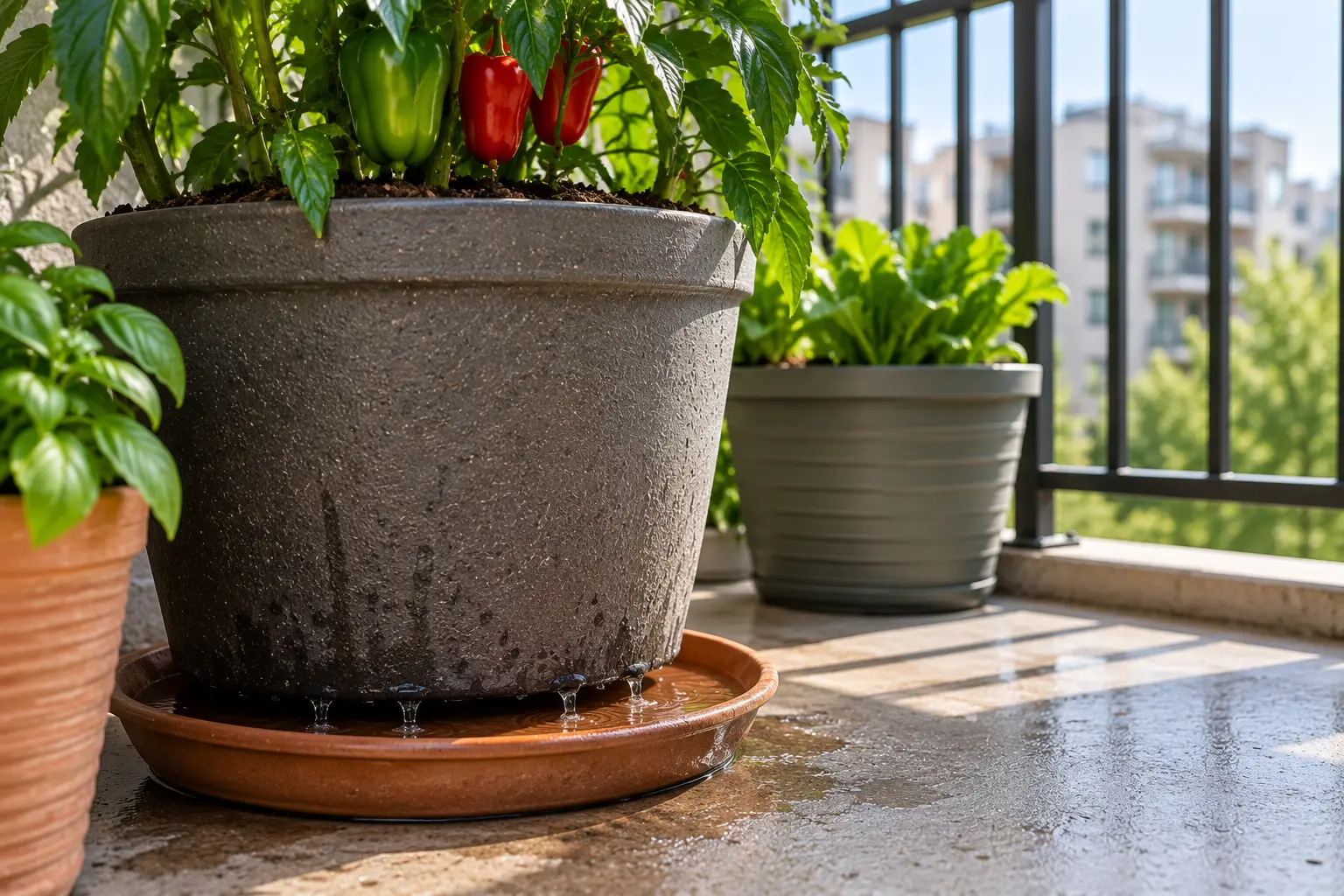
Vegetable containers need drainage, but on an apartment balcony the water doesn’t simply disappear.
Ask yourself where it goes.
Could it drip onto the balcony below? Run toward a neighbor’s belongings? Stain the balcony surface? Collect near a doorway?
Saucers or trays can help manage runoff where appropriate, especially when another balcony is below yours. University of Maryland Extension specifically notes that saucers can be useful when gardening above a neighbor, but they should be emptied regularly rather than allowing containers to remain in collected water.
Think about drainage before arranging the garden. Moving six wet containers because you discover they’re draining in the wrong direction isn’t much fun.
Check Your Lease or Building Rules
Before attaching anything permanently, check the rules for your property.
Restrictions may apply to railing planters, hanging containers, trellises, drilling or attaching hardware, runoff, common walkways, or other balcony modifications.
Rules vary from one property to another, so don’t assume a setup you’ve seen on someone else’s balcony is allowed on yours. This is especially important with vertical gardening. A freestanding support inside the balcony and a trellis physically attached to the building aren’t necessarily treated the same way.
If you’re planning more than vegetables, our broader apartment balcony gardening guide covers the general considerations for creating a garden in this type of space.
Match Vegetables to Your Balcony Conditions
Once you understand the balcony, choosing vegetables gets much easier.
Instead of starting with a list of crops you want to grow, start with the conditions you can provide.
NC State Extension’s small-space vegetable guidance offers a useful framework: about 3 to 6 hours of full sun can support many leafy crops; with 5 to 6 hours, root vegetables become more practical; and 6 or more hours opens the door to fruiting crops such as beans, cucumbers, eggplant, peppers, and tomatoes.
Here’s a simple way to think about it:
| Balcony condition | Crops to consider |
|---|---|
| 6+ hours of direct sun | Tomatoes, peppers, beans, cucumbers |
| About 5–6 hours | Leafy greens and some root crops |
| About 3–5 hours | Lettuce, spinach and other leafy greens |
| Very limited floor space | Compact varieties and vertically trained crops |
| Exposed or windy | Compact plants and stable, well-supported setups |
Sunny Balconies
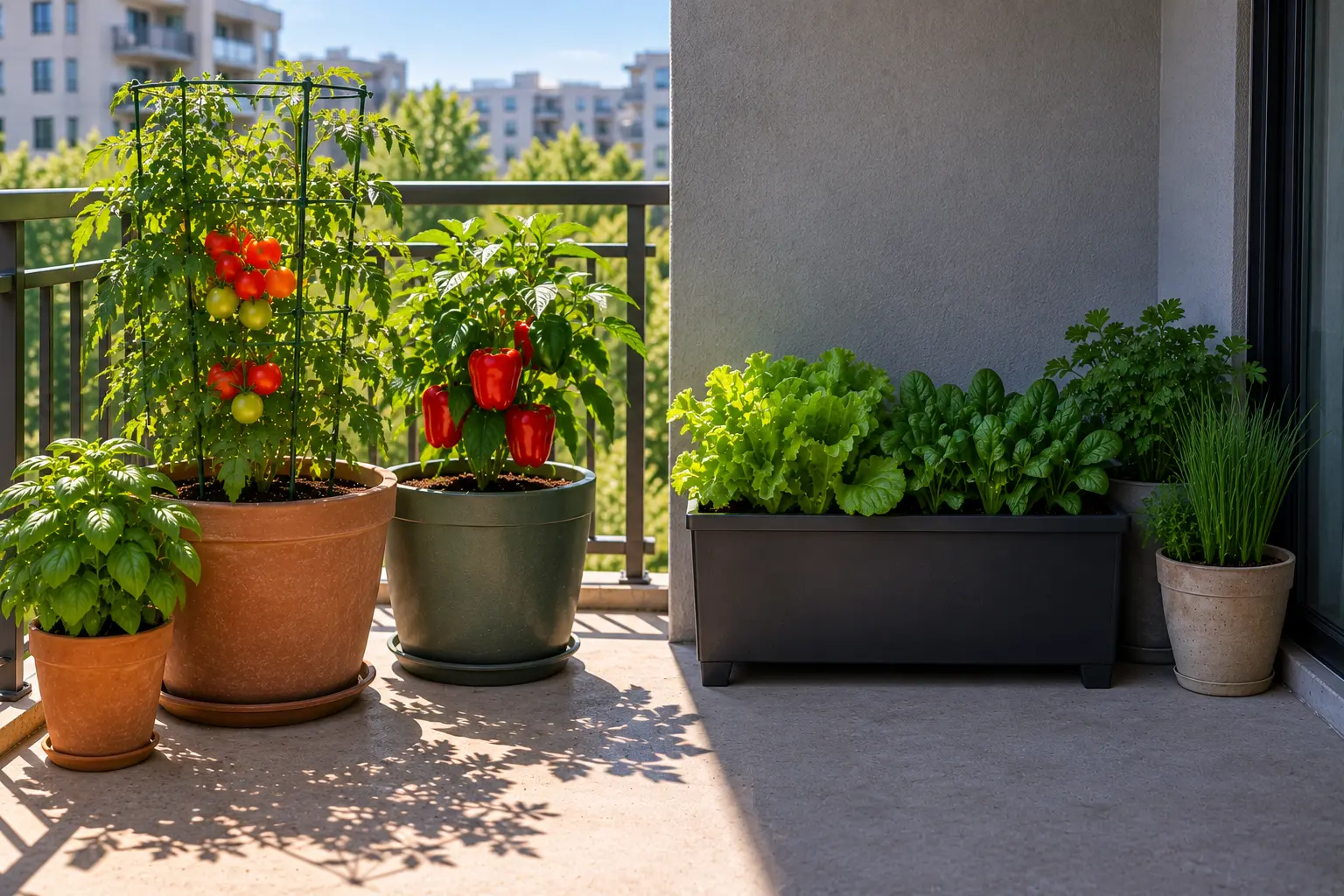
If your balcony receives six or more hours of good direct sunlight, you have more options.
Tomatoes and peppers are obvious choices, but think about how large the mature plant will become before buying it. On a small balcony, a compact or dwarf tomato may make more sense than an indeterminate tomato that wants to keep growing.
Cucumbers and beans can also use vertical space effectively when you have a suitable, stable support.
The goal isn’t to fit as many vegetables as possible. Choose plants that can mature without taking over the balcony.
Balconies With Less Direct Sun
A balcony that doesn’t receive enough direct sun for productive tomatoes isn’t necessarily a bad vegetable-growing space.
Change the crop.
Leafy vegetables such as lettuce and spinach generally need less direct sunlight than fruiting vegetables. Some root crops may become practical as the amount of available light increases.
A beginner can spend an entire season trying to “fix” a tomato plant when the real problem is simply that the balcony doesn’t provide enough direct sun.
Tiny Balconies
On a very small balcony, mature plant size matters almost as much as sunlight.
Look for seed packets or plant labels using words such as:
- bush
- dwarf
- compact
- determinate
University of Maryland Extension recommends bush and dwarf varieties as options for container growing in small spaces.
Don’t assume that “small balcony” means you need tiny pots, though. A compact plant still needs adequate root space.
Once you know what your conditions can support, our guide to the best vegetables to grow in an apartment takes a closer look at individual crop choices.
Plan a Small Balcony Vegetable Garden You Can Maintain
It is easy to overestimate how many plants a balcony needs.
Five healthy containers that you can water, inspect, and harvest consistently are more useful than 15 containers that become difficult to manage.
For your first balcony vegetable garden, start small enough that you can learn how quickly your containers dry, where the strongest sunlight falls, and how plants respond to the balcony’s wind and heat.
You can always add more later.
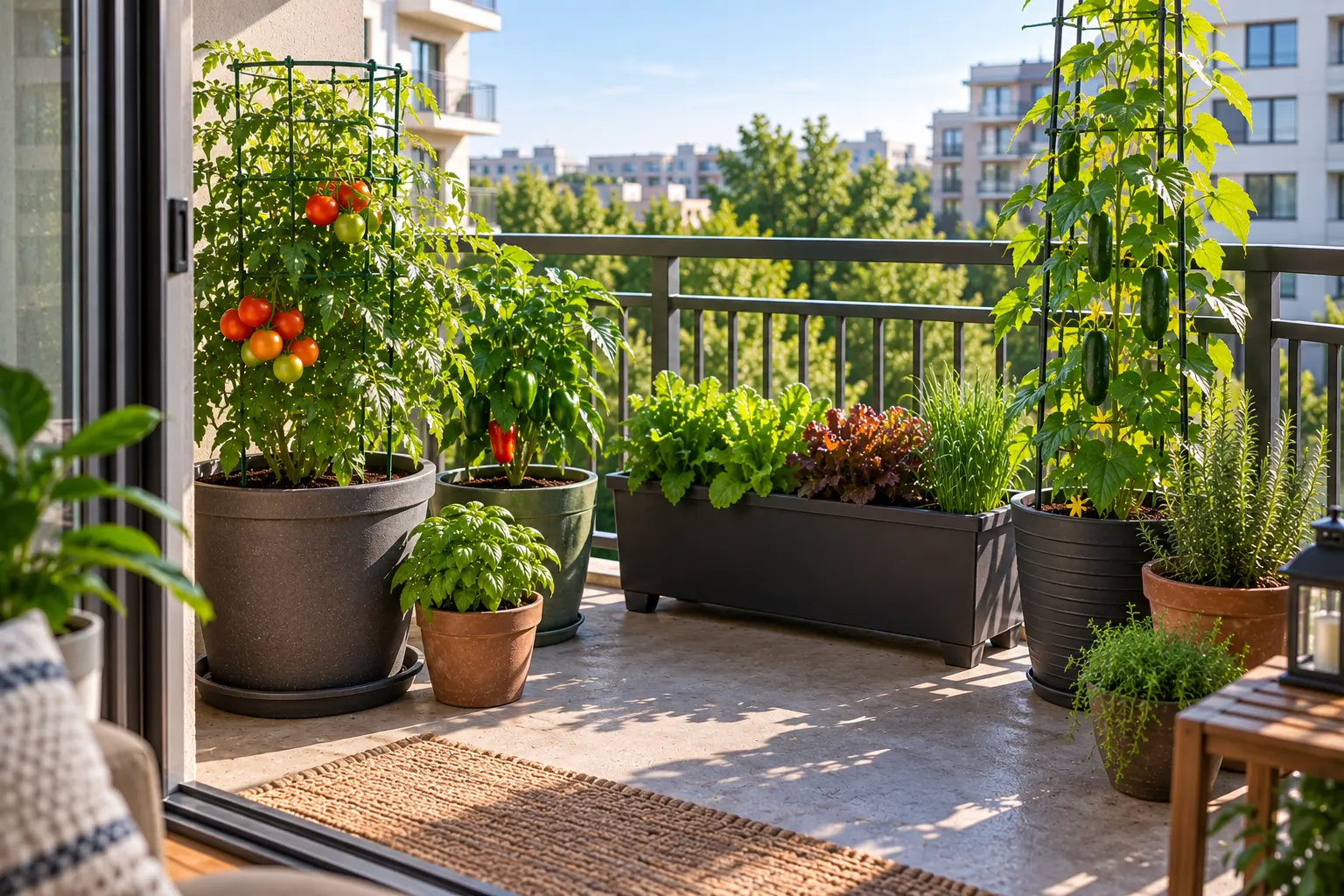
A Simple Sunny-Balcony Starter Setup
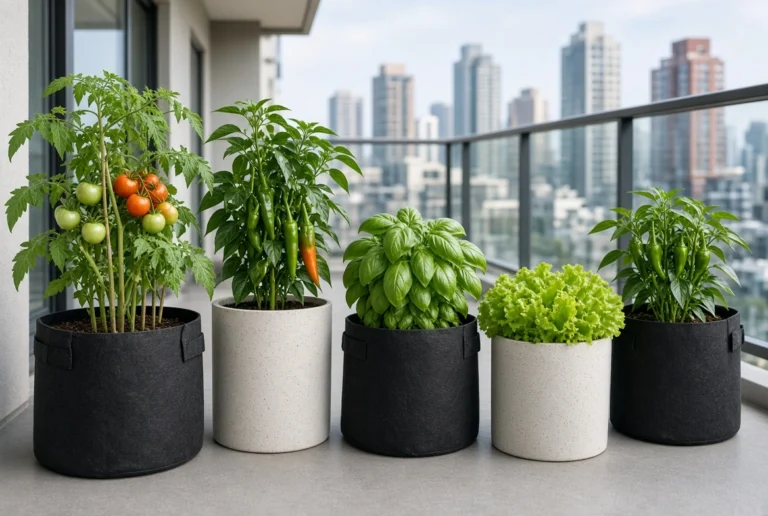
For a beginner with a reasonably sunny balcony, a simple garden might contain:
- one compact tomato or pepper plant;
- one container of leafy greens;
- one additional crop suited to the remaining light and space; and
- one or two herbs if space allows.
That’s an example, not a formula.
If your balcony receives less direct sun, skip the tomato or pepper and devote more of the available space to crops better suited to those conditions.
Starting with a few containers also makes watering easier to learn. You’ll quickly see which one dries first without having to inspect a miniature jungle every evening.
Use Vertical Space Carefully
Vertical growing can make a small balcony more productive, but it has to make sense for the space.
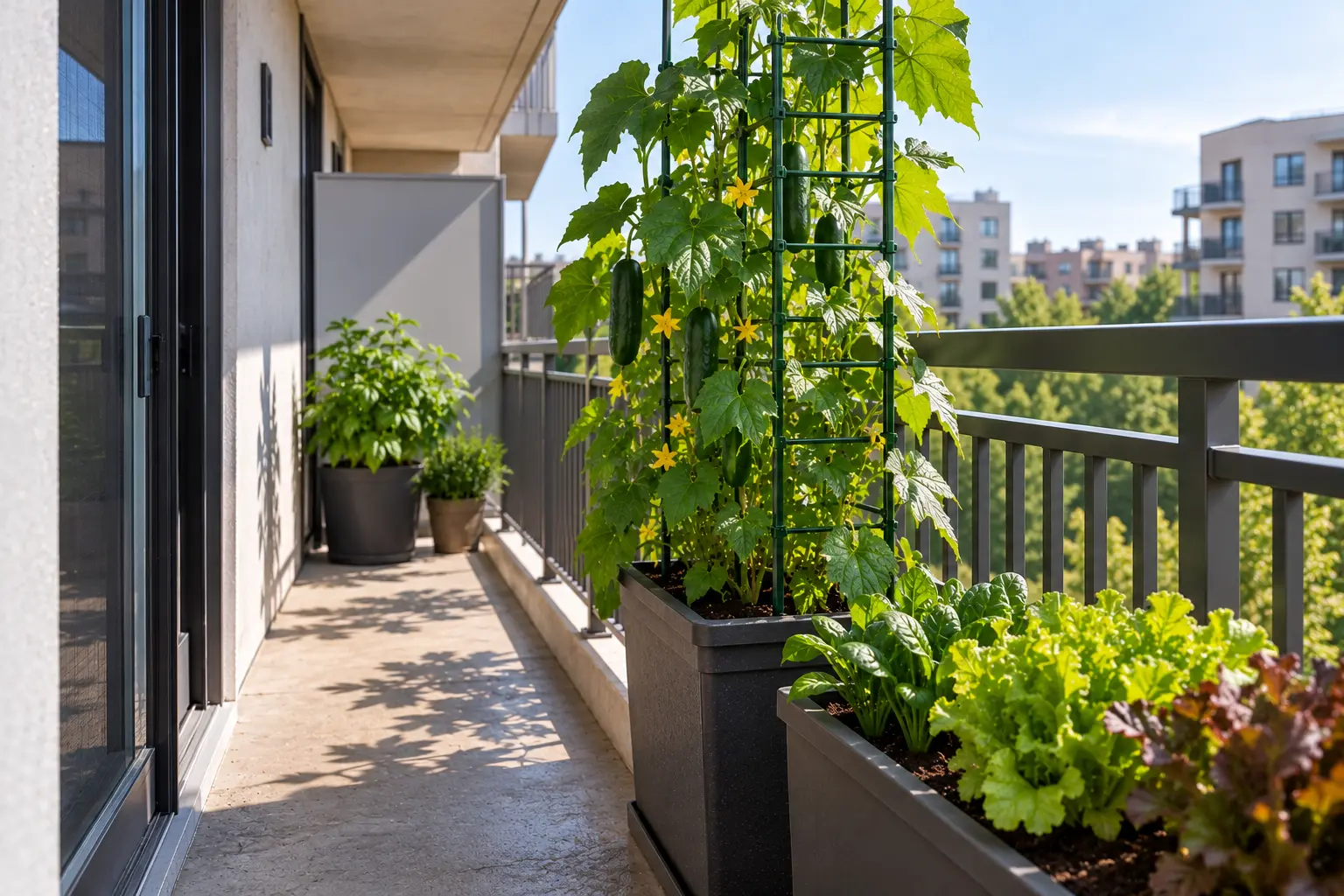
Cucumbers, pole beans, and some tomatoes can grow upward instead of spreading across valuable floor space.
Even compact vegetables may still need support. Penn State Extension’s container vegetable gardening guidance notes that tomatoes, pole beans, and cucumbers can require a trellis or other support even when you’re selecting plants for container growing.
On a balcony, stability matters just as much as vertical space.
Don’t automatically tie a tall trellis to a balcony railing or attach it to the building. Check your property rules and use a support that can remain stable under the conditions your balcony experiences.
A trellis that feels stable when the vines are small may behave differently once it’s covered in foliage, so check the support again as the season progresses.
Also think about shade. A six-foot trellis placed on the sunny edge of a tiny balcony can turn the plants behind it into a shade garden.
Choose Containers for Balcony Vegetables
A balcony vegetable container needs enough room for the crop’s roots, adequate drainage, and enough stability for its location.
Bigger isn’t automatically better on a balcony because larger containers mean more weight and less available floor space. Going too small creates the opposite problem: restricted roots and faster drying.
Container shape matters too. University of Maryland Extension notes that a wider 5-gallon container can be less top-heavy and more stable in a breeze than a taller container holding the same volume.
If you’re considering that container size for growing food, see what vegetables you can grow in a 5-gallon bucket to compare 12 crops and the amount of space each plant needs.
Vegetable containers also need adequate drainage holes or slits. Adding rocks or gravel to the bottom isn’t a substitute for proper drainage and can actually worsen drainage by raising the saturated zone in the growing medium.
For container materials, growing media, drainage, and general pot selection, see our complete guide to apartment container gardening.
Container depth also depends on the crop, so our guide to how deep containers need to be for vegetables breaks down root-space requirements in more detail.
Pre-publication note: Link that bold anchor to the scheduled container-depth article after its final WordPress permalink is confirmed. Delete this note before publishing Article 25.
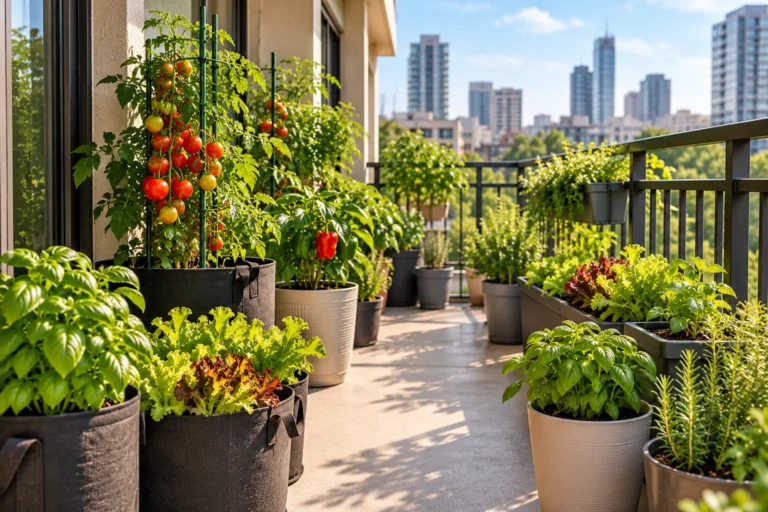
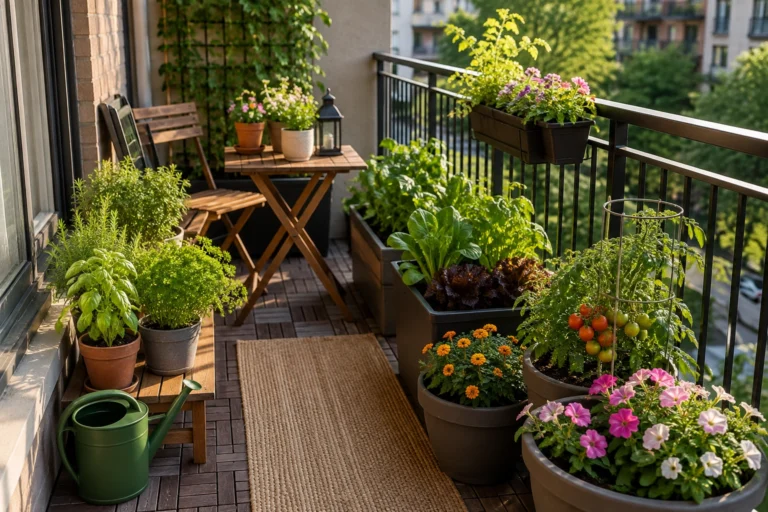
Arrange the Garden Around Sun, Height, and Access
The prettiest arrangement isn’t always the easiest one to grow.
Start with sunlight. Put vegetables with the greatest light requirements where they’ll receive the strongest direct exposure, and be careful about placing tall crops where they’ll unnecessarily shade shorter plants.
Then think about access.
Can you reach the back containers without moving everything in front? Can you water without leaning dangerously over a railing? Can you harvest tomatoes without climbing around a trellis?
Leave enough room to use the balcony normally, including access to the door.
Grouping containers can make watering more convenient, particularly when plants have similar needs. Just don’t pack foliage so tightly that air movement becomes poor.
And remember that the arrangement will change as plants grow. A small tomato transplant in May may occupy considerably more space later in the season.
For help planning the entire space—not just the vegetable containers—our balcony garden design guide covers layout, vertical space, and making a small balcony practical.
Water Balcony Vegetables Without Guessing
Watering is one of the areas where balcony gardening can surprise beginners.
Containers can dry much faster than an in-ground garden because their roots are confined above ground. Sun, wind, heat, container size, plant size, and the growing medium all affect how quickly moisture disappears.
There isn’t a useful rule that says:
Water balcony vegetables every X days.
Check the growing mix instead.
Feel below the surface rather than judging moisture by appearance alone. When the growing medium needs water, wet the root zone thoroughly and allow excess water to drain.
During hot, dry weather, some vegetable containers may need attention every day. University of Maryland Extension specifically notes that some containers can require daily watering under those conditions.
Make Watering Easier on a Small Balcony
If you have to carry a heavy watering can through the entire apartment several times every summer evening, the garden can become a chore quickly.
Consider water access when arranging containers. Grouping plants with similar moisture needs can simplify the routine, and mulch may help reduce evaporation where appropriate. Self-watering containers can also be useful when consistent moisture is difficult to maintain.
If keeping up with routine watering becomes difficult, an automatic plant watering system may be worth considering for containers that need more consistent moisture.
Vacations create a different problem. Our guide explains several ways to water plants while away without waiting until the night before a trip to figure it out.
Feed Container Vegetables for Continued Growth
A vegetable growing in a container has access only to the nutrients available within that limited root zone.
Start with a quality growing mix intended for containers rather than dense garden soil, then follow appropriate fertilizer recommendations for the crop and product you’re using.
More fertilizer isn’t automatically better. A stressed plant may be reacting to light, water, heat, root space, or another problem rather than a nutrient shortage.
Penn State Extension notes that container vegetables can’t extend their roots into surrounding soil for additional nutrients, making ongoing nutrient management important.
Finished compost can be useful in container growing, but don’t automatically treat it as a complete season-long fertilizer.
If you produce finished compost or worm castings at home, our apartment composting guide explains small-space composting methods and ways to use the finished material.
Protect Balcony Vegetables From Wind and Heat
Backyard gardeners deal with weather too, but balconies can intensify certain conditions.
A vegetable container may face hours of direct afternoon sun, heat reflected from a wall, and wind moving around the side of a building—all while holding only a limited amount of moisture.
Those conditions can also change as the season progresses.
How Wind Changes Balcony Growing
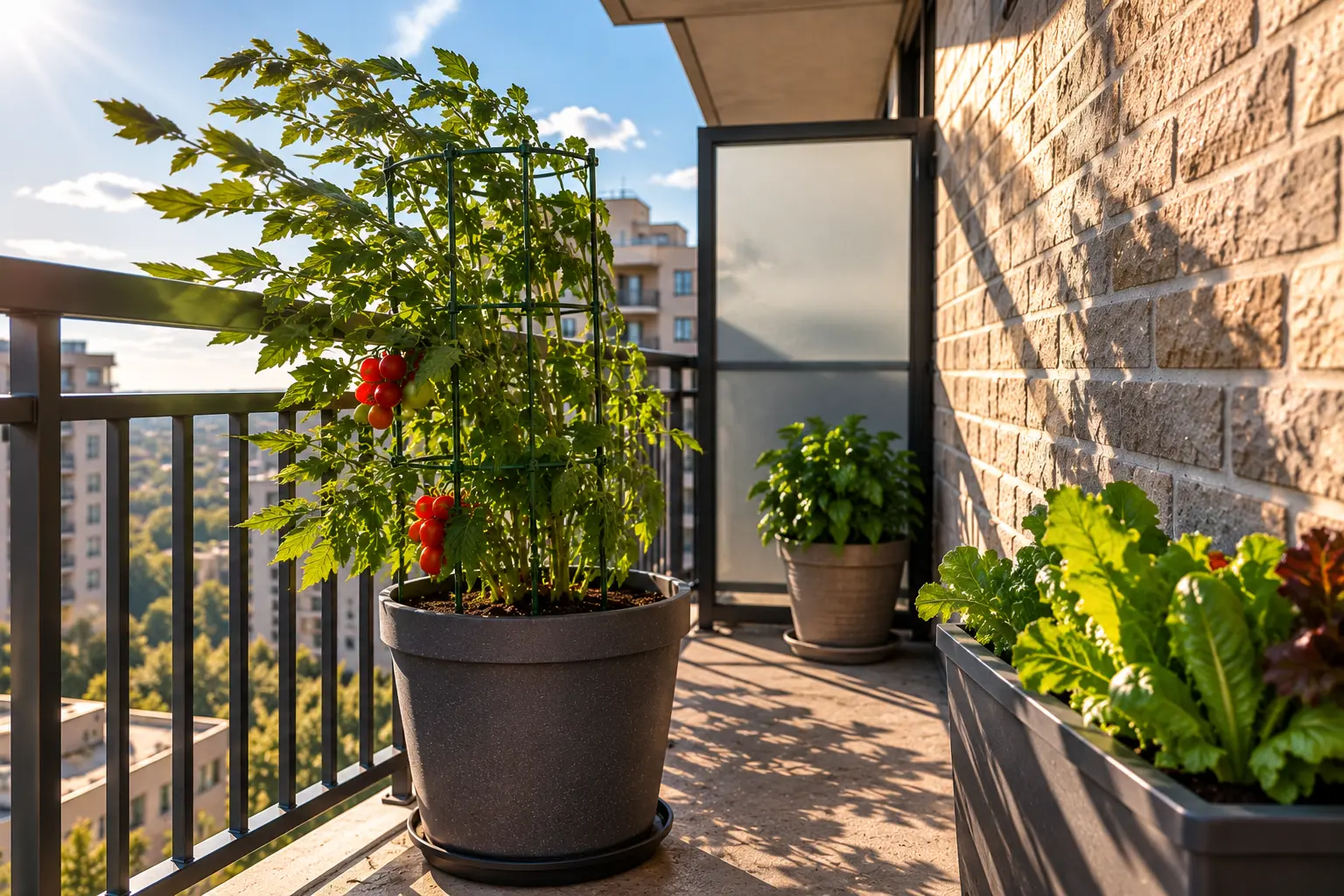
Wind can increase moisture loss and put pressure on tall plants and supports. A tomato cage that seems perfectly stable around a small transplant may behave very differently when the plant is four feet tall and carrying fruit.
Watch what happens on genuinely windy days.
If a container rocks, a trellis shifts, or stems are repeatedly whipped around, address the problem rather than waiting for the plant to fall.
Moving portable containers to a more protected part of the balcony, choosing more stable pots, or improving appropriate supports may help. Be careful about solving the problem by attaching structures to the building or railing without permission.
Watch for Reflected Heat
A sunny balcony surrounded by brick, concrete, glass, or metal can be hotter around the plants than you expect. Hard surfaces can absorb or reflect solar radiation and contribute to heat stress.
One clue may be a container that suddenly begins drying much faster as summer arrives.
Pay attention to plants closest to these surfaces. If a movable container struggles in a particularly harsh location, repositioning it may be more effective than continually trying to compensate with extra water.
Season matters too. The path of the sun changes throughout the year, so a location that worked in spring may not be the best spot in midsummer.
Your balcony garden isn’t a permanent arrangement. Moving a container a few feet when conditions change is one of the advantages of growing in pots.
Common Balcony Vegetable Garden Problems
A few practical mistakes account for many balcony-gardening headaches.
Not Enough Direct Sunlight
A bright balcony isn’t necessarily a sunny balcony. If a fruiting vegetable grows but produces poorly, check the actual hours of direct sunlight before changing everything else.
If the location simply doesn’t provide enough sun, switching crops may work better than fighting the balcony.
Too Many Plants in Too Little Space
Small seedlings make a balcony look empty in spring, but they’ll need room later.
Overcrowding increases competition for light, moisture, nutrients, and root space and can reduce air circulation. Plan for the mature plants, not the seedlings you see on planting day.
Containers That Are Too Small
A pot that’s too small can restrict root growth and dry quickly. Undersized containers also experience larger swings in moisture and temperature.
Use your floor space efficiently, but give each crop adequate root room.
Underestimating Wind
Wind may not become an obvious problem until plants get taller.
Plan supports early for vegetables that need them, and check containers and trellises again as plants gain height, foliage, and weight.
Underestimating Watering Demand
A container that stayed moist for days in spring may need checking daily during hot summer weather. Plant size, roots, heat, sun, and wind can all increase water demand.
Don’t base July watering on what worked in April.
Apartment Balcony Vegetable Garden Checklist
Before planting your balcony vegetable garden, run through this list:
- Measure the direct sunlight. Don’t rely on how bright the balcony looks.
- Check wind exposure. Pay attention during genuinely windy weather.
- Look for reflected heat. Concrete, brick, metal, and other hard surfaces can change the microclimate.
- Check building or lease rules. Especially before attaching trellises, hanging containers, or railing planters.
- Consider loaded container weight. Wet growing mix is much heavier than an empty pot.
- Plan where drainage water will go. Think about the balcony surface and neighbors below.
- Match vegetables to the available light.
- Choose appropriately sized containers with drainage.
- Plan supports before climbing or tall vegetables need them.
- Keep containers accessible for watering and harvesting.
- Start with a manageable number of plants.
You don’t need to solve every possible gardening problem before planting. You just need a setup that fits the balcony you actually have.
Frequently Asked Questions
Can you grow vegetables on an apartment balcony?
Yes. A balcony with adequate sunlight can support many vegetables in containers. The best choices depend on direct sun, available space, container size, climate, wind, and heat.
How much sunlight does a balcony vegetable garden need?
It depends on the crop. Leafy vegetables can often grow with less direct sunlight, while fruiting vegetables such as tomatoes and peppers generally need more. NC State Extension uses roughly 3–6 hours for many leafy crops and 6 or more hours for fruiting vegetables as a small-space planning framework.
What vegetables grow well on an apartment balcony?
Possible choices include tomatoes, peppers, beans, cucumbers, lettuce, spinach, carrots, beets, and radishes, depending on your conditions. Compact, bush, and dwarf varieties can be particularly useful where space is limited.
How many vegetables should a beginner grow?
There isn’t a correct number. Start with a few containers you can comfortably water and maintain, learn how plants respond to your balcony, and expand later if the space and your routine can handle more.
Do balcony vegetables need special containers?
No. They need containers with adequate root space, drainage, and stability. On a balcony, also consider loaded weight, wind exposure, runoff, and how much floor space each container occupies.
Start With the Balcony You Have
A successful apartment balcony vegetable garden doesn’t need dozens of containers or an elaborate vertical system.
Start by measuring the sunlight, noticing where wind and heat are strongest, choosing vegetables that fit those conditions, and putting the containers somewhere you can actually reach them to water and harvest.
Then start small.
After one growing season, you’ll know far more about your balcony than any generic garden plan can tell you. You’ll know which corner gets the best morning sun, which container dries first, where a tomato becomes too large, and which crops earn their limited space.
That’s when expanding the garden makes sense—not because there’s still an empty square foot, but because you know exactly what you want to grow there.