Automatic Plant Watering System: How to Choose the Right One for Indoor Plants
An automatic plant watering system can make caring for indoor plants easier when you have several containers, travel regularly, or want a more consistent way to deliver water. But the right system depends on more than how many plants a product claims it can water.
Some systems use a simple reservoir and wick. Others use pumps, timers, tubing, drip emitters, or Wi-Fi controls. Plant water needs, container size, potting mix, light, temperature, and the location of your plants all affect which approach makes sense.
Automatic watering should be matched to the plants rather than chosen for convenience alone. Virginia Cooperative Extension notes that houseplants do not all need the same watering frequency, and factors such as container size, pot material, temperature, humidity, and light can change how quickly potting mix dries.
If your main concern is caring for plants during a trip rather than choosing permanent watering equipment, start with our guide to how to water plants while away.
In This Guide
Which Automatic Watering System Is Right for Your Plants?
Start with the problem you actually need the system to solve.
| Your situation | System type to consider |
|---|---|
| One houseplant | Self-watering pot, wick, or watering stake |
| A few plants with similar water needs | Wick or reservoir system |
| Several plants grouped together | Pump-driven drip system |
| Plants with different water needs | Adjustable emitters or separate watering groups |
| No convenient electrical outlet | Passive, battery-powered, or rechargeable system |
| You travel regularly | Programmable system with an adequately sized reservoir |
| You want remote control | Wi-Fi or smart watering system |
| Most plants prefer drier potting mix | Continuous-moisture systems may not be appropriate |
This table is a starting point rather than a guarantee. Two people can own the same number of plants and still need different systems because their containers, light levels, room temperatures, and plant types are different.
How Automatic Plant Watering Systems Work
Automatic watering systems supply moisture to one or more containers without requiring you to manually pour water into every pot each time.
The main difference between systems is how the water moves from its source to the root zone.
Passive Wick and Reservoir Systems
A passive system does not require a pump.
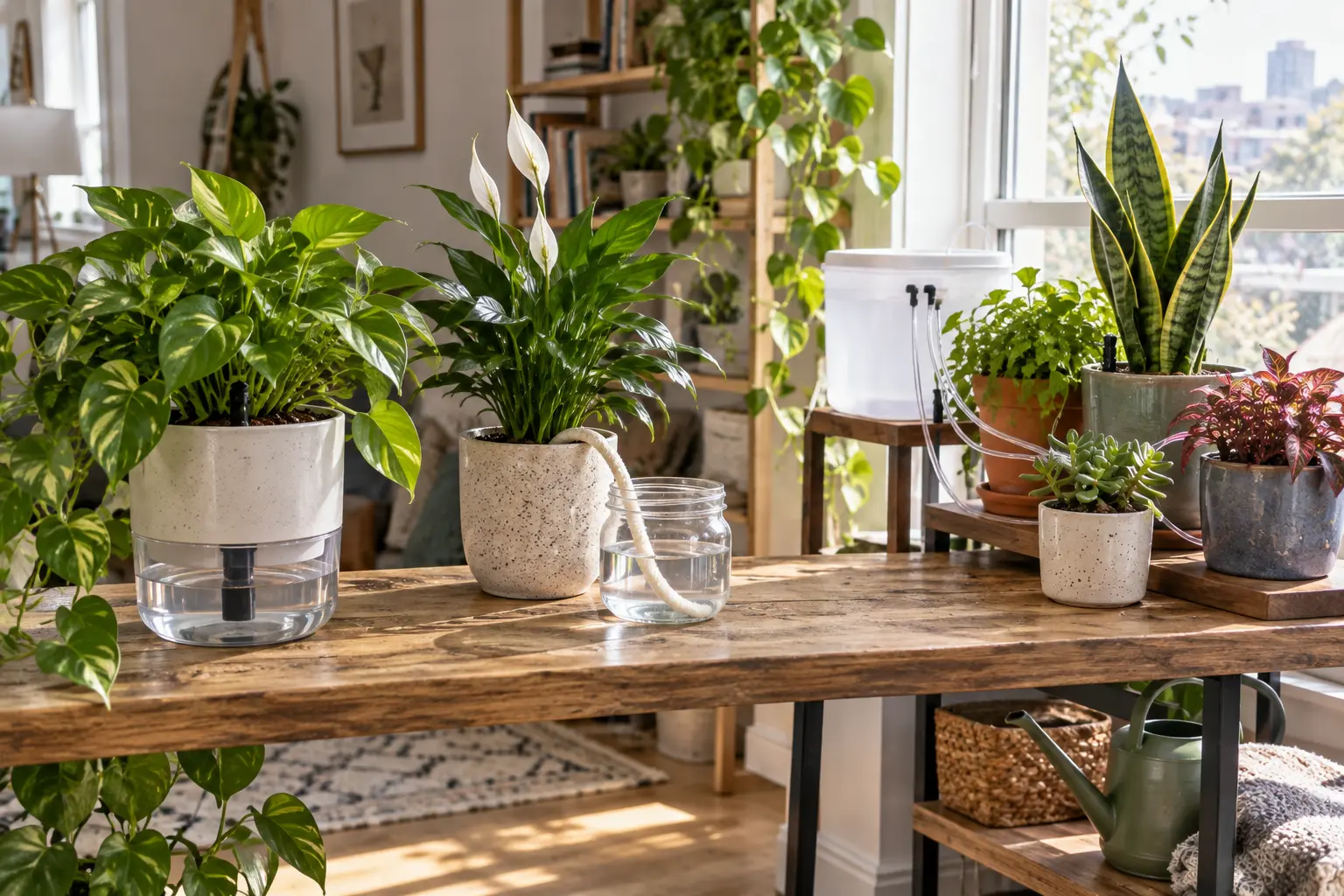
A reservoir stores water, and a wick or similar material allows moisture to move toward the growing medium through capillary action.
Virginia Cooperative Extension explains that self-watering containers commonly use a reservoir below the potting mix with a wick that draws water upward. These systems are designed to keep the growing medium more consistently moist.
The simplicity is attractive, but constant access to moisture does not suit every plant.
Gravity-Fed Systems
Gravity-fed systems place the water source above the plant or use the weight of water in a bottle or reservoir to move moisture toward the container.
They do not necessarily need electricity, but flow can change based on the height of the reservoir, the device being used, and the amount of water remaining.
That is one reason a gravity system should be tested rather than assuming it will provide the same amount of water to every pot.
Pump-Driven Drip Systems
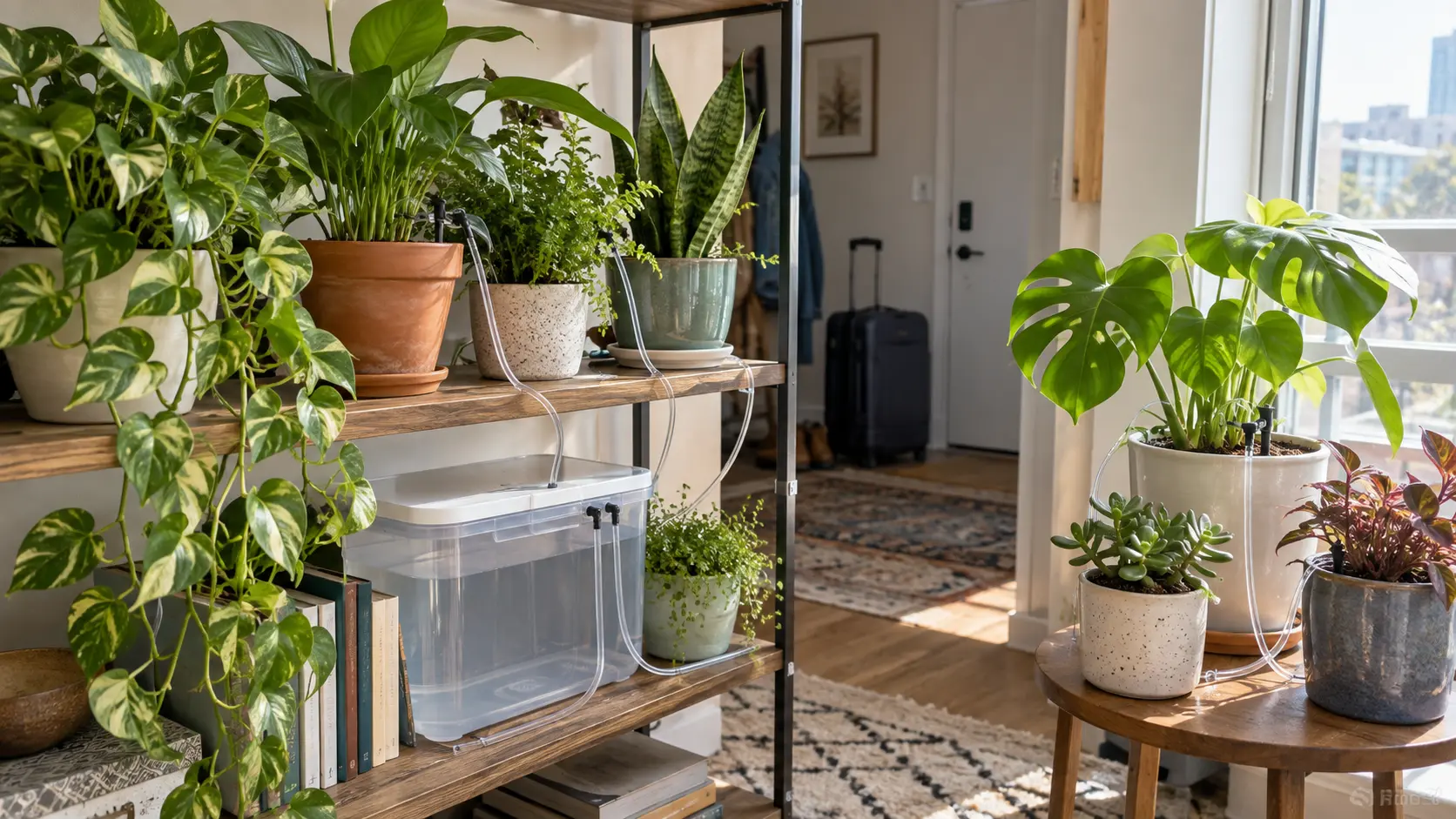
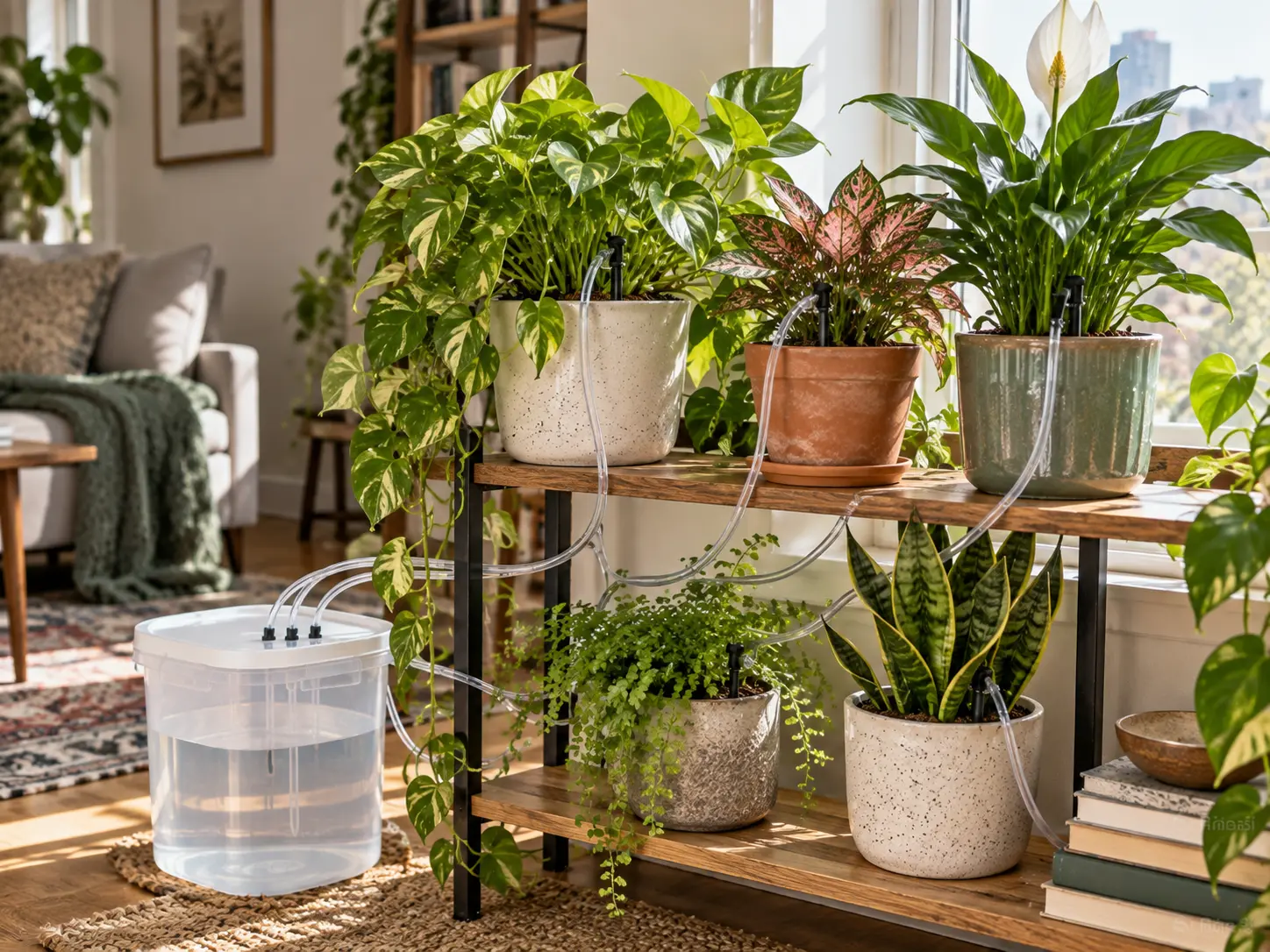
A pump-driven system draws water from a reservoir and sends it through small tubing to one or more emitters placed in individual containers.
This arrangement can be particularly useful when several pots sit on the same shelf, plant stand, windowsill, or nearby growing area.
Colorado State University Extension explains that drip irrigation systems use low-flow tubing and emitters to deliver water close to plant roots. Its guidance also notes that container plants can be well suited to drip irrigation and that system design, emitter placement, filtration, and maintenance affect performance.
Timer- and Sensor-Controlled Systems
A timer-based system waters according to the schedule you program.
A sensor-controlled system may attempt to adjust watering according to measured conditions such as growing-medium moisture.
Those are not the same thing.
A timer does not know whether a plant actually needs water. It simply follows its program. If the schedule is wrong, the system can repeatedly deliver too much or too little water.
Types of Automatic Plant Watering Systems for Indoor Plants
Several system types can work indoors, but they solve different problems.
Self-Watering Pots
A self-watering pot usually includes a reservoir built into or beneath the container.
This can be a good fit when:
- you are caring for one plant
- you do not want visible tubing
- you want a simple system without a pump
- the plant does well with relatively consistent moisture
Virginia Cooperative Extension says self-watering containers can work well for many houseplants but are not appropriate for plants that prefer drier potting soil. The reservoir should also be checked and cleaned periodically.
Wick and Reservoir Systems
A separate wick-and-reservoir setup applies the same basic principle without requiring a specialized pot.
One end of a suitable wick contacts the water source while the other delivers moisture toward the growing medium.
Wicking can be useful for a small number of plants, but it offers less precise control than an adjustable drip system.
Watering Stakes and Cones
Watering stakes and cones typically release water from a bottle or separate reservoir into one container.
Some are porous ceramic devices, while others use tubing.
They can be convenient for individual plants, but avoid assuming that a stake will automatically provide a fixed number of watering days. Duration depends on the plant, growing conditions, container, potting mix, water source, and device.
Automatic Drip Watering Systems
Pump-driven drip systems provide more flexibility when several plants need to share one water source.
A typical indoor kit may contain:
- a pump
- programmable controller or timer
- tubing
- connectors
- drip emitters or watering stakes
- a separate water reservoir
For most indoor potted-plant setups, individual drip emitters are usually more practical than broad sprayers because water can be directed into each container instead of covering a larger area.
Colorado State distinguishes individual drippers from microsprays, which use higher flow and wet a broader area.
Indoors, directing water into the pot can also reduce the chance of overspray reaching floors, walls, furniture, or electronics.
Affiliate disclosure: This article contains affiliate links. If you purchase through one of these links, we may earn a commission at no additional cost to you.
Product Example: RAINPOINT Indoor Large Display Automatic Plant Waterer Kit
The RAINPOINT Indoor Large Display Automatic Plant Waterer Kit is an example of a programmable pump-and-drip setup for several indoor containers.
Its Amazon listing describes a next-watering countdown, power-off memory, anti-siphon protection, and Cycle & Soak mode and markets the system for 10–15 plants.
That combination may appeal to someone who wants programmable watering without needing Wi-Fi or app control.
This is a product example, not a claim that the system is the best choice for every indoor garden.
Smart and Wi-Fi Systems
Smart automatic watering systems add features such as app-based scheduling or remote controls.
These features can be useful when you want to change a schedule without standing beside the system, but they also add complexity.
Product Example: RAINPOINT Direct WiFi Connection Smart Auto Plant Waterer
The RAINPOINT Direct WiFi Connection Smart Auto Plant Waterer Indoor Drip Irrigation System Kit represents the app-controlled category.
Its Amazon listing describes direct Wi-Fi connectivity, app control, local storage memory, adjustable water output, and support for a multi-plant setup.
A system like this makes more sense when remote control solves a real problem rather than when you simply need a basic watering timer.
Are Automatic Watering Systems Suitable for Every Houseplant?
No.
This is one of the most important things to understand before buying a system.
Virginia Cooperative Extension emphasizes that watering frequency should be based on the individual plant and growing conditions rather than a rigid schedule. It specifically notes that self-watering containers are not suitable for plants that prefer drier growing media.
Succulents, cacti, and other plants that tolerate or prefer substantial drying between waterings deserve particular caution with constant-moisture systems.
Plants that prefer more consistently moist conditions may be easier to match with a reservoir or carefully adjusted drip setup.
Even then, the system still needs to be monitored.
If you are still figuring out how light, temperature, humidity, and placement affect your plants, our indoor apartment gardening guide covers those growing conditions in more detail.
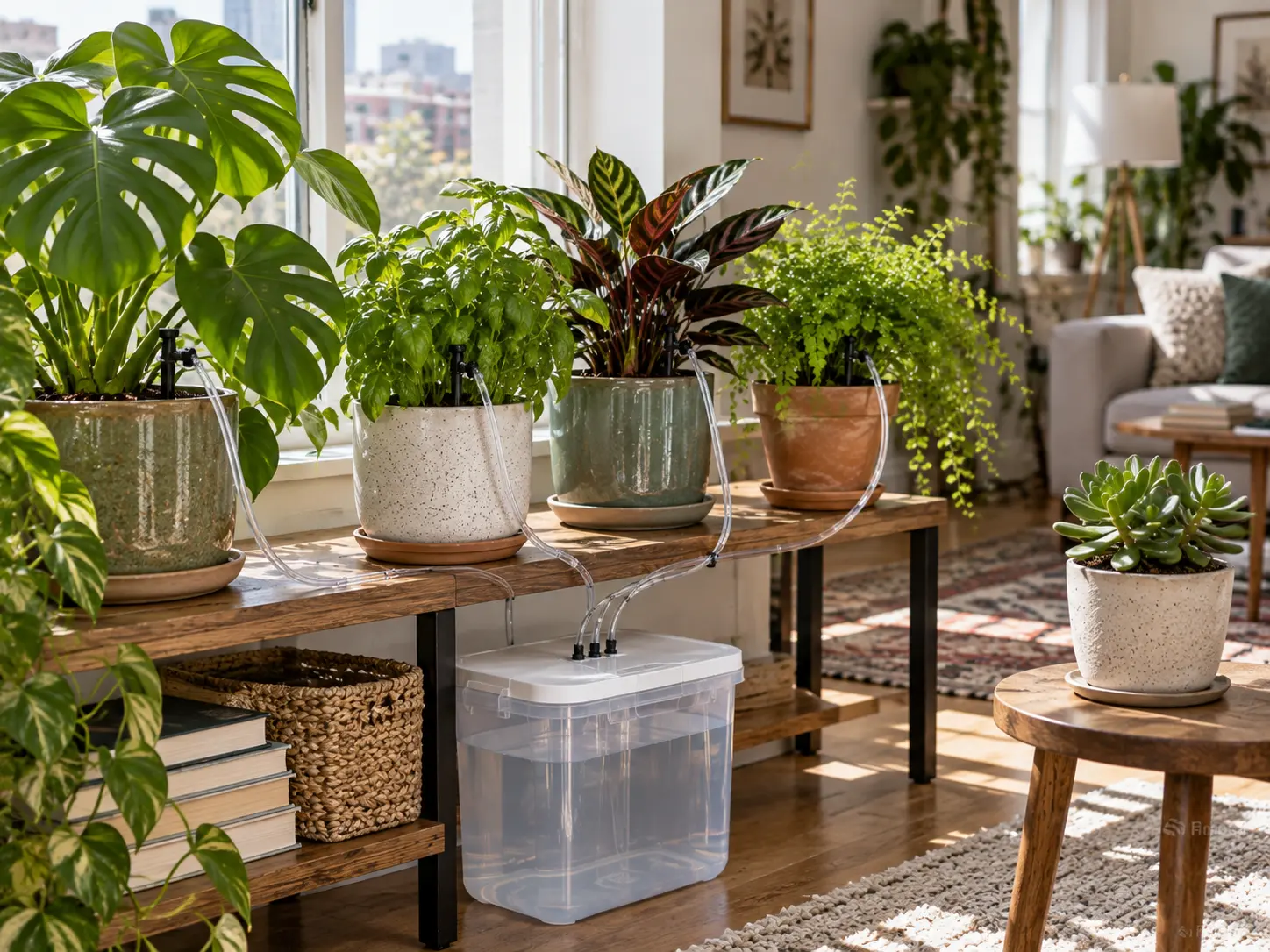
8 Things to Compare Before Buying an Automatic Plant Watering System
1. Number of Plants
Do not choose a system only because the package says it can water a particular number of pots.
Consider:
- pump capacity
- total tubing length
- how far apart the plants are
- emitter configuration
- differences in pot size
- differences in plant water needs
Ten similar plants grouped on one shelf are easier to manage with one system than ten plants scattered throughout several rooms.
2. Plant Water Requirements
Plants sharing a water source do not automatically have identical water needs.
Virginia Tech notes that light, temperature, humidity, container size, container material, potting mix, plant type, and season can all affect how quickly a houseplant uses water or its root zone dries.
This is why grouping plants with reasonably similar moisture needs can make automation easier.
Plants under stronger artificial lighting may also dry differently as growing conditions change. If you use supplemental lighting, our guide to grow lights for indoor plants explains what to consider when setting up indoor plant lighting.
3. Reservoir Capacity
A larger reservoir can extend the time between refills, but reservoir size alone does not tell you how many days the system will operate.
Water use depends on factors such as:
- number of plants
- plant size
- container size
- temperature
- humidity
- light
- watering frequency
- emitter flow
Avoid relying on formulas such as “one gallon lasts seven days.”
A more useful approach is to test the complete system while you are home and measure how quickly its reservoir drops.
4. Adjustable Water Flow
Adjustable emitters can be useful when several containers share a reservoir but do not need exactly the same amount of water.
That flexibility still requires observation.
An emitter set too high can keep one pot excessively wet while another dries too quickly.
5. Timer Flexibility
Check what the controller actually lets you adjust.
Depending on the product, useful features may include:
- watering frequency
- watering duration
- manual watering
- watering delay
- cycle-and-soak programming
- schedule memory after loss of power
More settings are not automatically better. A simple controller can be perfectly adequate when your plants do not require complicated scheduling.
6. Power Source
Indoor systems may use:
- mains power
- USB power
- replaceable batteries
- rechargeable batteries
- no electricity at all
Think about where the plants and reservoir will sit before buying.
A rechargeable or battery-powered system may be easier to place where an outlet is inconvenient.
7. Tubing and Emitter Layout
Look at the room, not just the product photo.
Ask:
- Are the plants grouped together?
- Are some on higher shelves?
- Will tubing cross a walkway?
- Where will the reservoir sit?
- Can the tubing reach every container?
- What happens if a connection leaks?
A system that works well mechanically can still be awkward in an apartment if tubing creates a trip hazard or reservoir placement creates a spill risk.
8. Cleaning and Maintenance
Automatic does not mean maintenance-free.
Reservoirs need to remain clean, and drip emitters can become clogged.
Virginia Cooperative Extension recommends checking self-watering reservoirs regularly and cleaning them periodically.
Colorado State also notes that filtration and emitter maintenance matter because algae, sand, debris, or other material can restrict flow.
How Much Does an Automatic Plant Watering System Cost?
Cost generally rises as a system adds more equipment and control.
A passive wick or watering stake requires relatively few components.
A pump-driven system adds equipment such as:
- pump
- tubing
- emitters
- timer
- connectors
- power source
Smart systems can add Wi-Fi connectivity, app-based controls, sensors, alerts, or more complicated scheduling.
Retail prices change frequently, so fixed Amazon prices can become outdated quickly. Compare the current price together with the features you will actually use rather than paying more simply because a product offers more automation.
Advantages and Disadvantages of Automatic Plant Watering Systems
| Potential advantage | Potential drawback |
|---|---|
| Reduces repeated manual watering | Requires setup and testing |
| Can serve several pots from one reservoir | One system problem can affect several plants |
| Programmable watering can simplify routines | Incorrect settings can repeatedly overwater or underwater |
| Useful when manual watering is inconvenient | Reservoir, battery, pump, or power supply can fail |
| Adjustable emitters can serve different containers | Emitters can clog or deliver water unevenly |
| Direct drip delivery can keep water in the container | Tubing or connections can leak indoors |
An automatic system is most useful when it makes a good watering plan easier to maintain. It cannot turn an unsuitable watering schedule into a good one.
When an Automatic Plant Watering System May Not Be Worth It
Buying a system is not automatically an improvement.
You may not need one if:
- you have only one or two easy-to-water plants
- manual watering is already simple
- most of your plants prefer substantial drying between waterings
- your plants have very different moisture requirements
- you do not want visible tubing or a water reservoir indoors
- you do not want to clean or test the equipment
- you are unlikely to use remote or smart features
In those situations, a watering can, self-watering pot, or simpler passive method may solve the problem with less equipment.
Common Automatic Watering Problems and How to Prevent Them
Empty Reservoir
An automatic pump cannot supply water after its reservoir is empty.
Do not guess how long a reservoir will last. Observe how quickly the water level changes during normal use.
Clogged or Uneven Emitters
Emitter flow can be affected by debris, mineral deposits, algae, system pressure, and layout.
Colorado State lists filtration and proper emitter design among important parts of a reliable drip setup. It also warns that too many emitters or overly long lines are common setup mistakes.
Check every pot rather than assuming that water reaching the first emitter means the entire system is working evenly.
Incorrect Timer Settings
A timer follows instructions. It does not determine whether those instructions are horticulturally appropriate.
Running too often can keep the growing medium too wet. Running too little can leave plants dry.
Virginia Tech emphasizes monitoring actual root-zone moisture instead of giving every houseplant a rigid watering schedule.
Leaks and Loose Tubing
A disconnected tube is inconvenient outdoors.
Indoors, it can drain reservoir water onto a floor, shelf, furniture, or electronics.
Inspect every connection before leaving the system unattended.
Power or Battery Failure
If the system depends on power, check its power source before relying on it for an extended period.
For battery or rechargeable models, understand how the system indicates low power and what happens to its saved schedule if power is interrupted.
Plants With Different Water Needs
One timer setting may not work for an entire mixed plant collection.
Where possible, group plants with similar moisture needs, use adjustable emitters, create separate watering groups, or leave dry-preferring plants outside the automatic system.
Test Your Automatic Watering System Before Leaving It Unattended
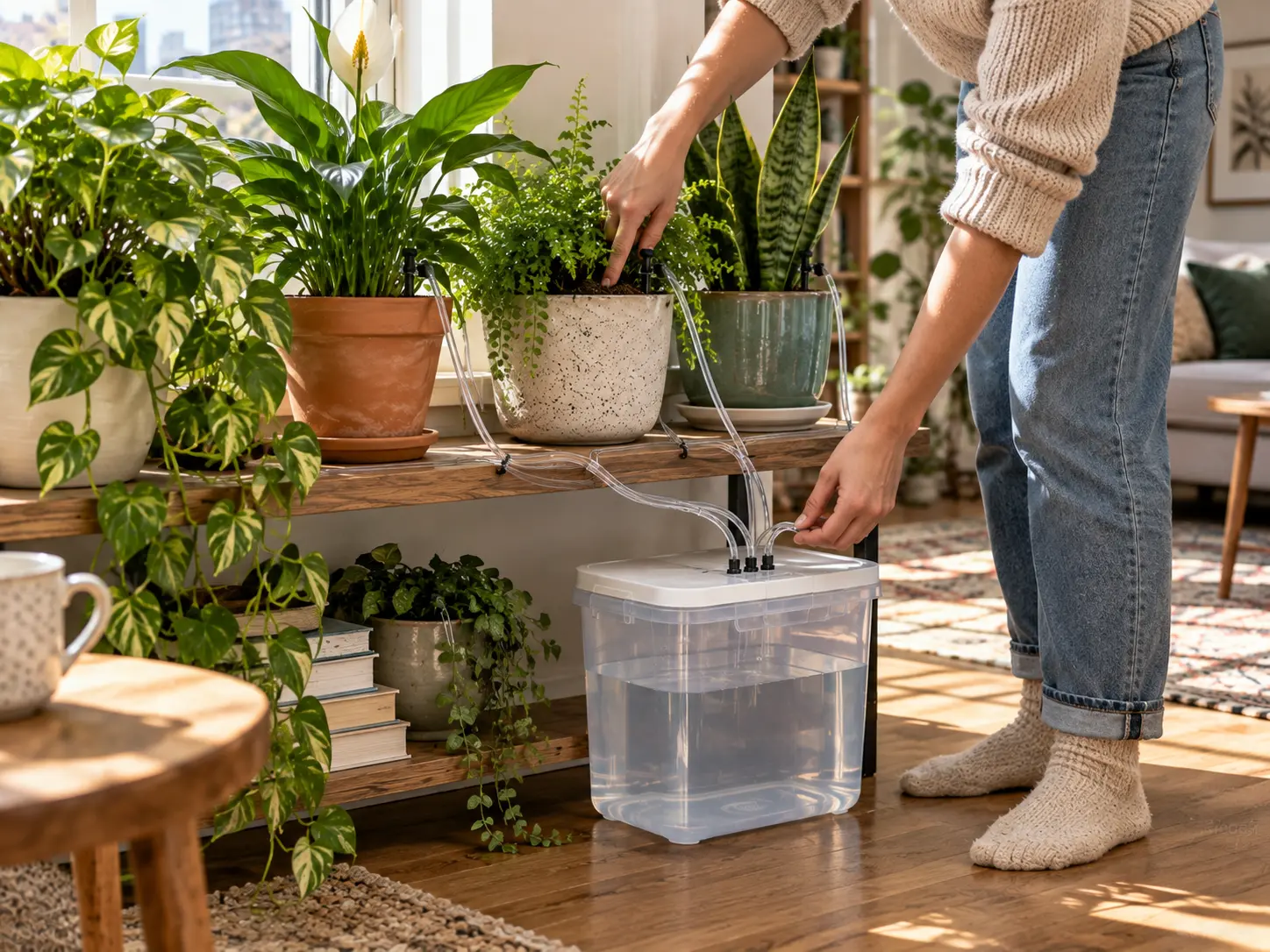
A new system should be tested while you are still home.
UF/IFAS recommends installing a micro irrigation setup in advance when preparing container plants for an absence so there is time to adjust the timing and make sure water is being delivered properly.
Run Several Normal Watering Cycles
Do not judge the system after a single test.
Run it under the schedule you actually plan to use and observe what happens over several cycles.
Check Every Pot and Connection
After watering, inspect:
- the potting mix
- each emitter
- tubing connections
- the reservoir
- the surface around the pots
Look for containers that remain too dry, stay excessively wet, or receive noticeably different amounts of water.
Also look for small leaks before they become large ones.
Measure Reservoir Use
Mark the starting water level.
After several cycles, check how much water the system has actually used.
That gives you a much more useful estimate for your particular setup than a generic claim about how long a reservoir should last.
If you change pot size, move plants, repot them, change lighting, or significantly alter the growing environment, test the system again.
Do You Need a Smart Automatic Plant Watering System?
Smart features are worthwhile when they solve a real problem.
A conventional programmable system may be enough when:
- all the plants are nearby
- you only need a basic schedule
- you can check the reservoir yourself
- remote adjustments are unnecessary
A Wi-Fi or app-controlled system may be more useful when:
- you travel regularly
- remote schedule changes matter
- you want app-based controls
- you manage a larger group of plants
- you specifically value connected features
Avoid paying for connectivity simply because it sounds more advanced.
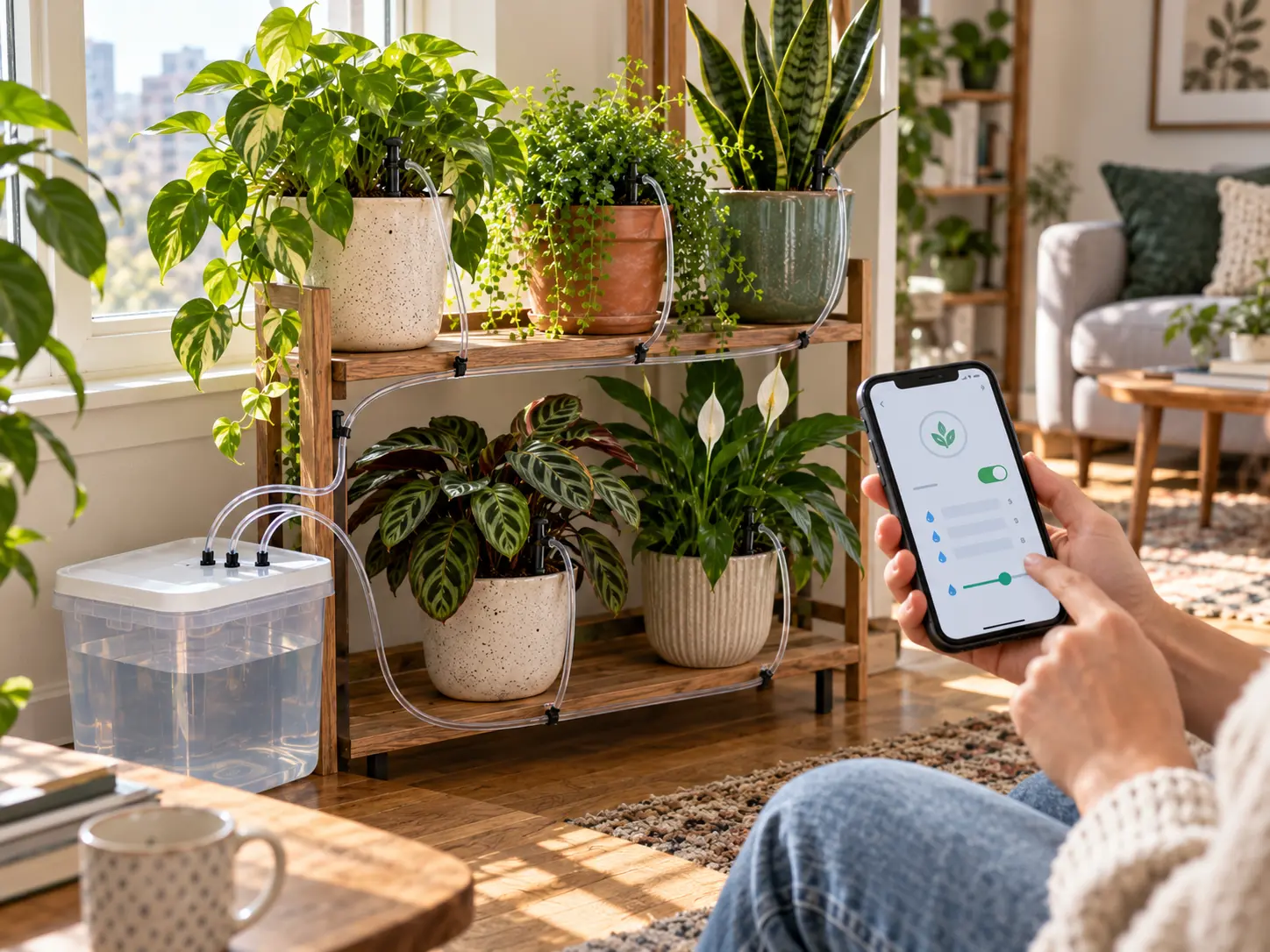
Another Smart-System Example: VIVOSUN Automatic Drip Irrigation Kit
The VIVOSUN Automatic Drip Irrigation Kit is another example of a smart multi-plant setup.
Its Amazon listing describes an app-controlled A10 GrowHub, 16 drip emitters, a 15W pump, anti-siphon components, and filtration.
It may be worth comparing with other pump-driven systems when several indoor containers are grouped together and app-based scheduling is something you expect to use.
Again, this is an example of the category rather than a claim that we have personally tested or ranked the system.
Automatic Watering System vs Self-Watering Pot
Both approaches reduce the need to manually pour water into a conventional pot, but they serve different situations.
Consider a Self-Watering Pot When:
- you are managing one plant
- you want minimal equipment
- the plant tolerates relatively consistent moisture
- you do not need programmable watering
- you would rather avoid external tubing
Consider a Multi-Plant Automatic System When:
- several containers are close together
- you want one central reservoir
- programmable watering is useful
- you want individual emitters
- you need more control than a passive reservoir provides
Neither approach is automatically better.
Choose based on the plant and the setup.
If your need is mainly temporary watering during a vacation rather than a permanent multi-plant system, simpler reservoirs, wicks, or other methods may be sufficient. Our guide to watering plants while away covers those options in more detail.
Frequently Asked Questions About Automatic Plant Watering Systems
What Is the Best Automatic Watering System for Indoor Plants?
There is no single best system for every indoor plant collection.
A self-watering pot or passive wick may be enough for one plant. Several nearby containers may be easier to manage with a programmable pump-and-drip system, while someone who values remote control may prefer a Wi-Fi model.
Plant moisture requirements should come before the number of features.
What Is the Best Automatic Watering System for Potted Plants?
For several indoor potted plants, a system with individual drip emitters can offer useful control because water can be directed into each container.
Plants with substantially different water requirements may still need separate emitter adjustments, separate watering groups, or different watering methods.
Can an Automatic Watering System Overwater Plants?
Yes.
An automatic system can overwater when it runs too frequently, supplies too much water, or keeps a plant continuously moist when that plant normally needs the root zone to dry between waterings.
Virginia Cooperative Extension notes that overwatering is closely related to watering frequency and that houseplant watering should be adjusted to plant and growing conditions.
How Many Plants Can One Automatic Plant Watering System Handle?
Follow the manufacturer’s limits, but do not treat the advertised plant count as the only factor.
The practical number also depends on:
- pump capacity
- tubing length
- emitter arrangement
- container sizes
- individual plant water requirements
A system marketed for 15 plants may still be a poor match for 15 plants with very different water needs.
How Long Can Plants Stay on an Automatic Watering System?
There is no universal number of days.
How long a setup can operate unattended depends on the water supply, reservoir capacity, number of plants, plant water use, emitter flow, power reliability, temperature, light, humidity, and whether the equipment continues operating correctly.
Test actual reservoir use instead of relying on a fixed survival estimate.
Are Automatic Plant Watering Systems Worth It?
They can be worth considering if you have several plants, find manual watering inconvenient, travel regularly, or want a central system for a group of containers.
For one or two low-maintenance plants, the added pump, tubing, reservoir, and maintenance may provide little benefit.
Choose a System That Matches Your Plants
The best automatic plant watering system for your apartment is not necessarily the one with the most emitters, the largest display, or the longest list of smart features.
Start with the plants.
Look at how many containers you need to water, how quickly their potting mix dries, whether their moisture requirements are similar, where the pots are located, what size reservoir you can accommodate, and how much maintenance you are willing to do.
Then choose the simplest system that can reliably handle those conditions.
And before trusting any automatic watering setup while you are away, test it while you are home. A few days of observation can reveal a dry pot, loose connection, unsuitable schedule, or reservoir problem before it becomes a much bigger issue.