Potting Mix for Container Vegetables: What to Use and Why
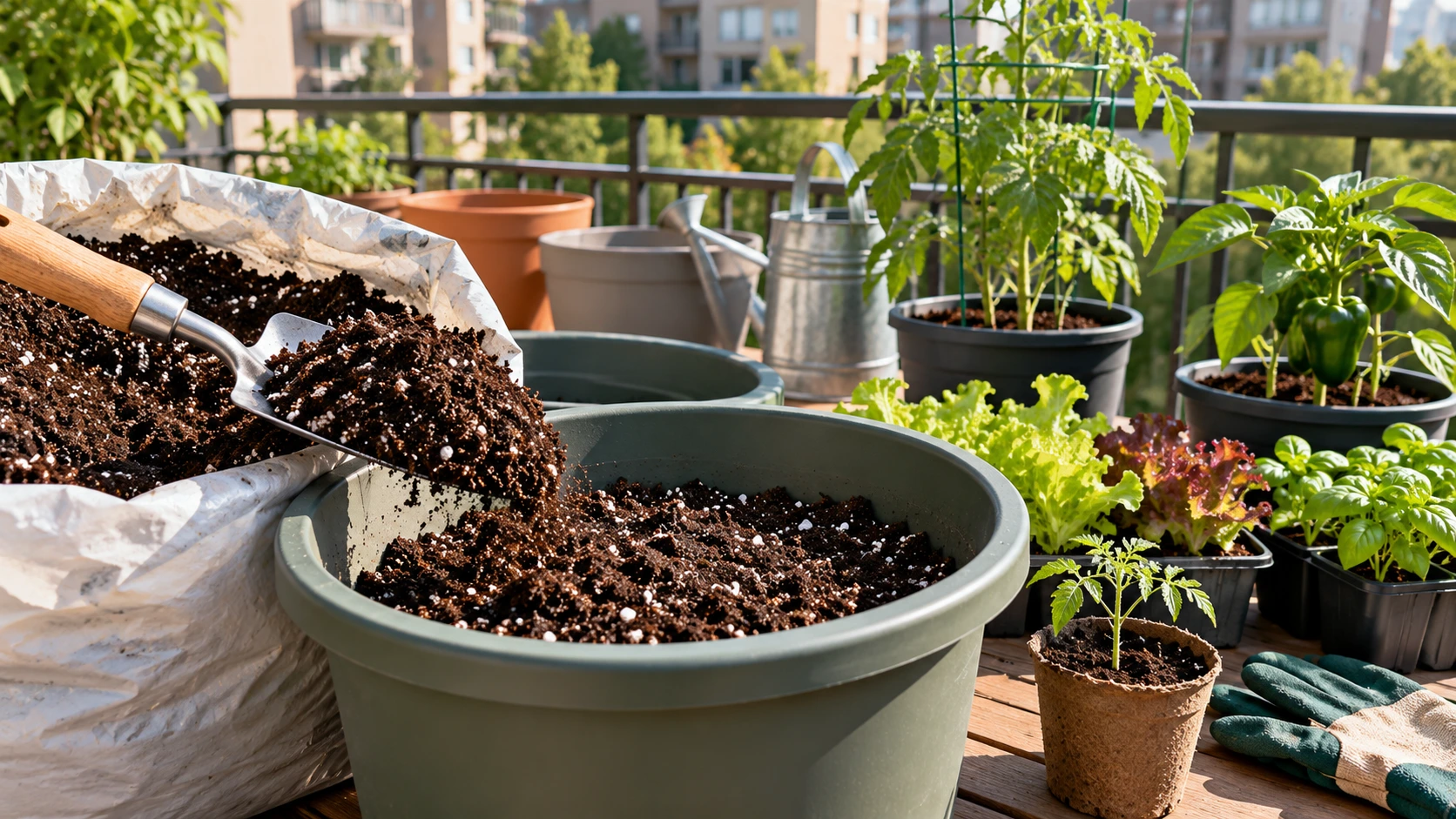
For most container vegetables, start with a lightweight potting mix made for containers rather than ordinary garden soil. The right potting mix for container vegetables should hold enough moisture for plant roots while still providing the air space and drainage that container-grown vegetables need
For beginners, a quality commercial soilless potting mix is usually the simplest choice. If you want to make or modify your own growing medium, a mixture of soilless potting mix and finished compost is another option supported by University of Maryland Extension’s container-growing guidance.
You don’t need a complicated homemade recipe or a potting mix marketed for one particular vegetable. What matters most is creating the right environment around the roots.
In This Guide
What Is the Best Potting Mix for Container Vegetables?
For most beginners, the choices can be simplified to three options:
| Option | Best use |
|---|---|
| Commercial container potting mix | Easiest choice for most beginners |
| Soilless mix + finished compost | Simple option if you already have compost or want to modify your mix |
| Ordinary garden soil | Usually avoid as the primary container medium |
If you’re buying a bag, don’t worry too much about finding one labeled specifically for tomatoes, peppers, or another individual vegetable. Instead, look for a quality mix intended for pots or containers and read the ingredient and fertilizer information on the label.
Why Container Vegetables Need the Right Growing Mix
Vegetables growing in the ground can send roots through a large volume of soil in search of water and nutrients.
A plant in a pot can’t. Its roots depend on the relatively small amount of growing medium inside the container.
That medium has to provide three basic things:
- water and nutrients;
- air and room for roots to grow; and
- enough physical support to anchor the plant.
The important part is the balance between air and water.
Water and air occupy pore spaces between particles in the growing medium. If excess water can’t drain away, those spaces stay filled with water instead of fresh air, which can deprive roots of oxygen. University of Maryland reports that high-quality potting mixes can have about 50% to 80% pore space.
That’s why “holds moisture” and “drains well” aren’t contradictory qualities.
A good vegetable potting mix does both.
Potting Mix vs. Potting Soil vs. Garden Soil
The terminology on bags isn’t always as straightforward as it sounds.
Products may be labeled potting mix, potting soil, planting mix, growing media, or something similar. University of Maryland notes that even “potting soil” is widely used as a product label for growing media that may actually be soilless.
So don’t choose a bag based only on whether it says “soil” or “mix.”
Instead, read the label and make sure the product is intended for container growing. UMass Extension’s guide to bagged potting mixes and garden soils specifically recommends checking a product’s intended use before buying it.
Why Garden Soil Usually Doesn’t Belong in Containers
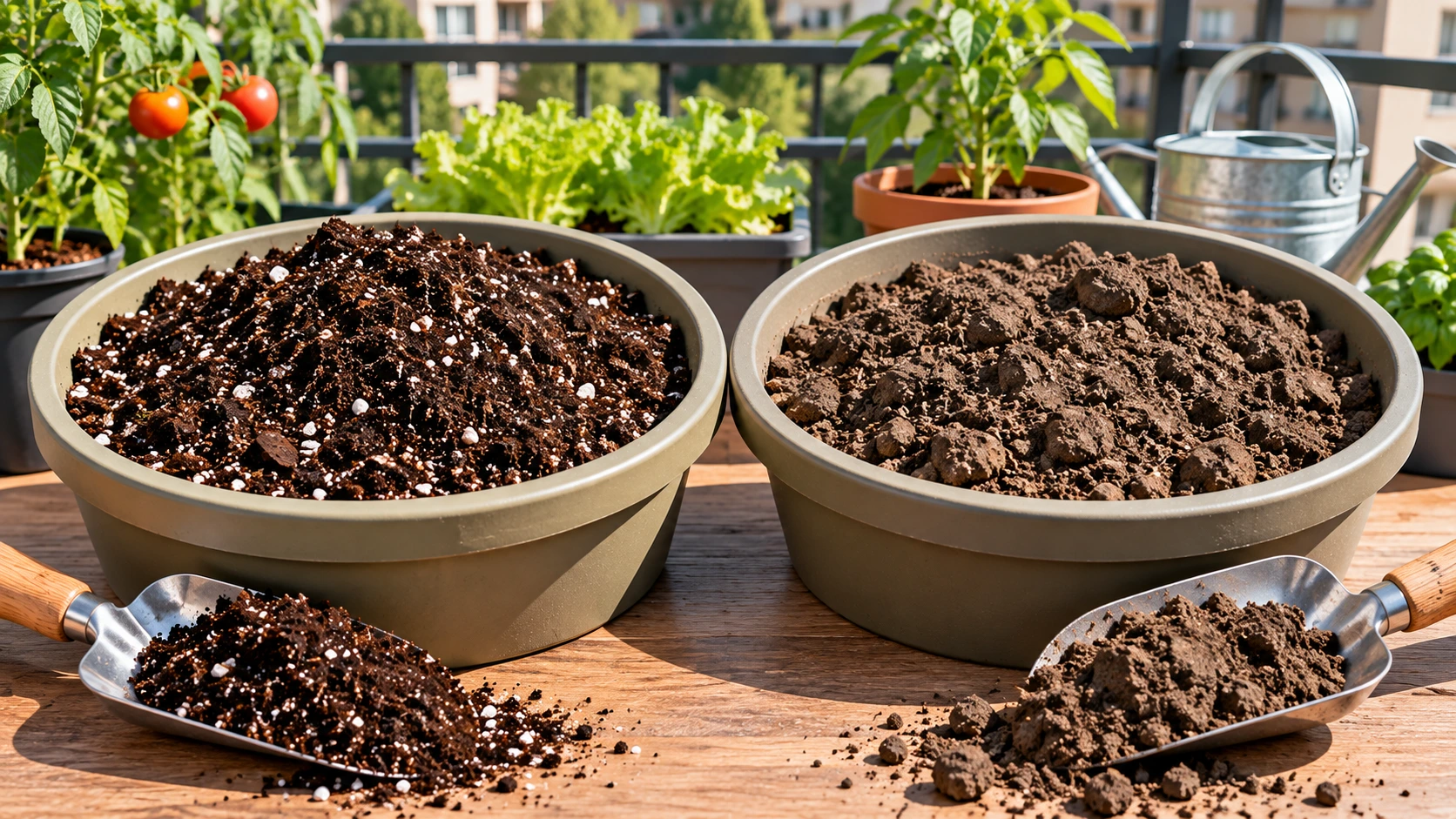
Digging soil from a yard or garden may seem like an inexpensive way to fill a vegetable pot, but soil behaves differently when confined to a container.
True soil is much denser than soilless growing media. University of Maryland gives approximate densities of 75 pounds per cubic foot for soil versus about 10 pounds per cubic foot for soilless media. Dense soil can also restrict air and water movement around roots.
Garden soil may introduce weed seeds, pests, or plant pathogens as well.
Maryland recommends that if topsoil is used at all, it should be limited to very large containers and no more than about 10% of the growing-medium volume.
The weight difference is particularly relevant in an apartment. A lightweight mix is easier to carry upstairs and makes containers easier to reposition.
For more on choosing pots and setting up a container garden, see our Apartment Container Gardening: A Beginner’s Guide.
What’s in a Good Vegetable Potting Mix?
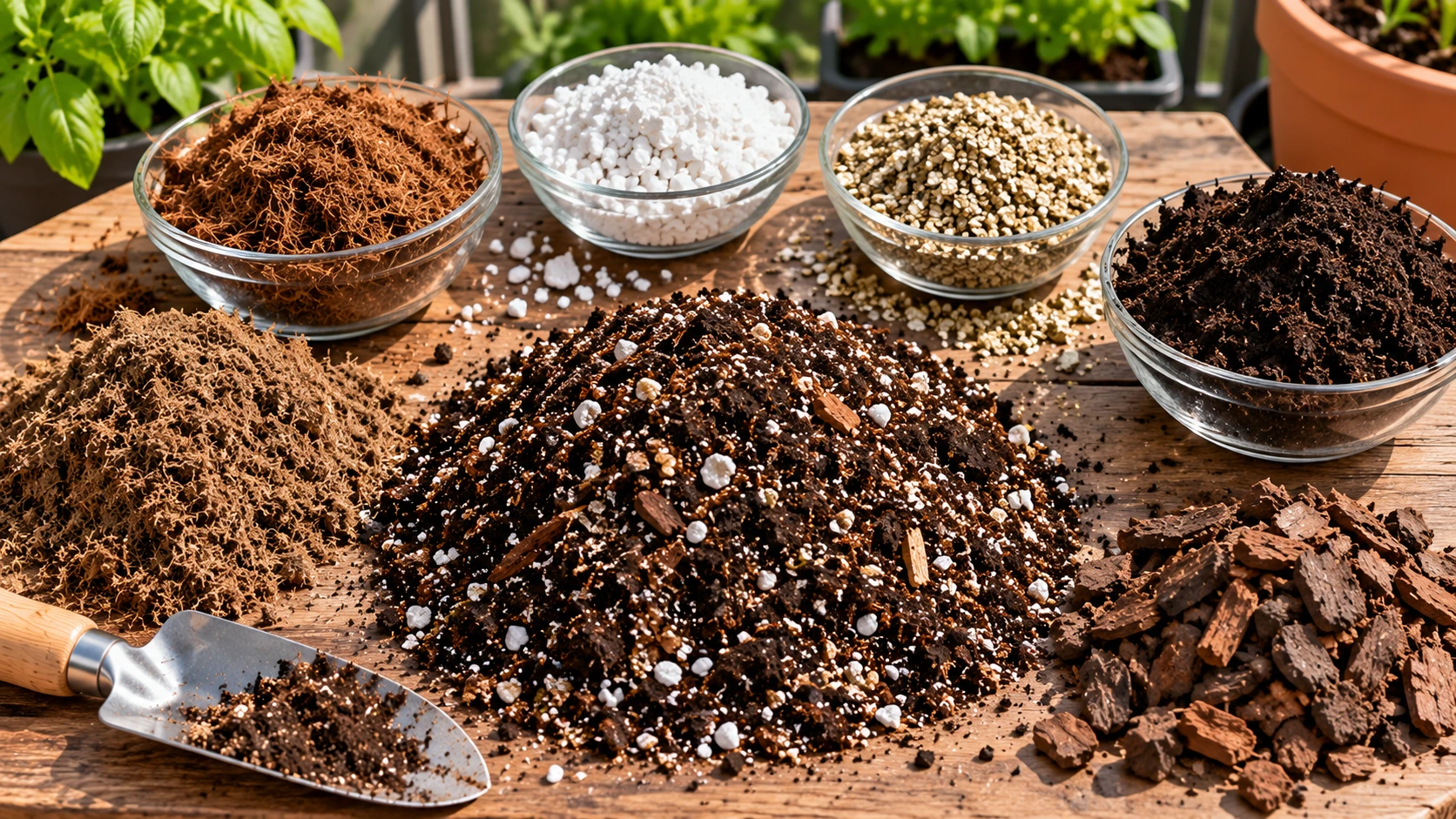
A good potting mix for container vegetables usually combines moisture-holding ingredients with materials that maintain air space around the roots. Common ingredients include peat moss or coconut coir, perlite, vermiculite, composted bark, and finished compost.
| Ingredient | What it contributes |
|---|---|
| Peat moss | Holds moisture and forms a lightweight base |
| Coconut coir | Holds moisture and can serve as an alternative to peat |
| Perlite | Adds pore space and improves aeration and drainage |
| Vermiculite | Helps retain moisture and nutrients |
| Composted bark | Adds structure and organic material |
| Finished compost | Adds organic matter and can contribute nutrients |
Peat Moss vs. Coconut Coir
Peat moss and coconut coir are both used as lightweight, moisture-holding components of potting mixes.
One practical difference appears when the mix becomes extremely dry. Peat can become hydrophobic, meaning it resists absorbing water again. Commercial peat-based mixes may therefore include a wetting agent.
Coir can serve a similar moisture-holding role.
You don’t need to choose a potting mix based solely on peat versus coir. Consider how the entire mixture is constructed.
Perlite vs. Vermiculite
Perlite and vermiculite aren’t the same ingredient.
Perlite is commonly used to improve aeration and drainage, while vermiculite can help retain water and nutrients. UMass lists both among common ingredients in soilless container media.
Seeing one or both in a vegetable potting mix is normal.
What About Compost?
Finished compost can provide organic matter and nutrients, but adding more compost doesn’t automatically create a better potting mix.
University of Maryland notes that compost can make up 50% to 100% of container volume, but compost also breaks down over time. Mixes high in compost can require more frequent watering because peat moss and coir hold water better.
We’ll look more closely at using compost alone below.
Store-Bought vs. DIY Potting Mix
Potting mix for container vegetables can be purchased ready to use or made by combining suitable growing-media ingredients at home. For apartment gardeners with only a few containers, a commercial mix is usually the more convenient option, while DIY mixing can make more sense when filling several large containers.
| Your situation | Practical starting choice |
|---|---|
| A few vegetable containers | Commercial container potting mix |
| Several large containers | Commercial or DIY mix |
| You already have finished compost | Soilless mix + compost may make sense |
| Very little apartment storage | Commercial mix |
| Reusing last year's potting mix | Refresh the old mix with fresh media and/or compost |
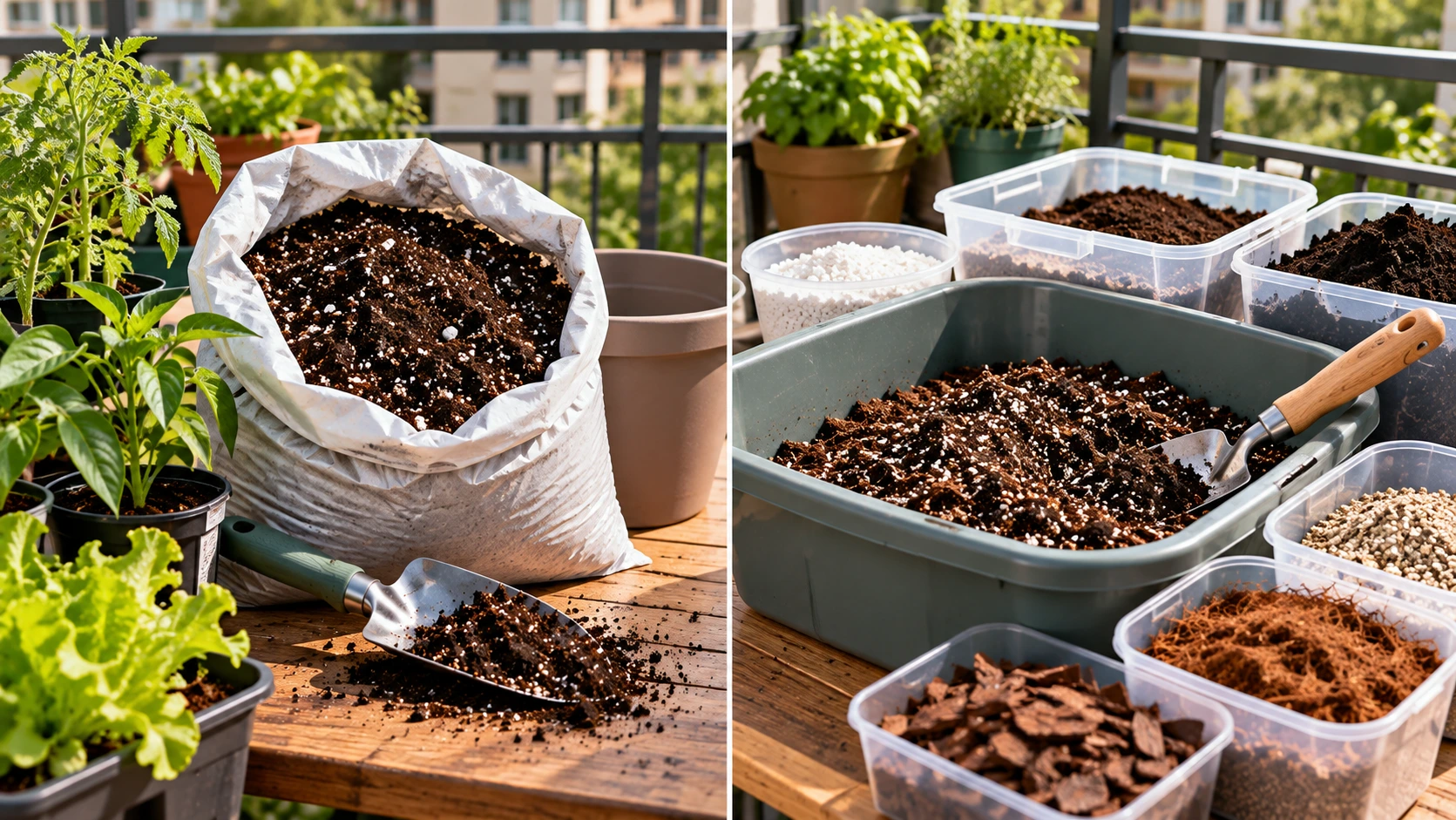
For many apartment gardeners, store-bought potting mix is the more practical option.
Making your own can mean buying and storing separate bags of peat or coir, compost, perlite, vermiculite, and other ingredients. That’s reasonable when you’re filling many containers, but less attractive if you’re growing three plants on a small balcony with nowhere to store leftovers.
One Simple DIY Option
If you already have finished compost or need to fill several containers, one straightforward Extension-supported option is:
1 part soilless potting mix + 1 part finished compost
University of Maryland lists a 50% soilless mix and 50% compost combination among suitable growing media for container vegetables. It also lists 100% soilless mix and 100% compost as workable options.
Treat 50/50 as one workable starting point, not a universal recipe.
Commercial potting mixes vary substantially, so always check what your starting mix already contains before adding other ingredients.
Can You Grow Container Vegetables in Compost Alone?
Yes. The common advice that vegetables can never be grown in straight compost is too absolute.
University of Maryland lists 100% finished compost as one viable container-growing medium.
That doesn’t necessarily make it the easiest choice for every beginner.
Compost characteristics vary, and compost continues to physically break down over time. That can reduce pore space. Maryland also notes that peat moss and coir hold water better than compost, so media containing a high percentage of compost may need more frequent watering.
For someone starting their first apartment vegetable garden, a quality commercial container mix is generally the simpler starting point. Mixing soilless media with finished compost is another straightforward option.
How Much Potting Mix Do You Need?
Potting mix is normally sold by volume, so compare the volume of your containers with the cubic-foot amount printed on the bag.
As a useful benchmark, University of Maryland says a 2-cubic-foot bag of potting mix will fill approximately three 5-gallon buckets or grow bags.
So, as a rough planning estimate:
Three 5-gallon containers: about one 2-cu.-ft. bag
Six 5-gallon containers: about two 2-cu.-ft. bags
Actual amounts will vary with container dimensions and how high you fill them.
Volume isn’t the only consideration. Different vegetables also need enough depth for their root systems. Our guide to how deep containers need to be for vegetables explains that separately.
How to Put Potting Mix in a Vegetable Container
Once you’ve selected your mix, four simple practices can help preserve the characteristics you bought it for.
1. Pre-Moisten Very Dry Potting Mix
This is particularly helpful with peat-containing media.
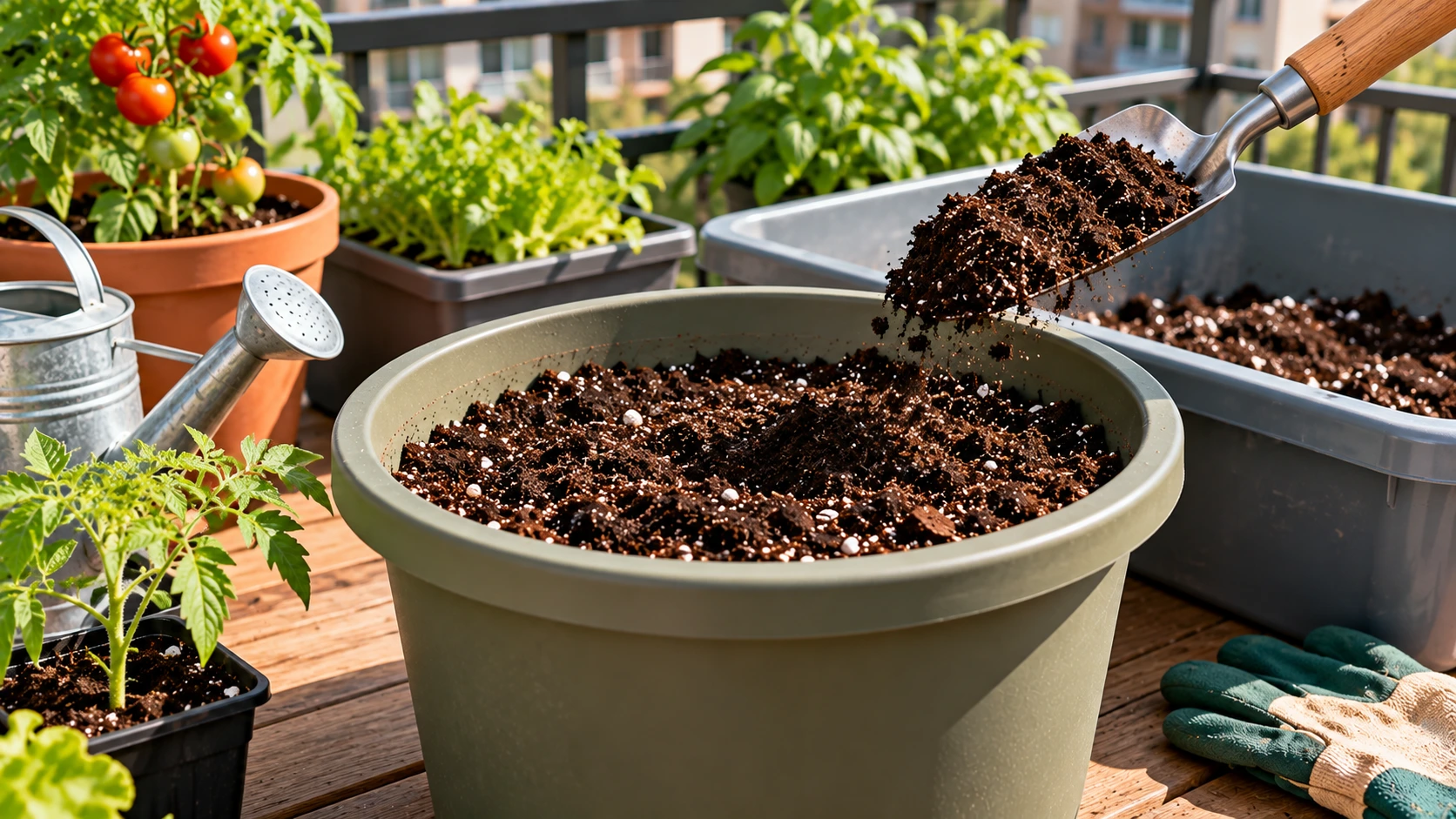
University of Maryland recommends gradually working water into dry media until it’s uniformly moist—roughly comparable to a wrung-out sponge—before filling the container. A large tub makes the process easier.
For an apartment gardener, a storage tote can also help keep loose potting mix contained while you work.
2. Don’t Add Rocks to Improve Drainage
Putting gravel, rocks, or broken pot pieces at the bottom of a planter does not improve drainage.
Maryland’s current guidance says these materials consume space needed for root growth and can actually worsen drainage.
Adequate drainage holes are what matter.
3. Don’t Pack the Potting Mix Tightly
Fill the container loosely enough for the growing medium to remain airy.
Packing it tightly works against the pore space you’re trying to preserve.
4. Leave Space Below the Rim
Stop filling about an inch below the top of the container.
That gives irrigation water room to collect temporarily and soak into the mix rather than immediately washing potting mix over the edge.
Can You Reuse Potting Mix for Vegetables?
Yes, in many cases.
This can be especially useful in an apartment where carrying new bags upstairs and storing unused potting mix may be inconvenient.
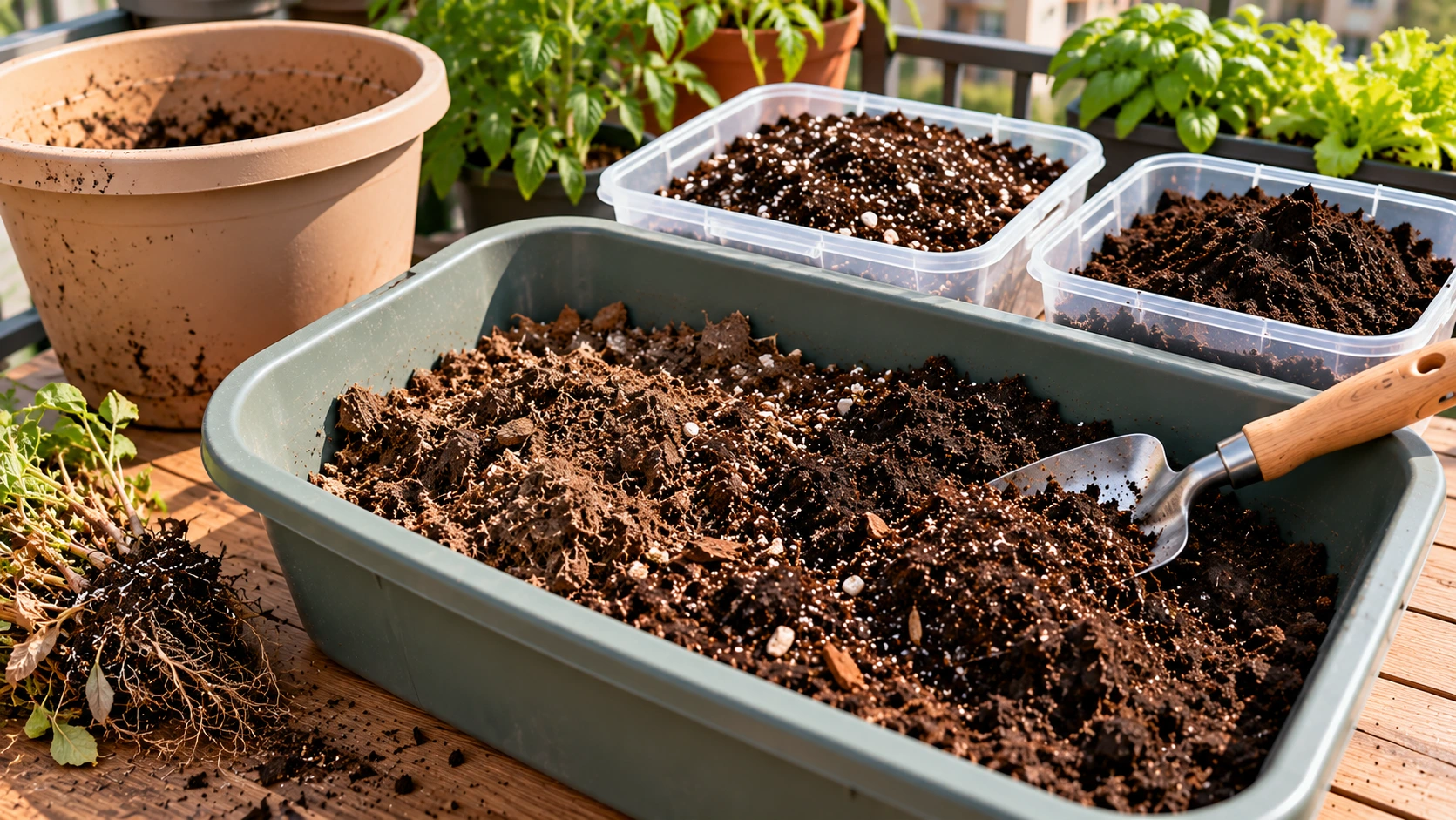
Don’t save old media if root disease was a problem. Otherwise, remove the old plant material before storing the used mix.
Potting media gradually break down, lose nutrients, and become less porous. University of Maryland recommends one straightforward way to refresh it: combine last year’s growing media in approximately equal amounts with fresh growing media and/or compost.
That doesn’t mean every reused container needs an identical formula. The condition of the old medium matters.
It also doesn’t replace fertilizer indefinitely. Used media will have depleted nutrients.
Avoid These Common Potting Mix Mistakes
Avoid using dense garden soil as your primary container medium, packing potting mix tightly, adding rocks as a supposed drainage layer, overlooking fertilizer already included in a commercial mix, or letting a peat-heavy mix become extremely dry.
One point is especially easy to miss: check the fertilizer information on the bag before adding more.
Some commercial mixes contain a starter fertilizer or controlled-release fertilizer. UMass recommends adjusting your fertilization practices accordingly, while Illinois Extension notes that mixes without fertilizer may require it to be added.
Choosing Potting Mix for an Apartment or Balcony Garden
The horticultural requirements don’t suddenly change because your vegetables are growing at an apartment, but the practical considerations often do.
Weight Matters
Soilless media are much lighter than true soil. That makes bags easier to carry and filled containers easier to reposition.
If you’re gardening on a balcony, lightweight potting mix doesn’t make every setup structurally appropriate. Follow your building’s rules and any applicable load restrictions.
Consider Storage Before Making Your Own Mix
A DIY recipe may sound inexpensive until you realize it requires several partially used bags that need somewhere to live.
For a small garden, one commercial container mix may be more practical than storing separate bags of compost, coir or peat, perlite, and vermiculite.
Contain the Mess
A large plastic storage tote makes a useful temporary mixing area. You can pre-moisten dry media and fill pots inside the tote instead of spreading loose potting mix across a balcony or apartment floor.
Buy Only What You Can Use or Store
Estimate the volume you need before buying.
If you need slightly more than one bag, consider where the remainder will be kept before opening it. Keep unused media appropriately contained and follow the manufacturer’s storage instructions.
Once your pots are filled, placement becomes the next issue.
Frequently Asked Questions
Can I Use Regular Potting Mix for Vegetables?
Yes. A quality general-purpose potting mix intended for containers can work well for most vegetables.
Check the label for its ingredients and whether fertilizer is already included. University of Wisconsin Extension notes that commercial potting mixes work well for most vegetables and recommends reading the label to determine their composition.
Can I Use Raised-Bed Soil in Containers?
Don’t assume that a product designed for raised beds will perform like container potting mix.
Containers need growing media that maintain adequate air and drainage within a confined space. Read the product label to see whether the manufacturer also recommends it for pots or containers. UMass Extension specifically distinguishes between products intended for in-ground gardening and those formulated for container plants.
Should I Add Fertilizer to Potting Mix for Vegetables?
It depends on what’s already in the bag.
Some commercial mixes contain fertilizer; others don’t. Illinois Extension notes that fertilizer may need to be added when it isn’t included in the potting mix.
Check the label before adding anything.
Do Tomatoes Need Special Potting Mix?
Not necessarily.
Tomatoes need enough root space and a container medium that provides good aeration, drainage, moisture, and nutrients, but you don’t have to buy a bag labeled specifically for tomatoes.
Container size is a separate consideration. Current Maryland guidance lists about 5 gallons for a standard tomato plant, while smaller varieties may use less space.
For other crops, see What Vegetables Can You Grow in a 5-Gallon Bucket?.
Bottom Line
For most beginners, the best potting mix for container vegetables is a lightweight growing medium designed for containers rather than ordinary garden soil. A quality commercial mix is the easiest starting point, while a soilless mix combined with finished compost is another practical option.
A soilless potting mix can work on its own, while a combination of soilless mix and finished compost is another Extension-supported option. Ordinary garden soil generally shouldn’t be the primary growing medium, and adding rocks to the bottom of a container doesn’t improve drainage.
Getting the growing medium right is only one part of successful container vegetable gardening. For the complete setup—from choosing crops and containers to light and ongoing care—continue with our Apartment Vegetable Gardening: A Beginner’s Guide