Container Vegetable Garden Layout: How to Arrange Your Pots
A good container vegetable garden layout starts with growing conditions, not appearance. First, identify the parts of your space that receive the most usable direct sunlight. Place your highest-light vegetables there, then arrange the remaining containers according to each plant’s mature size and support needs. Position tall crops and trellises where they won’t unnecessarily shade shorter sun-loving vegetables.
Finally, make sure every container is practical to maintain. Leave enough room to check the potting mix, water, harvest, and tend the plants. On an apartment balcony, also consider wind exposure, reflected heat, container weight, and where excess water will drain before filling large pots and putting them in place.
In This Guide
Container Vegetable Garden Layout at a Glance
| Plan for | How It Affects Your Layout |
|---|---|
| Direct sunlight | Put crops that need the most sun in the brightest usable locations |
| Mature plant size | Plan for the plant's eventual height and spread, not its size when planted |
| Tall crops and supports | Position trellises and tall plants so they don't unnecessarily shade shorter sun-loving crops |
| Container size | Allow enough floor space for the container size the mature crop requires |
| Watering access | Keep containers reachable for moisture checks and thorough watering |
| Similar water needs | Group containers with similar moisture needs when their light requirements also match |
| Plant spacing | Allow for mature plant spread instead of arranging pots based only on young plant size |
| Wind and heat | Account for exposed areas and heat reflected from walls and hard surfaces |
| Drainage | Decide where excess water will go before positioning containers |
| Balcony weight | Check applicable building rules or load restrictions before grouping large, heavy containers |
1. Start Your Container Vegetable Garden Layout With Sunlight
Sunlight should be one of the first things you consider because moving a pot even a few feet can change how much useful direct light the plant receives.
According to University of Maryland Extension’s container vegetable guidance, warm-season crops such as tomatoes, peppers, eggplant, and squash generally need 6 to 8 hours of direct sunlight. Cool-season crops such as lettuce, spinach, and Asian greens can grow with about 3 to 5 hours.
That doesn’t mean every container needs the sunniest location. Instead, reserve your strongest-light areas for vegetables that need them most and use less-sunny areas for crops suited to those conditions.
Map the Sun Before Moving Your Containers
Don’t plan your garden based only on whether your balcony faces north, south, east, or west.
Buildings, balcony overhangs, walls, railings, trees, and neighboring structures can create shade that changes throughout the day. Southern and western exposures tend to be sunnier and warmer, while northern and eastern exposures tend to be shadier and cooler, but the actual conditions in your growing space matter more than the compass direction alone.
Before finalizing your layout, watch the space at different times of day and note where direct sunlight actually reaches your containers.
If you’re not sure how much usable light your space receives, start by determining how much sun your balcony garden gets before deciding where individual containers should go.
2. Plan for the Mature Size of Each Vegetable
One of the easiest layout mistakes to make is planning around what the garden looks like on planting day.
A young tomato transplant, cucumber seedling, or squash plant may occupy very little space at first. As it matures, its leaves and stems can extend well beyond the edge of its container.
Design for the mature plant, not the seedling.
Before placing a pot, consider three dimensions:
- the container’s footprint,
- the plant’s expected height,
- and the plant’s mature spread.
That gives you a much more realistic idea of how crowded the garden could become later in the season.
Match the Container to the Crop
Different vegetables need different amounts of root space, so their containers can take up very different amounts of room. A pot for a compact leafy crop may occupy much less floor space than one intended for a mature tomato, squash, or another larger vegetable. University of Maryland Extension recommends matching container size to both a plant’s top growth and root system.
Choose the container for the crop first, then account for that container’s actual footprint when planning the layout.
Container depth and overall volume vary by crop, so check how deep containers need to be for vegetables before finalizing how much floor space each pot will occupy.
If 5-gallon containers are part of your plan, compare vegetables you can grow in a 5-gallon bucket before deciding how many buckets your layout needs.
Avoid Overcrowding Mature Plants
More containers do not automatically make a more productive vegetable garden.
University of Maryland Extension’s guidance on container-grown vegetables recommends following the crop’s planting and spacing guidance and thinning seedlings as necessary to leave room for plants to mature.
That doesn’t mean every pot needs to be a certain number of inches from the next one. There is no universal spacing rule for all vegetable containers.
Instead, use the recommended spacing and expected mature spread of the crop or cultivar you’re growing. Leave enough room for mature foliage without unnecessarily crowding neighboring plants or blocking access.
3. Position Tall Vegetables and Trellises Carefully
Tomatoes, cucumbers, pole beans, and other tall or climbing vegetables can make good use of limited space, but they can also change how much light reaches everything around them.
Illinois Extension’s guidance on growing vegetables in containers recommends moving containers to locations appropriate for the plants’ sunlight requirements and provides staking and caging guidance for crops that need support.
Plan those supports as part of the layout instead of waiting until the plants have already filled the space.
Keep Tall Plants From Shading Sun-Loving Crops
You’ve probably seen garden-layout advice that says to put tall plants in the back and short plants in the front.
For a container garden, that rule is too simple.
The correct position depends on where direct sunlight enters your space. A tomato or cucumber trellis in the wrong location can cast shade across shorter peppers or other sun-loving crops for part of the day.
Instead, position tall crops and supports where their mature growth will not unnecessarily block direct sunlight from shorter crops that also need strong light.
Use Vertical Space Without Blocking Access
Vertical growing can help you use a small space efficiently without filling every inch of floor space with pots.
Cucumbers, pole beans, peas, tomatoes, and other vegetables with climbing or supported growth habits can take advantage of stakes, cages, or trellises when those supports are appropriate for the crop.
But vertical space isn’t truly useful if the arrangement makes routine plant care difficult.
Make sure you can still reach the plants to train vines, inspect growth, water, and harvest. A good container vegetable garden design uses height without turning the garden into an inaccessible wall of foliage.
Example 1: Small Container Vegetable Garden Layout
For a narrow apartment balcony, start with the brightest usable area rather than automatically lining every pot against the railing.
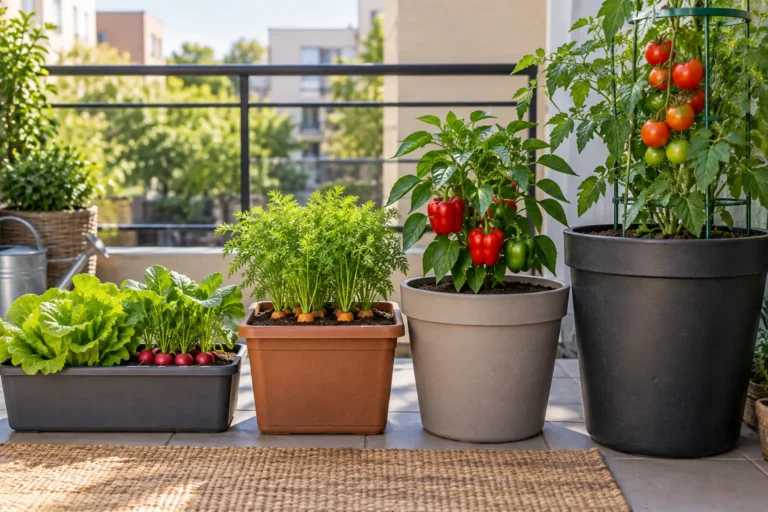
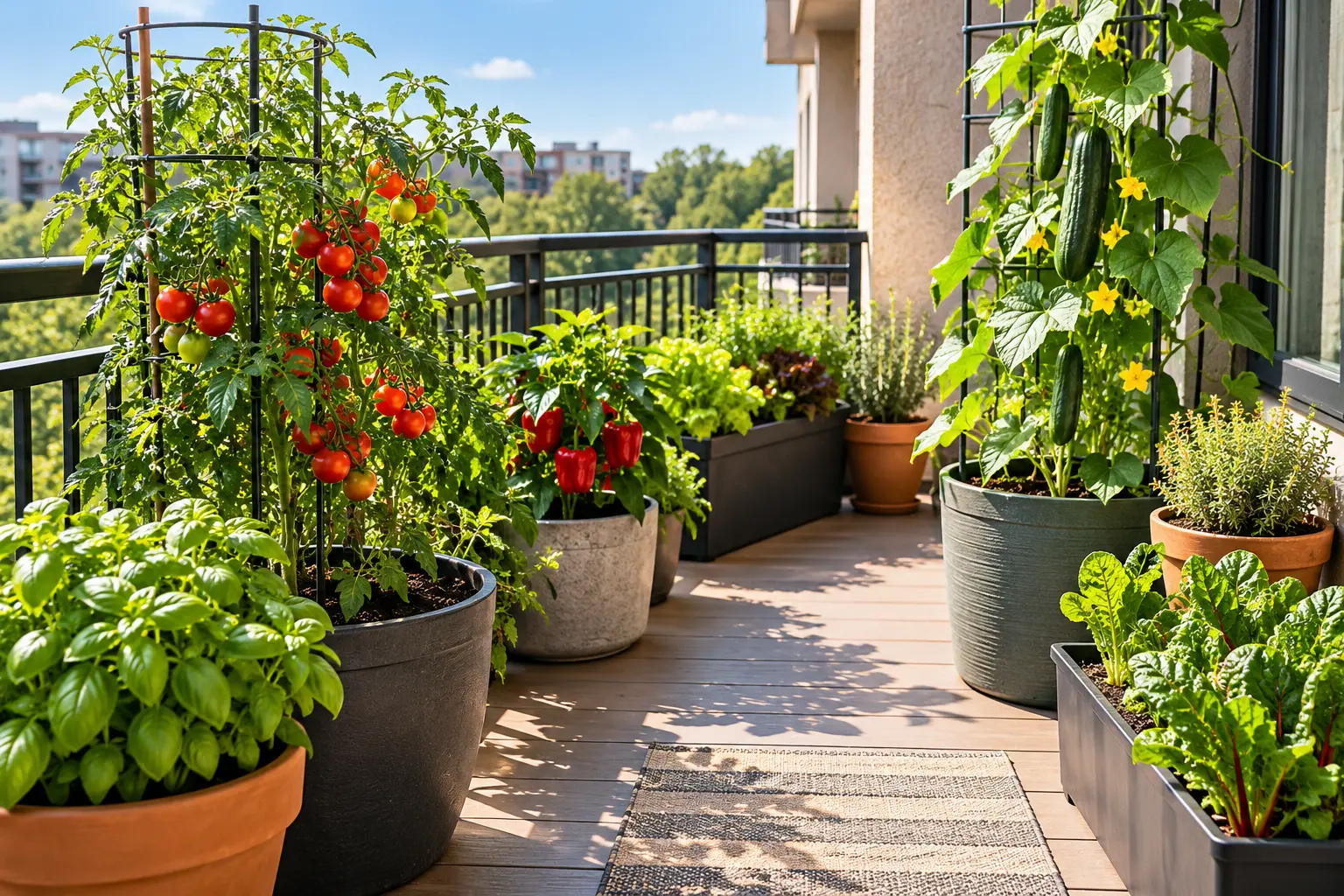
One possible small container vegetable garden layout might place a supported tomato and pepper in the strongest-light zone, shorter crops in nearby sunny locations, and leafy greens in an area that receives less direct sun when those conditions suit the crop.
A cucumber or pole bean could use vertical space if its support is positioned so the mature plant doesn’t create unnecessary shade across the rest of the garden.
| Layout Zone | Example Use |
|---|---|
| Brightest area | Tomato, pepper, or another high-light crop |
| Vertical-support area | Cucumber or pole bean where the support won't block needed light |
| Open sunny area | Shorter sun-loving vegetables |
| Lower-light usable area | Leafy greens when light conditions are suitable |
| Access area | Keep open for watering, harvesting, and plant care |
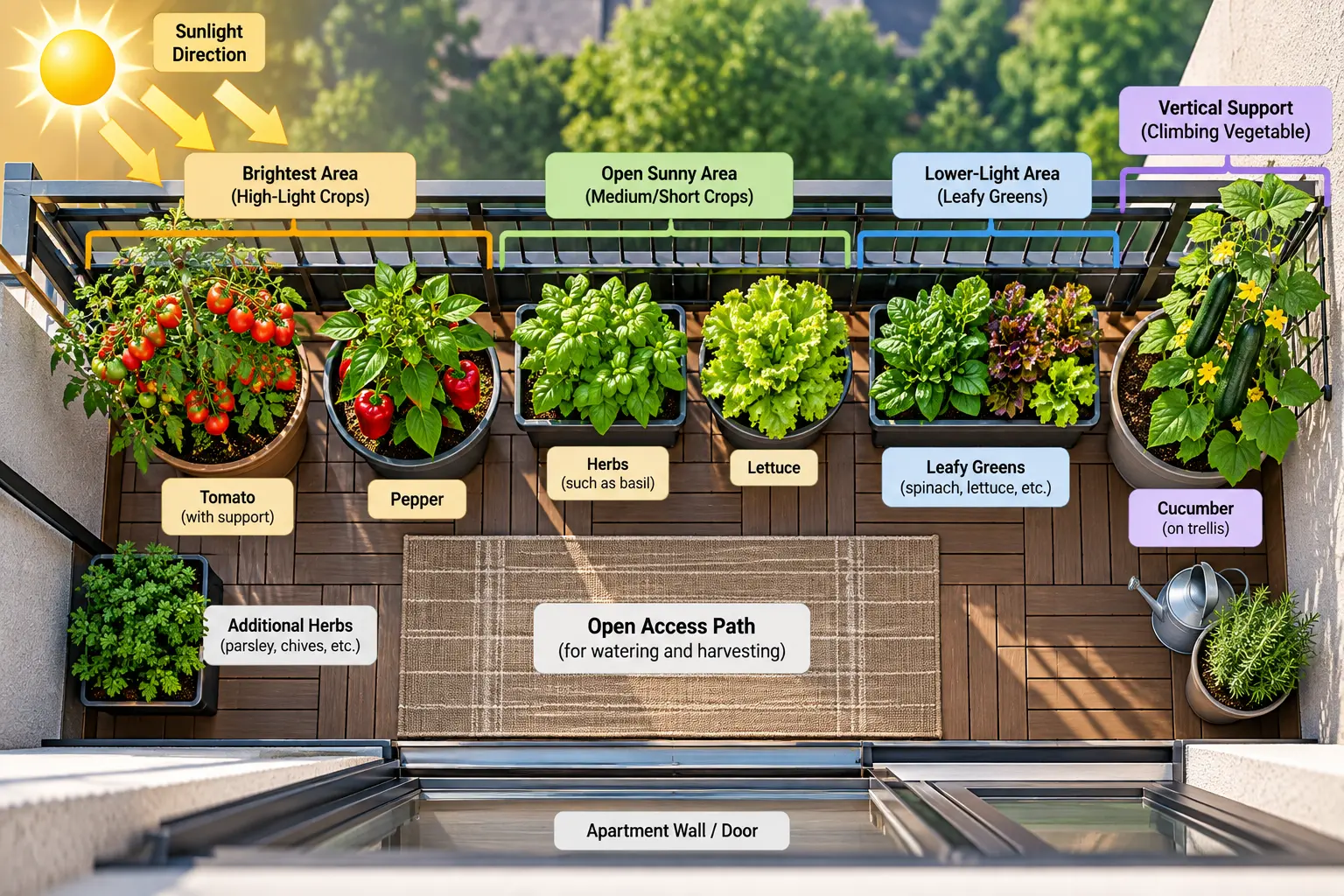
The diagram should show the direction of incoming sunlight, taller supported vegetables, shorter vegetables, container footprints, and a clear access area.
Treat this as an example rather than a universal plan. Rotate or rearrange the layout according to where direct sunlight actually enters your growing space.
4. Leave Room to Water, Harvest, and Maintain Your Plants
A layout can look efficient on paper and still be frustrating to use.
If reaching the back containers requires moving several heavy pots every time you water or harvest, the arrangement probably isn’t practical.
University of Maryland Extension emphasizes easy access to water when choosing a location for container vegetables and notes that some containers may need daily watering during hot, dry weather. University of Maryland Extension
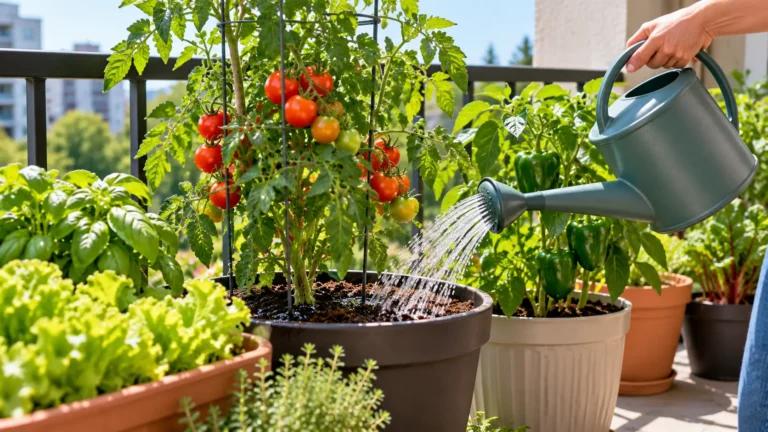
Try to keep the surface of each container accessible enough to check the potting mix before watering. You should also be able to reach vegetables for harvesting and routine plant care without damaging neighboring foliage.
Group Compatible Containers When It Makes Sense
Grouping containers can make maintenance easier, particularly when plants have similar moisture requirements.
Maryland Extension recommends grouping herbs with similar growing needs and notes that containers can be moved to find appropriate sunlight. The broader principle is useful when arranging a container garden: group compatible plants when doing so doesn’t compromise their light requirements.
Light requirements should still come first. Don’t move a sun-loving vegetable into an unsuitable shady location simply because it needs water at roughly the same time as another plant.
Sun, heat, wind, plant size, and container size can all affect watering frequency, so use the potting mix rather than the layout alone to determine how often you should water balcony plants.
Example 2: Sunny Container Vegetable Garden Layout
In a sunny space, the main layout challenge may not be finding enough light—it may be preventing tall plants from taking that light away from their neighbors.
Start by identifying the direction from which the strongest direct sunlight reaches the garden. Then consider where shadows from mature tomatoes, trellises, cages, and climbing vegetables are likely to fall.
Place tall supported crops where they can receive the light they need without creating unnecessary prolonged shade across shorter sun-loving vegetables.
A simple sunny layout might include taller supported crops in one zone, medium-height vegetables such as peppers in open sunny locations, and shorter crops positioned outside the strongest shade cast by the taller plants.
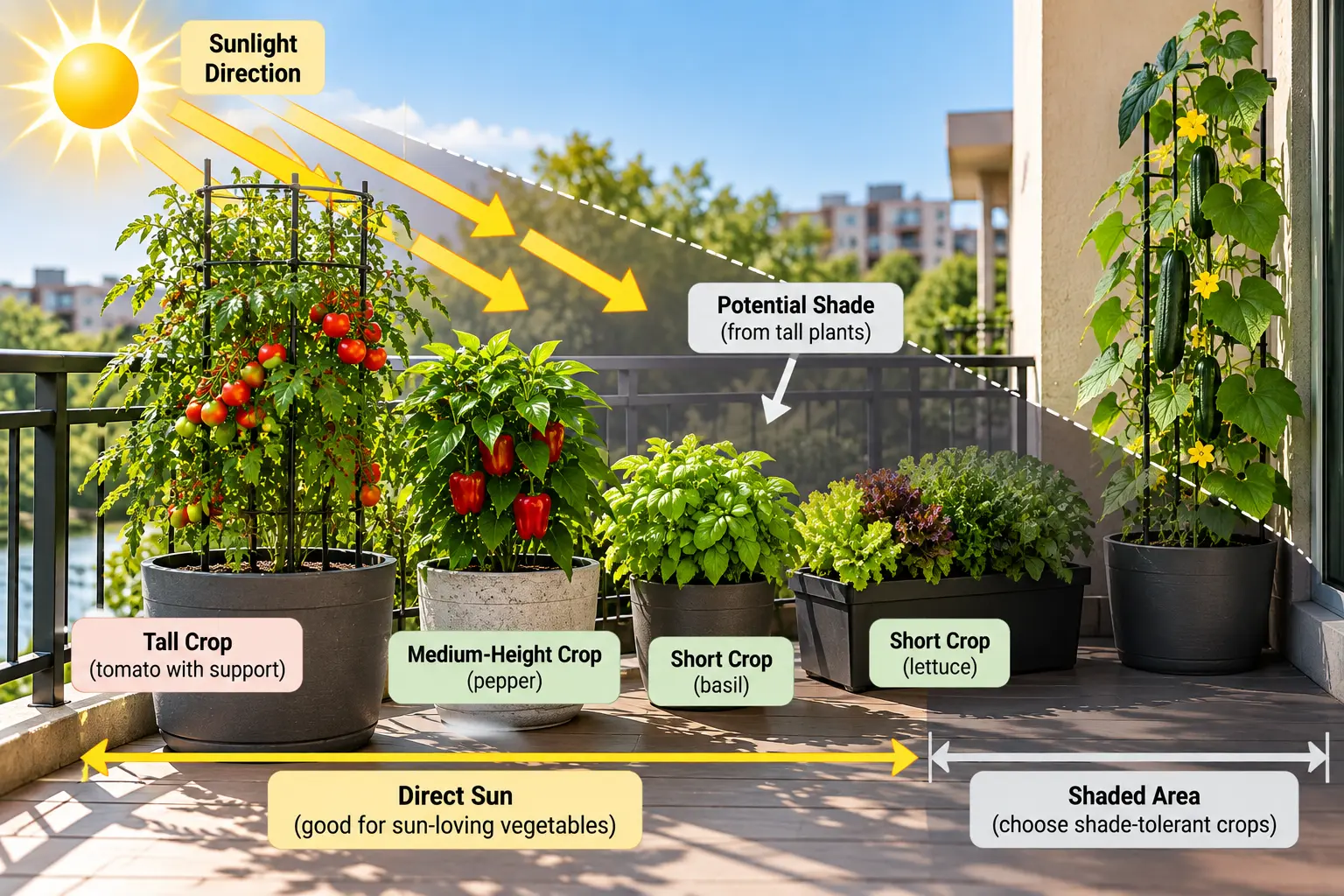
This diagram should show the direction of incoming sunlight and the approximate shade created by a mature tall crop or trellis. The purpose is to demonstrate why sunlight direction is more useful than automatically following a “tall plants in back” rule.
5. Account for Wind, Reflected Heat, and Microclimates
Two containers on the same balcony can experience surprisingly different conditions.
One might sit beside a hot wall in strong afternoon sun while another is shaded by an overhang. A pot near the outer edge of a balcony may also experience more wind than one closer to the building.
Your vegetable container garden layout should account for those differences rather than treating the entire space as one uniform growing environment.
Watch for Hot Walls and Hard Surfaces
Brick, stone, concrete, blacktop, decking, metal, and other hard surfaces can absorb or reflect solar radiation and increase temperatures around container plants, according to University of Maryland Extension.
That matters on balconies and patios, where containers are often surrounded by hard surfaces.
Pay attention to plants near especially hot walls or floors. If a particular location becomes more stressful as temperatures rise, one advantage of container gardening is that movable pots can sometimes be repositioned.
Consider Exposed and Windy Locations
Wind can affect your layout too.
Iowa State University Extension’s Container Vegetable Gardening guide explains that container vegetables can dry quickly in sun and wind.
Wind exposure is particularly worth considering for tall or top-heavy vegetables. Choose stable containers and appropriate supports, and don’t assume the most exposed location is automatically the best choice simply because it receives plenty of sun.
6. Plan for Drainage Before You Place the Pots
Containers need adequate drainage, but in an apartment garden you also need to think about what happens after the water leaves the pot.
University of Maryland Extension recommends adequate drainage holes or slits so excess water can escape and specifically discusses the importance of container drainage when choosing and setting up pots.
Before filling your containers, ask:
- Where will excess water drain?
- Could it run across a walking area?
- Could it drip onto a balcony below?
- Do you need a saucer or another way to manage runoff?
If you use saucers, check them regularly and empty excess water as needed rather than allowing pots to remain in standing water.
It’s much easier to solve drainage and runoff problems while planning the layout than after a large container has been filled, planted, and watered.
7. Consider Weight Before Grouping Large Containers
Large containers can become much heavier than they appear when empty.
University of Maryland Extension cautions gardeners to consider the weight of containers and growing media when planning container gardens. Its container guidance also emphasizes matching container size and stability to the mature plant.
The important point is that general container-gardening guidance does not provide a safe balcony load limit, and you shouldn’t try to calculate one from the weight of an individual pot.
If you’re gardening on a balcony, check your lease or property rules and any applicable load restrictions before concentrating multiple large containers in one area. Ask the property owner or building management when appropriate, and seek qualified structural guidance when necessary.
Weight is also a practical issue. Once a large container is filled and watered, changing your vegetable container garden layout can be much harder than rearranging empty pots.
Example 3: Vertical Container Vegetable Garden Layout
A vertical layout uses height to reduce the amount of floor space occupied by sprawling growth.
For example, a supported cucumber or pole bean can occupy a vertical zone while shorter crops use appropriately lit floor space nearby. One or two larger floor containers can anchor the arrangement without filling every available area with pots.
The support still needs to be positioned so its mature foliage doesn’t create unwanted shade or make neighboring containers difficult to reach.
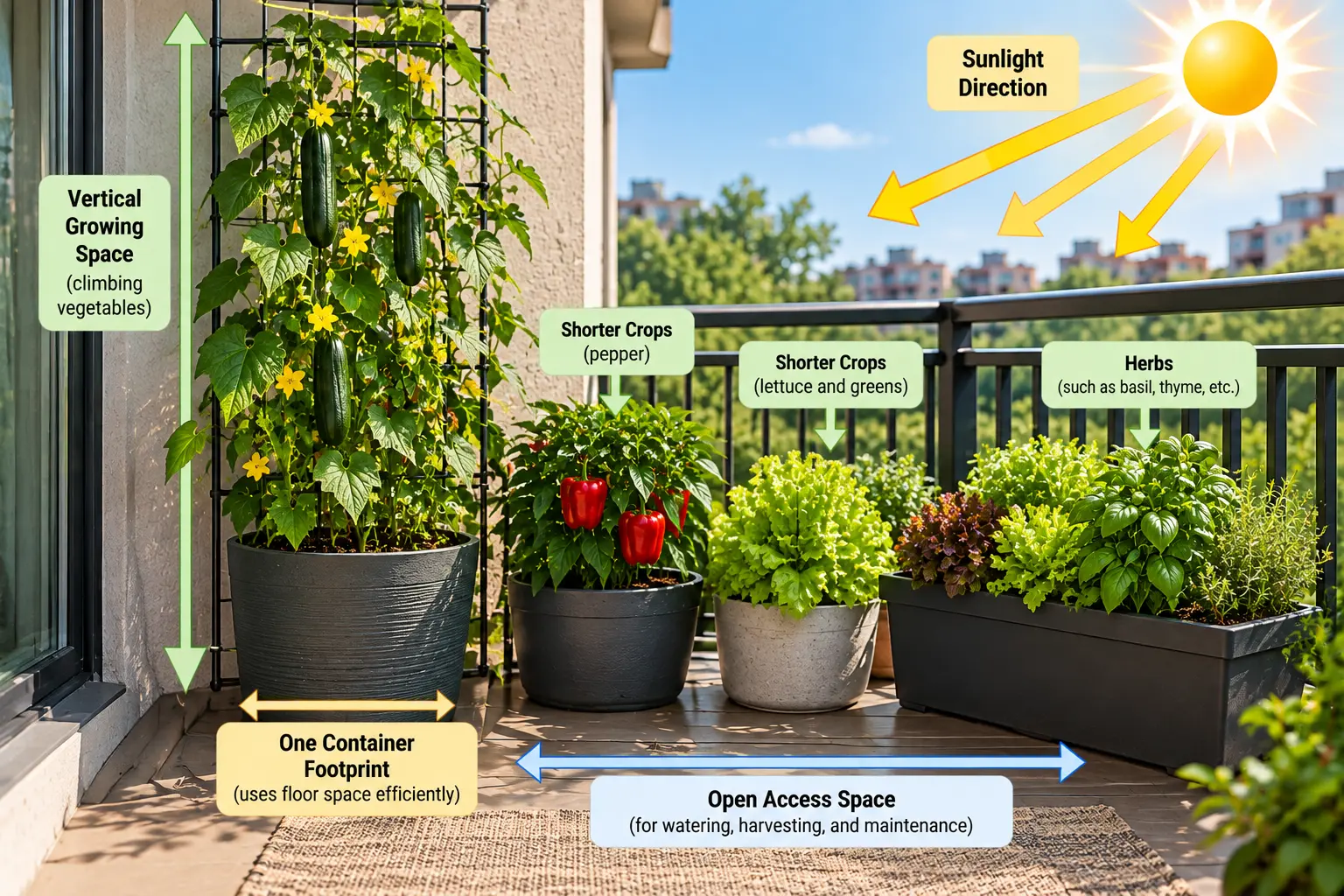
This diagram should emphasize the difference between vertical growing space and the containers’ floor footprint. It should also show sunlight direction and enough open space to reach the plants.
The goal isn’t to squeeze the maximum number of vegetables into the smallest possible area. It’s to use height without creating new problems with shade or maintenance.
8. Adjust Your Layout as the Garden Grows
Your first arrangement doesn’t have to be permanent.
One advantage of growing vegetables in containers is the ability to reposition movable pots when conditions or plant needs change. University of Maryland Extension specifically identifies portability and the ability to adjust light exposure as advantages of container gardening.
Reassess the layout as the garden develops. You may discover that a tomato has grown into a neighboring plant’s space, a trellis is creating more shade than expected, one corner becomes much hotter during summer, or a frequently harvested crop is difficult to reach.
When it’s practical and safe to do so, repositioning a container may be easier than forcing an arrangement that no longer works.
If you’re planning the entire growing space rather than just arranging individual pots, our guide to starting an apartment balcony vegetable garden covers the broader process of choosing crops, containers, and a workable setup.
Frequently Asked Questions About Container Vegetable Garden Layouts
How Do You Lay Out a Container Vegetable Garden?
Start by mapping the direct sunlight in your growing space. Place vegetables according to their light requirements, then account for mature plant size, container footprint, trellises or supports, watering and harvesting access, drainage, and local conditions such as wind or reflected heat.
Don’t arrange the garden only around how small the plants are when you first plant them.
What Is the Best Layout for a Small Container Vegetable Garden?
There isn’t one layout that works for every small space.
The best layout puts each vegetable in suitable light while providing enough room for its mature growth and container. Tall plants and trellises should be positioned so they don’t unnecessarily shade shorter sun-loving vegetables, and containers should remain accessible for routine care.
For very limited floor space, vertical supports can help when they’re appropriate for the crop.
How Far Apart Should Vegetable Containers Be?
There is no universal spacing distance between vegetable pots.
Spacing depends on the mature spread of the vegetables you’re growing, the number of plants in each container, the crop or cultivar’s recommended spacing, and how the arrangement affects light and access.
Rather than automatically leaving the same number of inches between every pot, plan around the mature plants.
Should Tall Vegetable Plants Go Behind Shorter Plants?
Not necessarily.
“Behind” only works when it makes sense relative to the direction of sunlight. A tall tomato or trellis placed on the wrong side of a small garden can shade shorter vegetables that also need strong direct light.
Position tall plants according to the actual path of sunlight through your space so their mature growth doesn’t unnecessarily block light from neighboring crops.
The Bottom Line
A good container vegetable garden layout starts with sunlight and plans for what each plant will become, not what it looks like on planting day. Give high-light crops the brightest usable locations, position tall plants and trellises so they don’t unnecessarily shade their neighbors, and leave enough access to care for every container.
On an apartment balcony or patio, also plan for wind, reflected heat, drainage, runoff, and the weight of filled containers. Then stay flexible: as plants grow and seasonal conditions change, moving a container may be the simplest way to improve the layout.