21 Best Low-Light Indoor Plants for Apartments
Finding plants for a darker apartment can be frustrating. A room may look bright enough to you but still provide much less usable light than a plant receives near a sunny window.
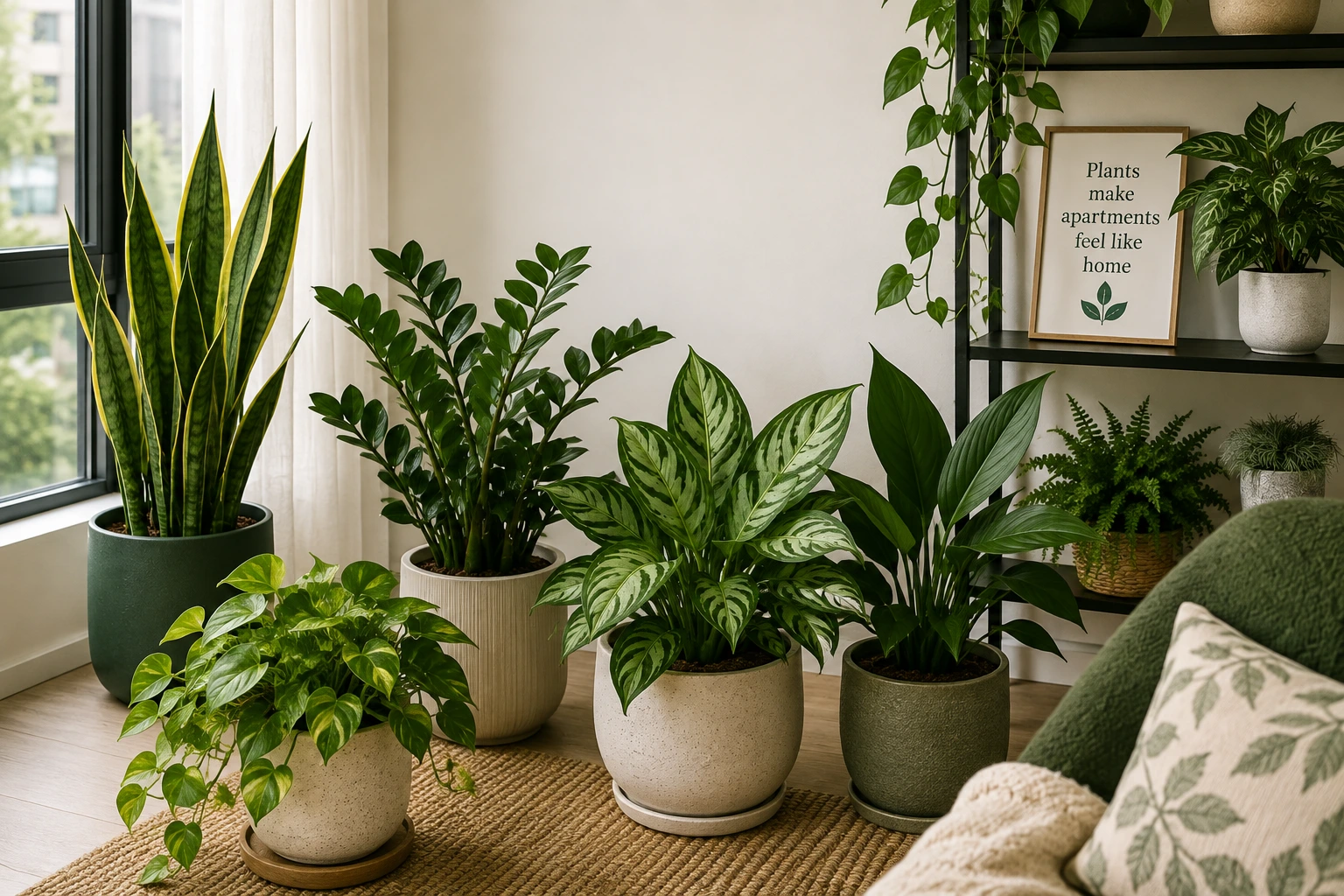
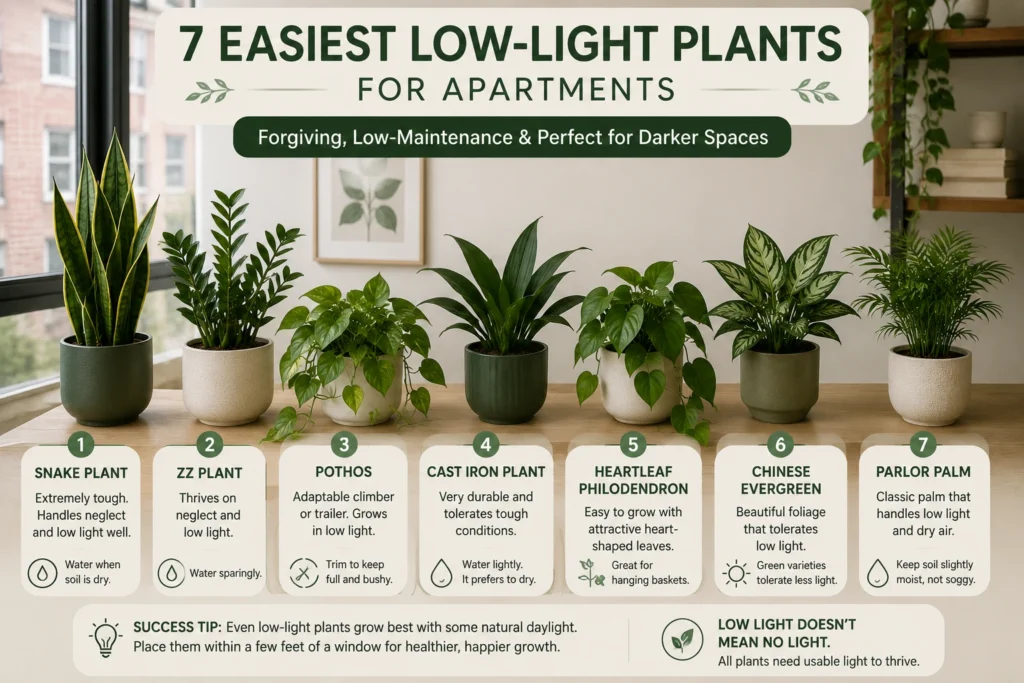
The good news is that some low-light indoor plants are much more tolerant of reduced natural light than others. Snake plants, ZZ plants, pothos, cast iron plants, Chinese evergreens, and several other houseplants can adapt to apartments where direct sunlight is limited.
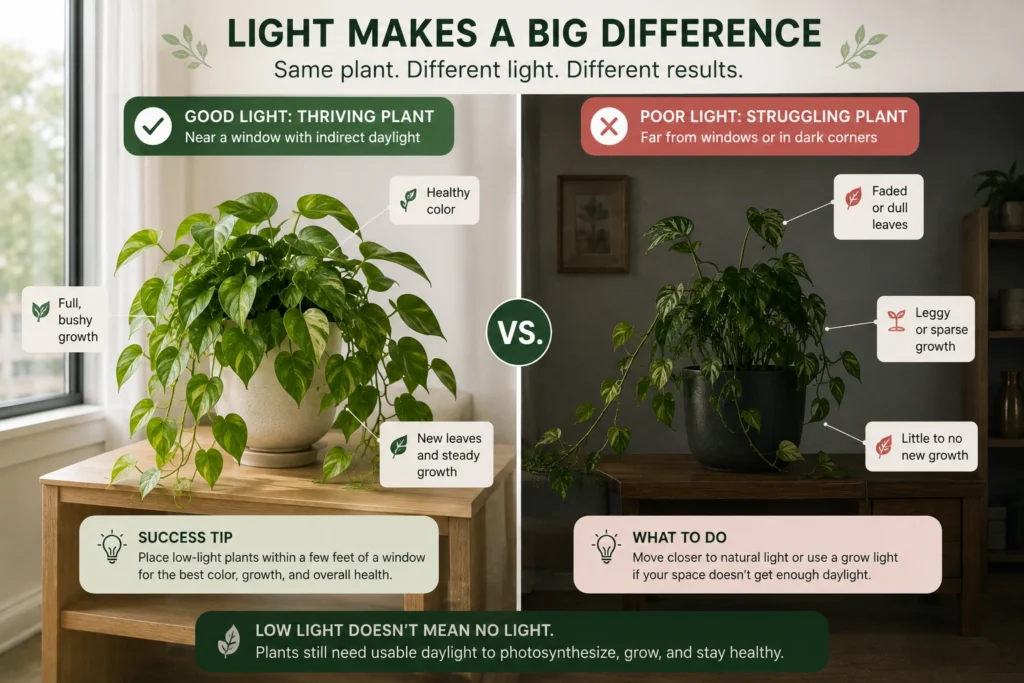
There is one important catch: low light does not mean no light. Plants still need usable light for photosynthesis. Even low-light indoor plants usually perform better when they receive consistent indirect daylight rather than being placed in a completely dark corner. The Royal Horticultural Society likewise notes that no houseplant will tolerate complete darkness indefinitely.
This guide focuses specifically on plants that are realistic choices for apartments with limited natural light. If your apartment has several different light conditions, our guide to the best plants for apartment gardening also covers sunny windows, balconies, herbs, edible plants, and foliage plants.
In This Guide
What Counts as Low Light in an Apartment?
“Low light” is easy to misunderstand.
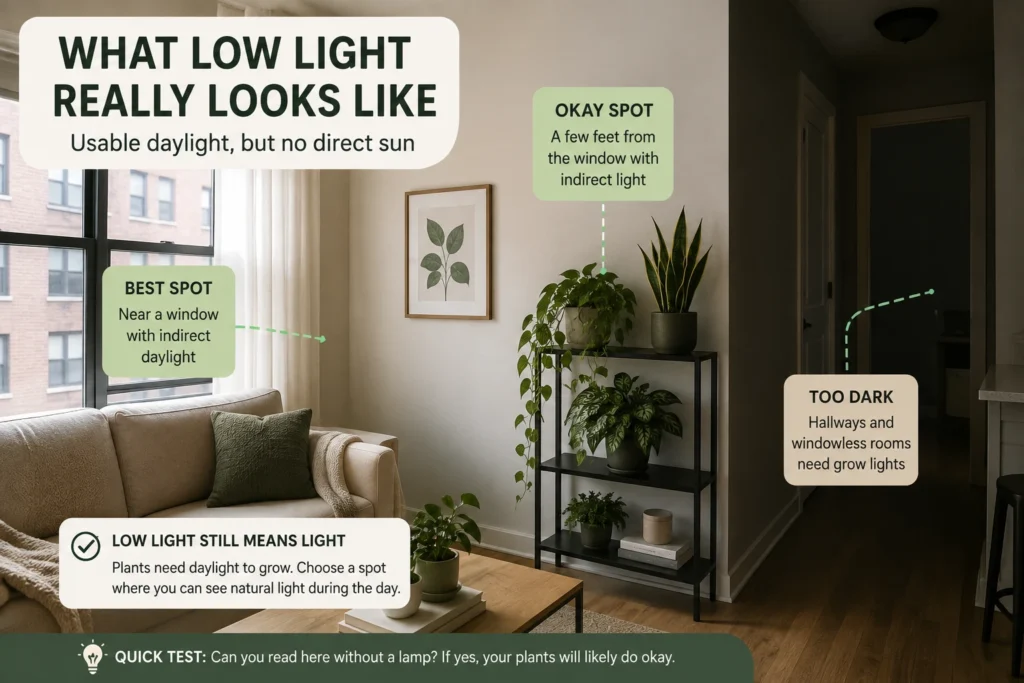
A low-light location still receives daylight, but it may be several feet from a window, beside a north-facing window, or in a room where nearby buildings, trees, balconies, or window coverings reduce incoming sun.
A simple way to think about indoor light is:
Low light: Daylight reaches the area, but little or no direct sun reaches the leaves.
Medium indirect light: The room is clearly bright for much of the day, but the plant is protected from strong direct sunlight.
Bright indirect light: Strong daylight reaches the plant without prolonged direct sun hitting the foliage.
An interior bathroom with no window, a hallway with no natural daylight, or a completely windowless office is not truly a low-light growing location. Those areas generally require suitable artificial lighting if you want plants there long term. Artificial lighting can supplement locations where natural light is inadequate.
Quick low-light test
During the daytime, stand where you want to place the plant.
Ask yourself:
- Can you comfortably read there without turning on a lamp?
- Can you see daylight coming from a window?
- Does the location stay illuminated for several hours?
- Is the plant within a realistic distance of the window rather than deep inside the apartment?
If the answer is no to most of those questions, consider moving the plant closer to a window or using a grow light.
Best Low-Light Indoor Plants at a Glance
For beginners, I would divide the 21 plants into three groups.
Strongest choices for lower-light apartments
- Snake plant
- ZZ plant
- Cast iron plant
- Pothos
- Heartleaf philodendron
- Chinese evergreen
- Parlor palm
Good choices that tolerate low light but usually look better with more indirect light
- Peace lily
- Spider plant
- Dracaena
- Lucky bamboo
- Arrowhead vine
- Dieffenbachia
- Lady palm
Plants that tolerate reduced light but should not be pushed into a very dark corner
- Bird’s nest fern
- Monstera
- Rubber plant
- Peperomia
- English ivy
- Boston fern
- Prayer plant
That distinction matters. A plant that tolerates low light is not necessarily receiving its ideal light.
1. Snake Plant
Snake plants are among the easiest plants to recommend for apartments with limited natural light.
Their upright leaves take up relatively little floor space, making them useful beside furniture, near entryways, or in small bedroom corners. They tolerate lower light better than many common houseplants and do not require frequent watering.
The biggest beginner mistake is usually too much water, not too little.
Allow the potting mix to dry considerably before watering again, especially when the plant receives limited light. Because growth slows in darker locations, the roots use water more slowly.
Best apartment location: Bedroom, living room, hallway with natural daylight
Care level: Very easy
Beginner tip: Move it closer to a window if new growth becomes unusually weak or stretched.
The RHS includes snake plant among houseplants suited to challenging lower-light indoor environments.
2. ZZ Plant
The ZZ plant is another excellent option for apartment gardeners who want something forgiving.
Its thick stems and glossy leaflets give it a clean, structured appearance, and it can handle periods of dryness better than plants that need consistently moist soil.
ZZ plants tolerate low light, but growth may become extremely slow in darker areas.
For beginners, that is often a good trade-off: the plant does not need constant attention.
Best apartment location: Bedroom, office area, living room or shaded corner with daylight
Care level: Very easy
Beginner tip: Do not water simply because a week has passed. Check whether the mix has actually dried.
3. Pothos
Pothos is one of the most versatile apartment plants.
It can trail from a shelf, climb a support, or grow from a hanging planter where permitted. That makes it particularly useful when floor space is limited.
Pothos tolerates lower light, although variegated varieties may lose some of their contrasting color when light is insufficient.
You can also prune long vines to keep the plant compact.
Best apartment location: Shelf, bookcase, plant stand or hanging planter near usable daylight
Care level: Easy
Beginner tip: If the spaces between leaves become increasingly long, move the plant toward brighter indirect light.
The RHS includes Epipremnum aureum among plants able to cope with lower-light indoor conditions.
4. Cast Iron Plant
The cast iron plant earns its name from its reputation for tolerating difficult indoor conditions.
It produces broad green leaves from the base and works especially well when you want a traditional foliage plant rather than a trailing vine.
Growth is naturally slow, and it becomes even slower in low light.
That makes it better for someone who wants a dependable plant rather than rapid growth.
Best apartment location: Shaded living room or bedroom with indirect daylight
Care level: Easy
Beginner tip: Slow growth does not automatically mean something is wrong.
5. Heartleaf Philodendron
Heartleaf philodendron is another useful trailing plant for apartments.
Its heart-shaped leaves grow along flexible vines that can hang from a shelf or climb a small support.
It tolerates reduced light, although brighter indirect light generally produces fuller growth.
Best apartment location: Shelf, bookcase or plant stand
Care level: Easy
Beginner tip: Prune overly long vines above a node to encourage a more manageable shape.
The RHS lists heartleaf philodendron among plants suited to lower-light and variable indoor conditions.
6. Chinese Evergreen
Chinese evergreen, or Aglaonema, is one of the best choices when foliage color matters.
Many varieties have attractive green, silver, cream, or patterned leaves.
Green varieties generally tolerate lower light better than heavily variegated cultivars. Variegated varieties may need more light to maintain their coloring.
Best apartment location: Living room, bedroom or home office with indirect daylight
Care level: Easy to moderate
Beginner tip: Choose greener varieties if your apartment is genuinely dim.
RHS guidance describes Chinese evergreen as able to tolerate lower light better than many houseplants while noting that variegated forms may need brighter conditions.
7. Parlor Palm
A parlor palm can give a small apartment a softer, tropical appearance without demanding direct sunlight.
It has delicate fronds and generally prefers indirect light.
Because the foliage can eventually spread outward, check the plant’s mature size before placing it beside a narrow walkway.
Best apartment location: Living room or bedroom with indirect light
Care level: Moderate
Beginner tip: Keep it away from heating vents and harsh direct afternoon sun.
The RHS includes parlor palm among plants that can cope with lower-light indoor conditions.
8. Peace Lily
Peace lilies are popular for their glossy foliage and distinctive white spathes.
They can tolerate lower light, but there is an important distinction:
A peace lily may survive in deeper shade while producing few or no flowers.
If flowering matters to you, provide brighter indirect light.
Best apartment location: Bathroom with a window, bedroom or living area with indirect light
Care level: Moderate
Beginner tip: Do not use dramatic drooping as your only watering schedule. Check the potting mix too.
RHS guidance notes that peace lilies prefer bright indirect light, while deeper shade can reduce growth and flowering.
New to growing plants inside? Our indoor apartment gardening guide explains the basics of light, containers, plant placement, and indoor growing conditions.
9. Spider Plant
Spider plants are excellent beginner houseplants because they adapt to a range of indoor conditions.
Their long arching leaves work well on shelves and stands, and mature plants may produce small hanging plantlets.
Spider plants tolerate low light, but they normally look better in brighter indirect light. Variegated forms may lose some color when kept too dark.
Best apartment location: Shelf, table or hanging planter near indirect daylight
Care level: Easy
Beginner tip: Brown leaf tips do not automatically mean the plant needs more water.
RHS guidance says spider plants tolerate relatively low light, although growth can slow and variegation may fade.
10. Dracaena
Several Dracaena varieties work well in apartments because they grow upright rather than spreading across a large floor area.
Darker green varieties are usually better choices for lower-light situations than highly colorful cultivars.
Dracaenas prefer indirect light but can adapt to reduced light levels.
Best apartment location: Bedroom corner, living room or home office
Care level: Easy to moderate
Beginner tip: Keep the plant away from constant cold drafts and heating vents.
11. Lucky Bamboo
Despite its common name, lucky bamboo is actually a type of Dracaena.
Its narrow upright stems make it especially useful in small apartments where tabletop space is easier to find than floor space.
It tolerates indirect and reduced light, but avoid placing it in a completely dark area.
Best apartment location: Desk, shelf or kitchen counter receiving indirect daylight
Care level: Easy
Beginner tip: A compact arrangement is usually more practical than a tall decorative display in a small apartment.
12. Arrowhead Vine
Arrowhead vine, or Syngonium, begins with upright growth and may become more trailing as it matures.
It can tolerate lower light but generally develops stronger growth in medium indirect light.
This makes it useful for apartments where one room receives moderate daylight but no strong direct sun.
Best apartment location: Shelf, tabletop or plant stand
Care level: Easy to moderate
Beginner tip: Prune regularly if you want to maintain a compact form.
13. Dieffenbachia
Dieffenbachia is grown for its large patterned leaves.
It can tolerate lower indirect light, although highly variegated varieties usually maintain better coloring with more brightness.
Its larger leaves also mean it may eventually need more room than pothos or snake plant.
Best apartment location: Living room or bedroom with filtered daylight
Care level: Moderate
Beginner tip: Check mature width before buying a large specimen for a narrow corner.
14. Lady Palm
Lady palm produces clusters of fan-shaped leaves and can tolerate lower indoor light.
It is useful when you want a larger floor plant without placing it directly beside a bright window.
However, larger specimens can take up significant floor space.
Best apartment location: Living room with indirect daylight
Care level: Moderate
Beginner tip: Measure the available floor area before purchasing.
The RHS describes lady palm as preferring bright indirect light while tolerating lower-light conditions.
15. Bird’s Nest Fern
Bird’s nest fern forms a rosette of broad, wavy leaves rather than traditional divided fern fronds.
It prefers indirect light and can tolerate somewhat lower light, especially when humidity is adequate.
Bathrooms with windows can work particularly well.
Best apartment location: Bright bathroom or humid room with indirect light
Care level: Moderate
Beginner tip: Avoid pouring water directly into the center of the crown.
16. Monstera
Monstera is commonly marketed as an easy indoor plant.
It can adapt to reduced light, but this is one plant where expectations matter.
In a darker apartment, growth may slow significantly and leaves may remain smaller or develop fewer characteristic splits.
Best apartment location: Living room several feet from a bright window
Care level: Moderate
Beginner tip: If you want large mature leaves, provide more usable indirect light.
17. Rubber Plant
Rubber plants have thick, glossy leaves and upright growth.
They tolerate lower light better than many sun-loving plants but generally perform best with brighter indirect light.
Consider this a low-to-medium light plant, not a plant for the darkest corner in your apartment.
Best apartment location: Living room or bedroom near indirect daylight
Care level: Moderate
Beginner tip: Rotate the pot occasionally if growth leans strongly toward the window.
The RHS includes Ficus elastica among houseplants capable of coping with more challenging lower-light indoor conditions.
18. Peperomia
Peperomias come in many compact forms, making them especially attractive for shelves, desks and small windowsills.
Most prefer brighter indirect light, but some green-leaved varieties can adapt to reduced light better than highly variegated forms.
Their compact size is their greatest advantage in apartments.
Best apartment location: Desk, shelf or small table with indirect daylight
Care level: Easy to moderate
Beginner tip: Avoid keeping the potting mix constantly wet.
19. English Ivy
English ivy can grow in containers indoors and works well where trailing growth is useful.
It tolerates indirect and somewhat reduced light, although brighter indirect light usually creates stronger growth.
Indoor ivy can also be more demanding than pothos because dry air and pests may become problems.
Best apartment location: Cool room with indirect light
Care level: Moderate
Beginner tip: Inspect leaves regularly for pests instead of assuming every damaged leaf is caused by watering.
20. Boston Fern
Boston fern is better described as shade tolerant than darkness tolerant.
It prefers indirect light and higher humidity and can struggle when apartment air becomes very dry.
For that reason, it is not my first recommendation for someone who routinely forgets to check plants.
Best apartment location: Bathroom with a window or another moderately humid room
Care level: Moderate to high
Beginner tip: Low light plus dry indoor air is a difficult combination for ferns.
21. Prayer Plant
Prayer plants are known for decorative leaves that may change position between day and night.
They prefer indirect light and can adapt to somewhat reduced light, but they should not be treated as plants for a windowless room.
Humidity and consistent care matter more here than they do with snake plants or ZZ plants.
Best apartment location: Bedroom, bathroom or living room with indirect daylight
Care level: Moderate
Beginner tip: Choose this plant after you have already learned how quickly potting mix dries in your apartment.
Which Low-Light Indoor Plants Are Best for Beginners?
If this is your first apartment plant, I would narrow the list dramatically.
Start with:
- Snake plant
- ZZ plant
- Pothos
- Cast iron plant
- Heartleaf philodendron
- Chinese evergreen
- Spider plant
These plants generally provide more room for beginner mistakes than humidity-sensitive ferns or plants that demand consistently brighter conditions.
If you’re still deciding among plants for several different apartment locations, our broader guide to the best plants for apartment gardening compares low-light foliage plants, sunny-window plants, herbs, greens, and compact crops.
Best Low-Light Plants for Small Apartments
Limited light is only half the problem in many apartments. You may also have limited floor space.
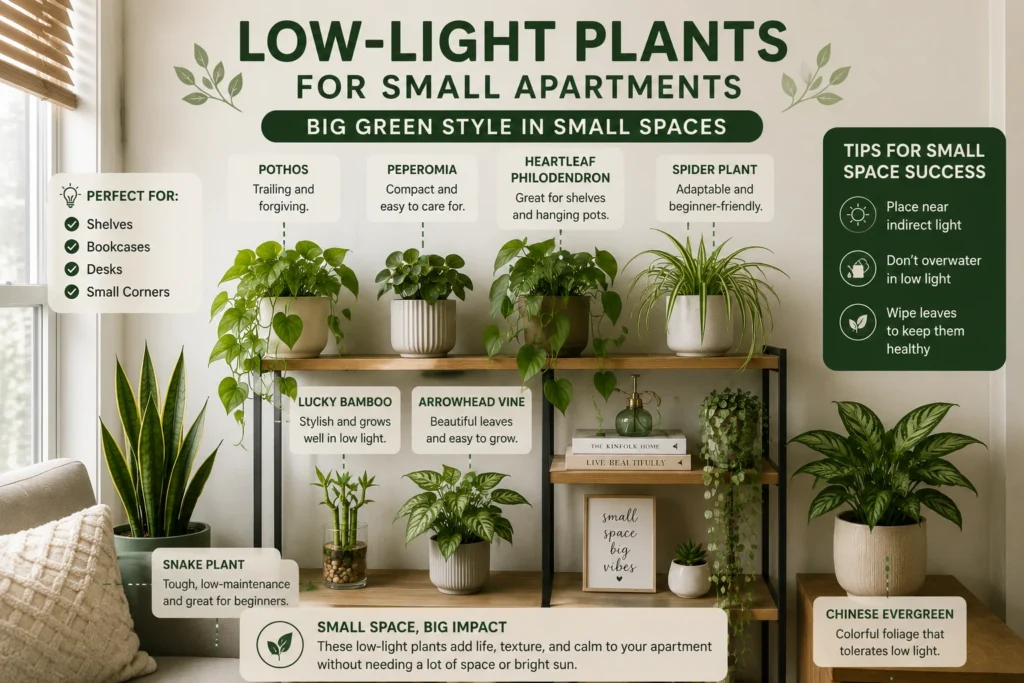
For shelves and compact surfaces, consider:
- Pothos
- Heartleaf philodendron
- Peperomia
- Spider plant
- Lucky bamboo
- Arrowhead vine
For narrow floor locations, consider:
- Snake plant
- ZZ plant
- Dracaena
- Chinese evergreen
For a larger floor plant:
- Parlor palm
- Lady palm
- Monstera
- Rubber plant
Always check mature dimensions rather than judging a plant by the size of its nursery pot.
How Far From a Window Can a Low-Light Plant Be?
There is no universal distance that works in every apartment.
A plant six feet from a huge unobstructed south-facing window may receive more usable light than a plant two feet from a small window blocked by another building.
Window direction also isn’t the whole story.
Light is affected by:
- window size
- nearby buildings
- trees
- balconies above your unit
- blinds and curtains
- season
- latitude
- tinted glass
- distance from the window
For that reason, observe the actual plant rather than relying only on a label that says “low light.”
If you’re new to growing plants in a small space, our complete beginner’s guide to apartment gardening covers light, containers, watering, plant selection, and other fundamentals.
Signs Your “Low-Light” Plant Needs More Light
A plant may survive in a location without doing particularly well there.
Watch for:
Long, stretched growth
Large spaces between new leaves can indicate the plant is reaching for more light.
Smaller new leaves
New growth that becomes progressively smaller may indicate inadequate light.
Loss of variegation
Variegated spider plants, pothos and Chinese evergreens may produce greener growth under reduced light.
Little or no growth
Some low-light plants grow slowly anyway, but months without meaningful new growth can justify reassessing placement.
Leaning strongly toward the window
A plant that repeatedly turns toward the window is responding to the strongest available light source.
Potting mix that stays wet for too long
Low-light plants use water more slowly. Soil remaining wet for long periods can increase root problems.
RHS houseplant guidance identifies weak, spindly growth, pale foliage, poor flowering and leaf loss among possible signs of inadequate light.
Low Light Changes How You Should Water
One of the most important differences between bright and low-light plant care is watering.
Plants in reduced light generally photosynthesize and grow more slowly. As a result, they often use water more slowly too.
That means a watering routine that works beside a bright window may keep the same plant too wet in a darker room.
Instead of watering every Sunday simply because it is Sunday:
- Feel the upper potting mix.
- Consider how wet the pot still feels.
- Check the plant’s individual moisture preference.
- Water thoroughly when appropriate.
- Allow excess water to drain.
- Empty standing water from decorative containers or saucers.
Your plant type still matters. A peace lily should not be treated exactly like a snake plant.
Should You Use a Grow Light in a Dark Apartment?
Sometimes the best answer is not another “low-light plant.”
It’s more light.
A grow light may make sense when:
- the room has no window
- plants repeatedly stretch toward the window
- winter daylight becomes inadequate
- you want to grow plants that need brighter conditions
- there is no practical way to move the plants closer to natural light
If you are building your first indoor garden, don’t buy elaborate equipment automatically. Start by making the best use of the natural daylight you already have.
Our how to start an indoor garden guide walks through the full setup process, including choosing your growing area before purchasing plants and equipment.
A Note About Pets and Low-Light Plants
Do not assume a plant is pet-safe simply because it is common or marketed as easy to grow.
If cats, dogs or small children can reach your plants, verify the specific species before bringing it home. Plant toxicity can differ significantly among houseplants.
This is especially important when choosing floor plants or trailing vines that animals can easily reach.
I recommend checking a reliable plant-toxicity database for the exact plant before purchase rather than relying on a general social-media plant list.
Common Mistakes With Low-Light Indoor Plants
Putting a plant in complete darkness
Low-light tolerance is not the same as surviving indefinitely without usable light.
Overwatering because the soil looks dry on top
The lower portion of the container may still contain substantial moisture.
Buying heavily variegated plants for the darkest location
More colorful cultivars often need stronger light to maintain their pattern.
Assuming slow growth means the plant needs fertilizer
Insufficient light may be the limiting factor.
Moving a struggling plant even farther from the window
Decorating around a plant’s appearance instead of its biological needs rarely improves its health.
Buying a large plant without measuring the apartment
A six-inch nursery plant can eventually occupy much more floor or shelf space.
How to Choose the Right Low-Light Plant for Your Apartment
Use this quick decision process.
Choose snake plant or ZZ plant if:
You want minimal maintenance and don’t mind slower growth.
Choose pothos or heartleaf philodendron if:
You want trailing growth for a shelf or planter.
Choose Chinese evergreen if:
You want more decorative foliage.
Choose parlor palm if:
You want a softer floor plant.
Choose spider plant if:
You want a beginner-friendly plant that can eventually produce plantlets.
Choose peace lily if:
You can provide reasonable humidity and want the possibility of flowers.
Choose cast iron plant if:
You value durability more than rapid growth.
For most beginners, I would choose one or two low-light indoor plants that match the same light zone rather than buying a collection with completely different requirements.
That makes watering, observation and troubleshooting much easier.
Key Takeaways
- Low light does not mean no light.
- Snake plants, ZZ plants, pothos, cast iron plants, Chinese evergreens and heartleaf philodendrons are among the strongest choices for darker apartments.
- Many plants marketed for low light still grow better with brighter indirect light.
- Reduced light usually means slower growth and slower water use.
- Variegated plants may lose color when light is insufficient.
- A grow light is a better solution than forcing a plant to survive indefinitely in a windowless room.
- Choose low-light indoor plants based on the actual conditions in your apartment, not simply a “low-light” label.
Once you’ve chosen plants that match your apartment’s light, follow our step-by-step guide to starting an indoor garden to set up your containers, growing area, watering routine, and plant care.
Frequently Asked Questions
What is the best indoor plant for a low-light apartment?
There is no single best plant for every apartment, but snake plant, ZZ plant, pothos, cast iron plant and Chinese evergreen are strong beginner choices because they tolerate reduced light better than many common houseplants.
Can plants survive in a room with no windows?
Not reliably without artificial light. Plants still require usable light for photosynthesis. A truly windowless room generally needs an appropriate grow light.
What plants need the least amount of sunlight?
Snake plant, ZZ plant, cast iron plant, pothos, heartleaf philodendron and Chinese evergreen are among the better choices for locations with limited natural light.
Can pothos grow in low light?
Yes. Pothos can tolerate low light, although growth may slow and variegated varieties may lose some color. Brighter indirect light generally produces stronger growth.
Can snake plants grow in dark rooms?
Snake plants tolerate reduced light but should not be treated as plants that can grow indefinitely in complete darkness. They still need usable natural or artificial light.
Do low-light plants need less water?
Often, yes. Plants growing in reduced light generally grow and use water more slowly. Because low-light indoor plants often grow more slowly in dimmer conditions, their potting mix may also take longer to dry between waterings.
Where should I put low-light plants in my apartment?
Place them where they receive usable daylight without harsh direct sun. North-facing windows, areas several feet from brighter windows, shelves and indirectly lit rooms can work depending on the individual plant.