Indoor Herb Garden: How to Grow Fresh Herbs in an Apartment
You don’t need a backyard—or even a balcony—to keep fresh herbs within reach. A sunny kitchen window, a few containers, and two or three herbs you actually cook with can be enough to start an indoor herb garden.
The challenge is that culinary herbs don’t all behave like ordinary houseplants. Many need plenty of usable light, some prefer their potting mix to dry more between waterings, and a container that works well for chives may not be the best long-term home for a larger herb.
That doesn’t mean indoor herbs are difficult. It means you’ll have better results if you choose plants that fit your apartment instead of trying to force every herb into the same conditions.
This guide walks through the entire process—from choosing herbs and containers to lighting, watering, feeding, harvesting, and keeping your plants productive throughout the year.
In This Guide
Can You Really Grow Herbs Indoors?
Yes. Many culinary herbs can grow indoors successfully when they receive suitable light, drainage, water, and enough room for their roots.
The University of Vermont Extension notes that annual herbs such as basil and longer-lived herbs such as sage, oregano, and thyme can all be grown indoors. The difference is that annuals eventually reach the end of their life cycle, while perennial herbs may continue growing for years under suitable conditions.
That distinction matters because an indoor herb garden isn’t necessarily something you plant once and keep unchanged forever. Basil may eventually need replacing. A healthy thyme or oregano plant may stay with you much longer.
Space matters too. Penn State Extension recommends container-friendly herbs such as chives, basil, and cilantro while cautioning that herbs with larger root systems are generally poor choices for small indoor containers.
Start with what fits your apartment. Three useful herbs growing well are better than a dozen plants crowded onto one windowsill.
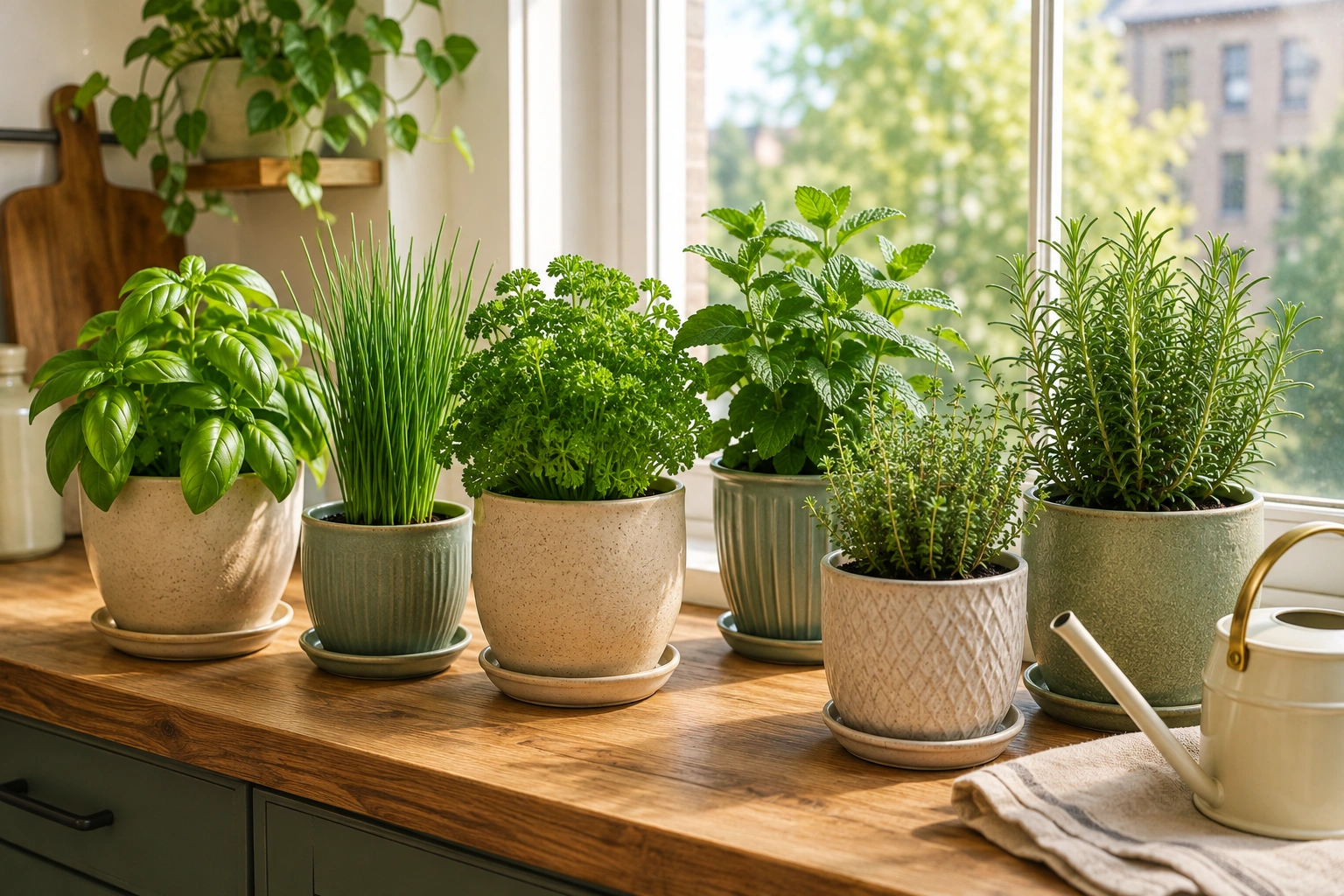
8 Herbs to Grow in an Indoor Herb Garden
The best starting herbs aren’t necessarily the ones with the prettiest labels at the garden center. Choose herbs you will actually use and that you can reasonably support with the light and space available in your apartment.
Basil
Basil is a natural choice if you regularly make pasta, pizza, salads, or pesto. It likes warmth, good light, and more consistent moisture than some Mediterranean herbs.
Basil also responds well to regular harvesting. Pinching the growing tips encourages bushier growth and helps delay flowering.
Because basil is an annual, don’t expect one plant to remain productive indefinitely. Replacing plants or starting new ones is a normal part of growing basil indoors.
Chives
Chives are compact, which makes them especially convenient when windowsill space is limited.
You can snip the leaves as needed for eggs, baked potatoes, soups, dips, and other dishes. The Royal Horticultural Society recommends cutting chives back after flowering to encourage fresh leaf growth.
Their upright growth also means they don’t sprawl across neighboring containers the way some herbs can.
Parsley
Parsley works well for cooks who want an herb that can be used in a wide range of dishes.
It isn’t necessarily the fastest plant in your collection, so don’t be discouraged if it seems less dramatic than basil. Give it suitable light and consistent care instead of trying to force rapid growth with excessive fertilizer.
Parsley is technically biennial, so it won’t behave exactly like a long-lived perennial herb.
Mint
Mint is useful, fragrant, and vigorous.
That last characteristic is both an advantage and a reason to give it its own container. Mint can grow aggressively, and the RHS specifically recommends growing it in a container and dividing it periodically.
Keeping mint separate also makes watering and pruning easier without having to worry about it competing with more compact herbs.
Thyme
Thyme is a good choice for someone who frequently cooks roasted vegetables, poultry, soups, sauces, or Mediterranean dishes.
It doesn’t want exactly the same watering treatment as basil. Penn State Extension advises allowing herbs such as thyme, rosemary, oregano, and sage to dry somewhat between waterings.
This is one reason individual pots can be easier for beginners than planting every herb together in one decorative container.
Oregano
Oregano is another strong candidate for a sunny indoor location.
Like thyme, it prefers not to remain constantly wet. Good drainage and restraint with the watering can are more useful than keeping the potting mix continually damp.
Regular harvesting can help keep the plant manageable in a small apartment.
Cilantro
Cilantro can be grown indoors, but it’s worth setting realistic expectations.
It is more likely than some herbs to have a relatively short productive period and run to seed. The RHS recommends succession sowing for herbs such as coriander because they can bolt quickly.
Rather than trying to keep one cilantro plant going forever, it may be easier to start new plants periodically if cilantro is something you use often.
Rosemary
Rosemary can grow indoors, but I would not call it the easiest choice for a first-time herb grower.
It needs strong light and doesn’t like consistently wet potting mix. Penn State also notes that rosemary has higher light requirements than some indoor herbs.
If your apartment has a particularly bright location, rosemary may be worth trying. If your available light is limited, basil, chives, parsley, or another herb may be a more forgiving place to begin.
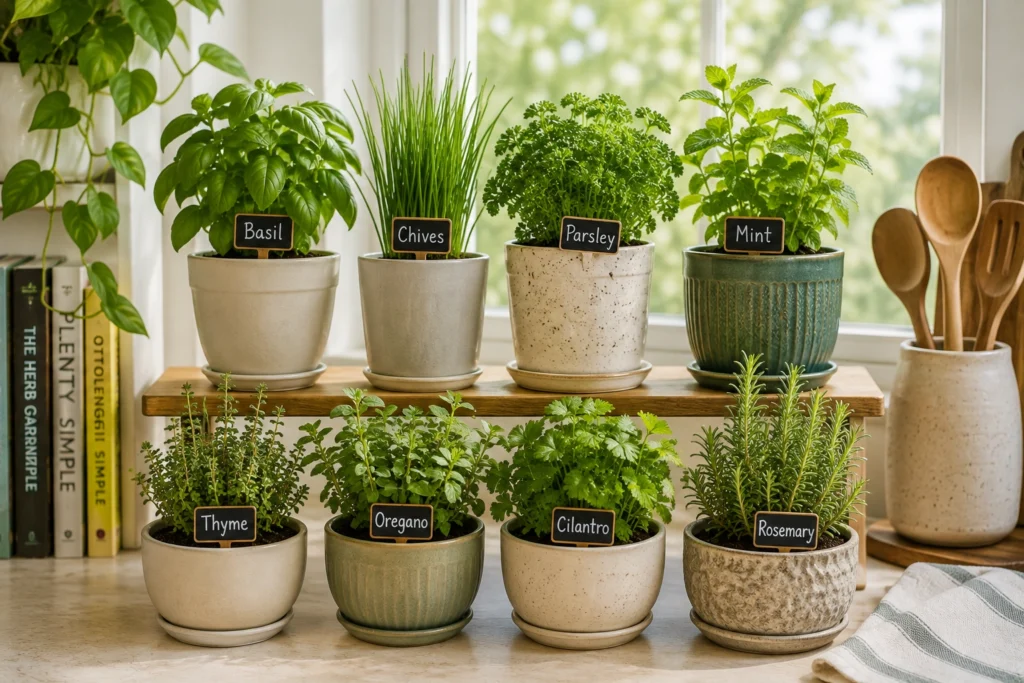
Where Should You Put an Indoor Herb Garden?
The most convenient location isn’t always the best growing location.
A kitchen windowsill seems obvious because the herbs are close to where you’ll use them, but first pay attention to how much light actually reaches the spot.
Many culinary herbs need substantial light. University of Vermont Extension suggests looking for a window receiving roughly six to eight hours of direct sun for light-loving herbs. Penn State similarly notes that many herbs perform best with about six hours of direct sunlight.
Don’t judge a location simply by how bright the room feels.
A shelf several feet from a sunny window can receive dramatically less usable light than the windowsill itself. Buildings across from your apartment, trees, window orientation, and seasonal changes can also reduce the amount of light reaching your plants.
Temperature matters as well. Avoid putting herbs directly in the path of heating vents, air-conditioning drafts, or other locations with extreme fluctuations.
A cold winter window can create another problem. Penn State specifically cautions that basil is sensitive to low temperatures and shouldn’t be left on a cold windowsill when conditions fall below what it can tolerate.
For a broader look at choosing indoor growing locations, our indoor apartment gardening guide covers the basic environmental factors that affect plants inside an apartment.
How Much Light Do Indoor Herbs Need?
This is one of the biggest differences between keeping an herb plant alive and keeping it productive enough to harvest.
Many culinary herbs are light-hungry plants.
Extension guidance commonly points toward approximately six hours of direct sunlight for many herbs. Some herbs, including rosemary and thyme, generally favor stronger light, while herbs such as chives and cilantro may tolerate somewhat lower-light conditions.
Insufficient light often shows up in the way a plant grows. Penn State notes that herbs receiving inadequate light can become thin and spindly, develop smaller leaves, and lose some of their aroma.
If your herbs are stretching toward the window or producing weak growth, adding more water or fertilizer isn’t necessarily the answer. Light may be the limiting factor.
A grow light can be useful when an apartment doesn’t provide enough natural light, especially during shorter winter days.
You don’t need to turn an herb article into a lighting engineering lesson, though. If natural light is your main limitation, our guide to grow lights for indoor plants explains fixture types, placement, and lighting schedules in much greater detail.
Choosing Containers for Indoor Herbs
You can grow herbs in inexpensive nursery pots, ceramic planters, terracotta, or decorative containers. What matters more than the material is whether the container works for the plant.
The first requirement is drainage.
University of New Hampshire Extension states that containers should have drainage holes so excess water can leave the pot freely. That protects roots from sitting in constantly saturated potting mix.
Pot size matters too.
A very small container may dry so quickly that keeping the plant watered becomes frustrating. An oversized pot can present the opposite problem by holding moisture for too long around a relatively small root system.
That doesn’t mean you need to calculate the perfect container dimensions. Choose a pot reasonably matched to the size of the plant and move it into something larger when roots and growth justify it.
Decorative planters without drainage aren’t automatically unusable. One simple option is to leave the herb in a draining inner pot and place that inside the decorative outer container. Just don’t allow excess water to collect around the inner pot.
Individual containers also have a practical advantage: you can water each herb according to what it actually needs.
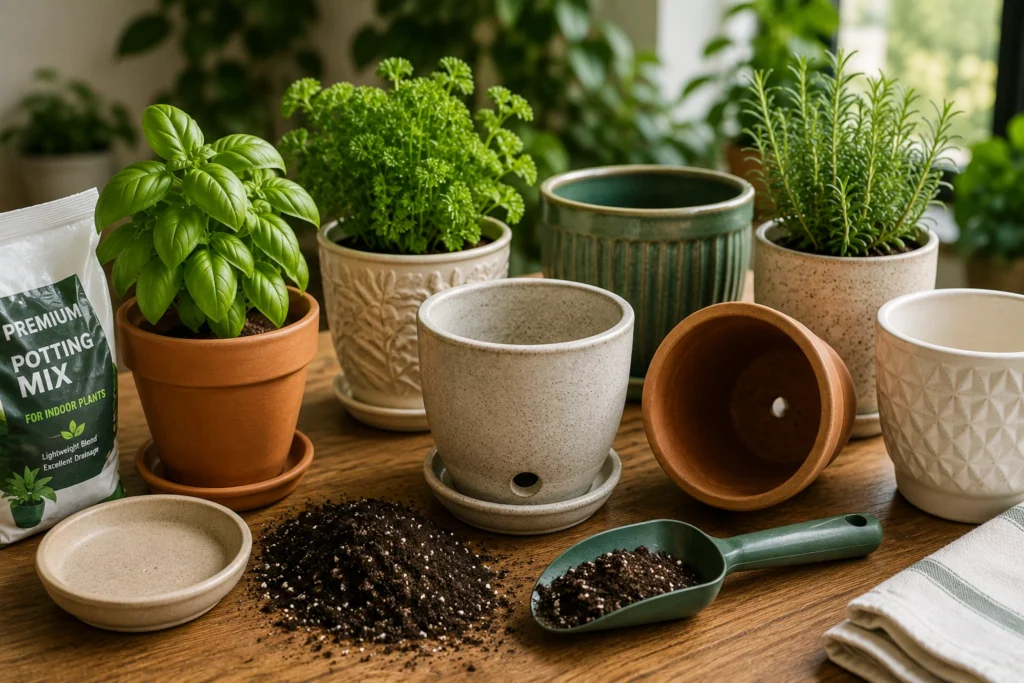
What Potting Mix Should You Use?
Indoor herbs don’t need soil dug from outside.
In fact, garden soil can be a poor choice for containers because it doesn’t behave the same way in a pot as it does in the ground.
Illinois Extension recommends a loose, well-drained potting mix for herbs grown in containers. A container mix is designed to hold useful moisture while still allowing air around the roots and excess water to drain.
The goal isn’t to keep the roots constantly wet.
Colorado State University Extension explains that waterlogged growing media can fill the pore spaces around roots with water and reduce the oxygen available to them.
For a beginner, a quality container potting mix is much simpler than trying to create a complicated custom soil recipe.
Seeds or Starter Plants: Which Is Better for Beginners?
Both work. The better choice depends on whether you value speed or variety.
Starter plants give you a head start. You can see what you’re buying, begin harvesting sooner, and skip germination.
That can make them particularly useful if this is your first indoor herb garden.
Seeds cost less per plant and give you access to far more varieties, but they require patience. You’ll also need to manage germination, young seedlings, thinning, and eventually transplanting when necessary.
You don’t have to choose one method for the entire garden.
You might buy a rosemary or thyme plant while starting basil and cilantro from seed. Choose whichever method makes sense for the individual herb and how quickly you want to begin harvesting.
How to Start an Indoor Herb Garden Step by Step
You don’t need matching planters, an expensive automated system, or an entire kitchen wall covered in plants.
1. Choose Two to Four Herbs
Begin with herbs you actually use.
If basil goes into dinner twice a week while you almost never cook with sage, grow basil.
Starting with only a few plants also makes it easier to learn how each one responds to your apartment.
2. Find Your Best Growing Location
Watch the light throughout the day rather than judging the location at one moment.
Piedmont Master Gardeners suggests observing a proposed location over the course of the day to see how much sun it truly receives.
3. Choose Containers With Drainage
Make sure excess water has somewhere to go.
Add saucers where needed to protect windowsills, furniture, and floors.
4. Add Potting Mix
Use a loose container mix rather than ordinary garden soil.
Fill the container without packing the mix down so firmly that drainage and airflow are reduced.
5. Plant Your Herbs
For starter plants, transplant at an appropriate depth based on how the plant was growing in its nursery container.
For seeds, follow the depth and spacing guidance on the seed packet because germination requirements vary.
6. Water Thoroughly
After planting, water appropriately so the growing mix is evenly moistened and excess water can drain.
Don’t leave the pot sitting in collected water afterward.
7. Watch What the Plant Does
Gardening gets easier once you stop treating the calendar as more important than the plant.
Watch leaf color, new growth, soil moisture, and how quickly containers dry. Those clues will help you adjust your care over time.
If you want a broader introduction to containers, watering, indoor locations, and other setup fundamentals, see our guide to starting an indoor garden.
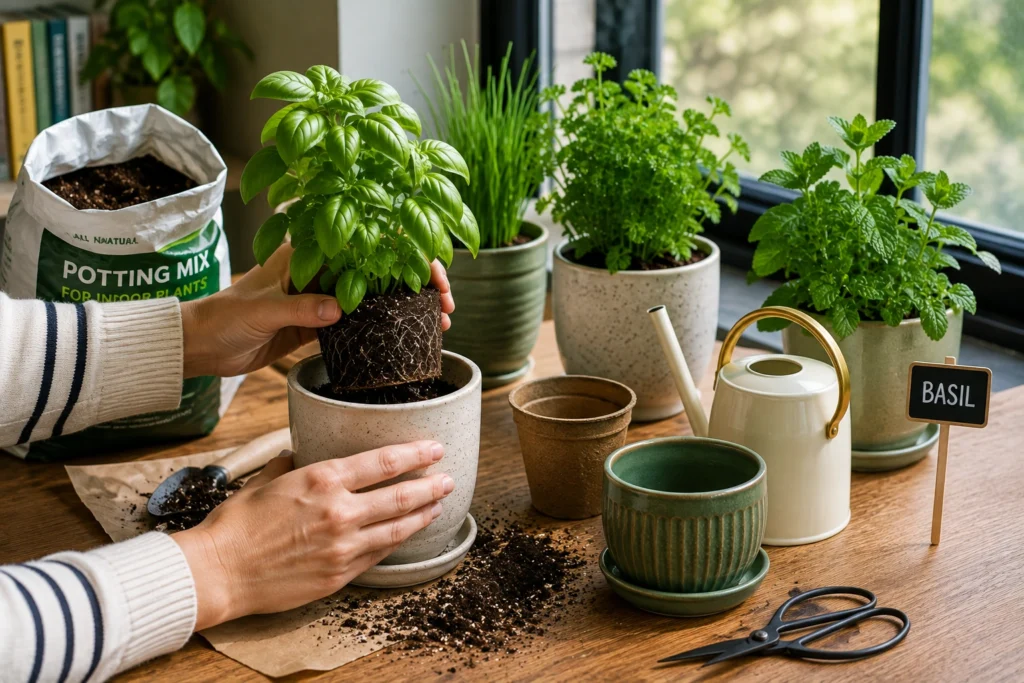
How to Water Indoor Herbs Without Overdoing It
One of the least helpful pieces of gardening advice is a rigid statement such as “water your herbs every three days.”
Your basil doesn’t know what day of the week it is.
How quickly a container dries depends on the herb, pot size, growing mix, room temperature, humidity, plant size, season, and amount of light.
Oregon State Extension recommends checking the potting mix with your finger rather than relying only on a schedule. When watering is needed, water thoroughly enough for excess moisture to drain, then allow the container to finish draining instead of leaving it standing in water.
Individual herbs matter too.
Penn State recommends allowing herbs including oregano, sage, thyme, and rosemary to dry somewhat between waterings, while basil shouldn’t be allowed to dry out completely.
That’s another argument against putting herbs with very different moisture needs into one large planter.
If you’re unsure whether a struggling herb needs water, check the growing mix before automatically reaching for the watering can. Yellow or drooping leaves don’t always mean “add more water.”
Do Indoor Herbs Need Fertilizer?
Container herbs can eventually use up nutrients available in their potting mix, so light feeding may be helpful during active growth.
More is not better.
Penn State Extension specifically cautions against overfertilizing culinary herbs because excessive feeding can negatively affect their aroma and flavor.
The Extension sources you gathered use different feeding schedules, which is a good reason not to pretend that one universal timetable exists.
For a beginner, the safer approach is simple: use an appropriate fertilizer conservatively and follow the manufacturer’s directions for container plants rather than increasing the dose because you want faster growth.
Light, water, temperature, and root health still matter. Fertilizer cannot compensate for an herb sitting in a dark corner.
How to Harvest Herbs So They Keep Growing
Harvesting isn’t something you have to avoid until the plant becomes huge. For many culinary herbs, regular cutting is part of keeping the plant useful and manageable.
The exact method depends on the herb.
For basil, pinch or cut the growing tips to encourage branching and delay flowering.
Chives can be cut for their leaves, and the Royal Horticultural Society recommends cutting plants back after flowering to encourage fresh growth.
With parsley, harvest useful outer stems and leaves rather than stripping the entire plant at once.
Mint can also be trimmed regularly, which helps control its vigorous growth.
As a general rule, don’t remove most of a plant in one harvesting session. Piedmont Master Gardeners advises taking less than about one-third at a time, while Illinois Extension similarly recommends lighter harvesting from perennial herbs.
The purpose is straightforward: take what you need while leaving enough healthy plant behind to keep producing.
And don’t worry if your herb pots don’t look like showroom houseplants. If you’re regularly clipping basil for dinner or cutting chives for breakfast, they’re doing their job.
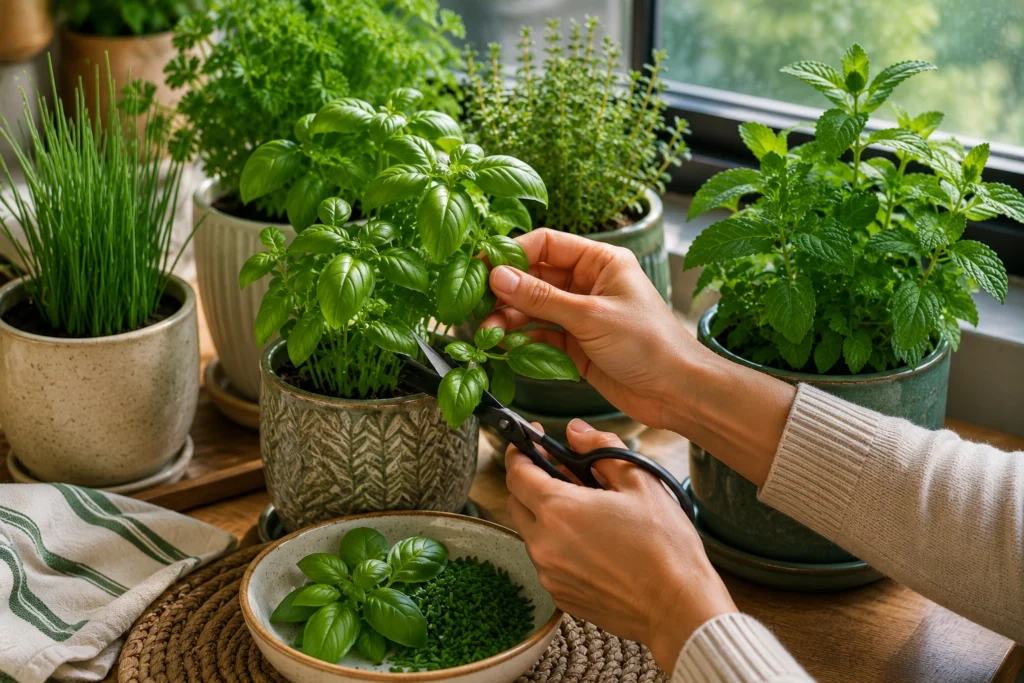
Can You Grow Herbs Indoors Year-Round?
You can keep an indoor herb garden going throughout the year, but that doesn’t mean every individual plant will live indefinitely.
Annual herbs such as basil eventually complete their life cycle. Parsley is biennial. Perennial herbs such as thyme, sage, and oregano may live much longer under suitable conditions.
Winter also changes the growing environment.
Days become shorter, window temperatures can fall, and indoor heating can make the air considerably drier.
Penn State recommends keeping indoor herbs in reasonably warm conditions and specifically warns that basil is sensitive to cold windows in winter.
Light may become the biggest seasonal limitation. A windowsill that worked well in June may provide far less usable light in December.
For herbs that naturally bolt or have shorter productive cycles, starting new plants periodically can make more sense than trying to preserve one plant indefinitely.
The goal isn’t to make every herb immortal. It’s to keep useful herbs available by replacing, dividing, pruning, or restarting plants when their natural growth pattern calls for it.
7 Common Indoor Herb Garden Problems
1. Not Enough Light
Thin, stretched growth and smaller leaves can indicate insufficient light.
Move the herb to a brighter suitable location or consider supplemental lighting.
2. Overwatering
Constantly wet potting mix can deprive roots of the conditions they need.
Check the mix before watering instead of watering automatically.
3. Poor Drainage
A beautiful container doesn’t make up for having nowhere for excess water to escape.
Use a draining inner pot if necessary.
4. Crowding Too Many Herbs Together
A planter containing six small starter plants can become crowded surprisingly quickly.
Crowding makes it harder to manage root space, airflow, and individual watering needs.
5. Treating Every Herb the Same
Basil and rosemary may both be herbs, but that doesn’t mean they want identical watering conditions.
Learn the basic preference of each herb you’re growing.
6. Forgetting to Harvest
Indoor culinary herbs are meant to be used.
Appropriate pruning and harvesting can help keep many herbs compact and productive.
7. Starting With Too Many Plants
Buying every herb at once sounds fun until you’re trying to find adequate window space for all of them.
Start with a small collection, learn what works in your apartment, then expand.
What Do You Actually Need to Start?
A basic indoor herb garden is refreshingly simple.
You need herbs or seeds, containers with drainage, saucers where necessary, suitable potting mix, enough light, and water.
That’s enough to begin.
A small watering can, herb scissors, labels, or a grow light can make care more convenient, but none of those automatically makes the garden successful.
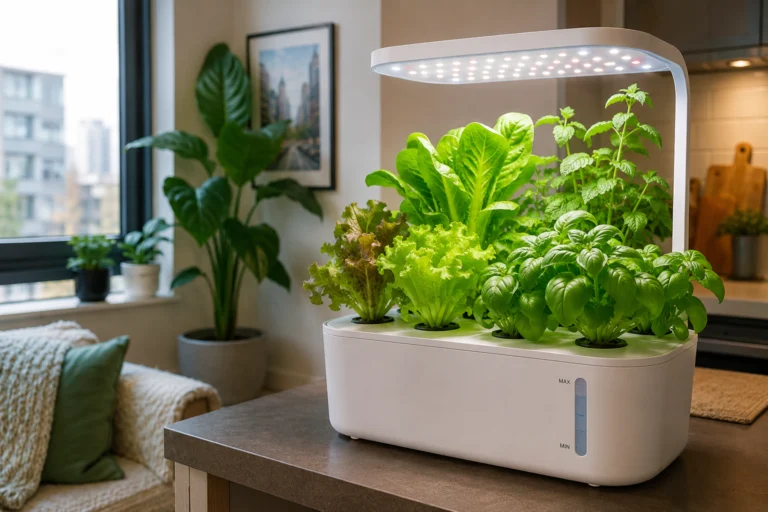
An indoor herb garden kit can also be convenient because several components may come packaged together. Just remember that a kit doesn’t eliminate the basic growing requirements. You still need to consider the herbs included, available light, watering, and the amount of space the plants will eventually need.
Don’t buy equipment simply because the package says “indoor garden.”
Buy it because it solves a problem you actually have.
Indoor Herb Garden Kit vs. Building Your Own
A kit isn’t automatically better or worse than assembling a garden yourself.
| Consideration | Indoor Herb Garden Kit | Build Your Own |
|---|---|---|
| Setup | Usually simpler | Requires choosing components |
| Plant choices | May be predetermined | Choose exactly what you want |
| Containers | Included in many kits | Pick your own sizes/styles |
| Flexibility | Usually lower | Usually higher |
| Best for | Convenience | Customization |
If you want two pots of basil and a container of chives on a sunny windowsill, building your own may be all you need.
Someone with very little natural light may value a system that includes lighting.
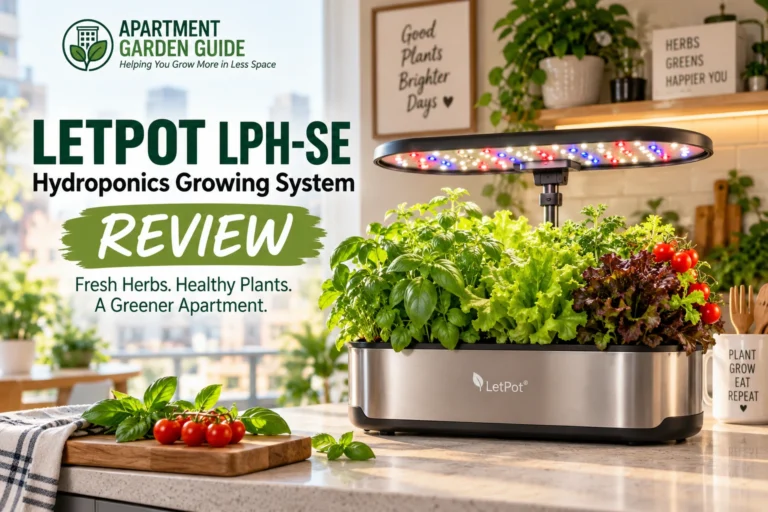
We’ll keep product comparisons separate from this article so this guide remains focused on actually growing herbs, rather than becoming a shopping roundup. If you’re considering an all-in-one system with built-in lighting and automated features, our LETPOT LPH-SE review takes a closer look at a 12-pod hydroponic garden designed for growing herbs, leafy greens, and other compact plants indoors.
Indoor Herb Garden vs. Indoor Hydroponic Garden
A traditional indoor herb garden usually grows herbs in containers filled with potting mix.
A hydroponic system grows plants without traditional potting soil and delivers water and nutrients through the growing system instead.
Both can be used in apartments, but they involve different equipment and maintenance.
If you’re simply trying to grow a few pots of basil, parsley, or chives on a windowsill, you do not need a hydroponic system.
We’ll cover indoor hydroponic gardening separately because choosing a hydroponic system is a much larger topic than growing herbs in containers.
Key Takeaways
- Start with two to four culinary herbs you genuinely use rather than filling your apartment with plants all at once.
- Give herbs as much suitable light as their individual needs require; many culinary herbs need considerably more light than low-light houseplants.
- Use containers with drainage and a loose potting mix intended for containers.
- Check the growing mix instead of following a rigid watering calendar.
- Remember that different herbs have different moisture, light, growth, and life-cycle needs.
- Harvest regularly but avoid removing too much growth from a plant at one time.
- Treat replacing annual herbs or restarting short-lived plants as a normal part of maintaining an indoor herb garden.
Frequently Asked Questions
What herbs grow best indoors for beginners?
Basil, chives, parsley, mint, thyme, oregano, and cilantro can all be grown indoors under suitable conditions. For a first garden, choose a few herbs you regularly cook with and that match the light available in your apartment.
Rosemary can also grow indoors, but its preference for strong light and careful watering may make it somewhat less forgiving than several other options.
Can I grow herbs indoors without direct sunlight?
Some herbs tolerate less direct light than others, but many culinary herbs need substantial usable light to remain compact and productive. If your apartment doesn’t provide enough natural light, supplemental lighting may be useful.
Avoid assuming that a room is suitable simply because it looks bright to you.
How often should I water indoor herbs?
There is no universal schedule.
Check the potting mix and learn the preferences of the herb. Herbs such as rosemary, thyme, oregano, and sage generally prefer to dry somewhat between waterings, while basil shouldn’t be allowed to dry completely.
Do indoor herbs need drainage holes?
Containers should allow excess water to drain freely. If you want to use a decorative container without drainage, keep the herb in a draining inner pot and remove or empty accumulated water rather than allowing the roots to remain submerged.
Can you grow herbs indoors all year?
Yes, an indoor herb garden can remain productive year-round, but individual plants may need to be replaced or restarted. Annuals such as basil naturally have shorter life cycles, while perennial herbs may persist much longer under appropriate conditions.
Seasonal changes in light and temperature can also affect growth.
Is an indoor herb garden kit worth it?
It can be if convenience matters to you or the kit solves a specific problem such as limited natural light.
A kit isn’t necessary, though. Containers, potting mix, herbs, adequate light, and water are enough to build a simple indoor herb garden yourself.