Apartment Balcony Greenhouse: A Guide for Small Spaces
An apartment balcony greenhouse can work well in a small outdoor space, especially for protecting seedlings, sheltering plants from weather, and extending parts of the growing season. Before buying one, check your building rules and consider the balcony’s sunlight, wind exposure, available space, ventilation, total weight, and drainage.
A clear greenhouse cover can create a warmer, more protected environment, but it cannot make up for inadequate sunlight or guarantee that plants will stay above freezing. On a sunny balcony, overheating can actually become the bigger problem.
If you’re planning the rest of your outdoor growing space, our guide to apartment balcony gardening covers the broader basics of containers, sunlight, wind, drainage, and choosing plants for a balcony.
In This Guide
Can You Put a Greenhouse on an Apartment Balcony?
Potentially, yes. But whether a greenhouse is appropriate depends on the balcony, the building rules, and the particular greenhouse.
Start with your lease, apartment rules, condo association rules, or other building requirements. A greenhouse may be treated differently from ordinary plant containers because it is a larger structure that could extend above the railing, catch wind, or require some method of securing it.
Virginia Cooperative Extension’s balcony gardening guidance recommends checking with the apartment manager or condo association before designing a balcony garden. It notes that rules may restrict the height of items or prohibit attaching them to the building.
That makes the building rules the first question—not the greenhouse dimensions.
Next, make sure the greenhouse won’t interfere with normal balcony access and that you can comfortably open it, reach the plants, and move around it. Wind exposure and the total weight of the planted greenhouse also need to be considered before installation.
If you’re uncertain about what your balcony can support or what your building permits, check with the property owner, manager, condo association, or appropriate building authority rather than assuming a generic balcony load figure applies to your balcony.
What Does a Balcony Greenhouse Actually Do?
A balcony greenhouse creates a more sheltered growing environment around your plants.
Depending on the design, weather, and season, it can be useful for:
- starting or protecting seedlings and transplants;
- shielding plants from some wind and weather;
- providing temporary protection for tender plants;
- extending parts of the spring or fall growing season;
- creating a more sheltered microclimate that may warm during sunny conditions.
However, it’s just as important to understand what a mini greenhouse doesn’t do.
A greenhouse doesn’t create sunlight. If surrounding buildings or an overhang leave your balcony heavily shaded, putting plants under a clear cover won’t solve the underlying light problem.
A greenhouse also doesn’t eliminate watering, drainage, pests, or other plant-care requirements. And an inexpensive plastic-covered mini greenhouse shouldn’t automatically be treated as a frost-proof winter growing space.
Think of a balcony greenhouse as a tool for modifying growing conditions rather than creating completely controlled growing conditions.
Types of Apartment Balcony Greenhouses
You don’t necessarily need a traditional glass greenhouse. Several smaller designs are more practical for balconies.
Tiered Mini Greenhouse
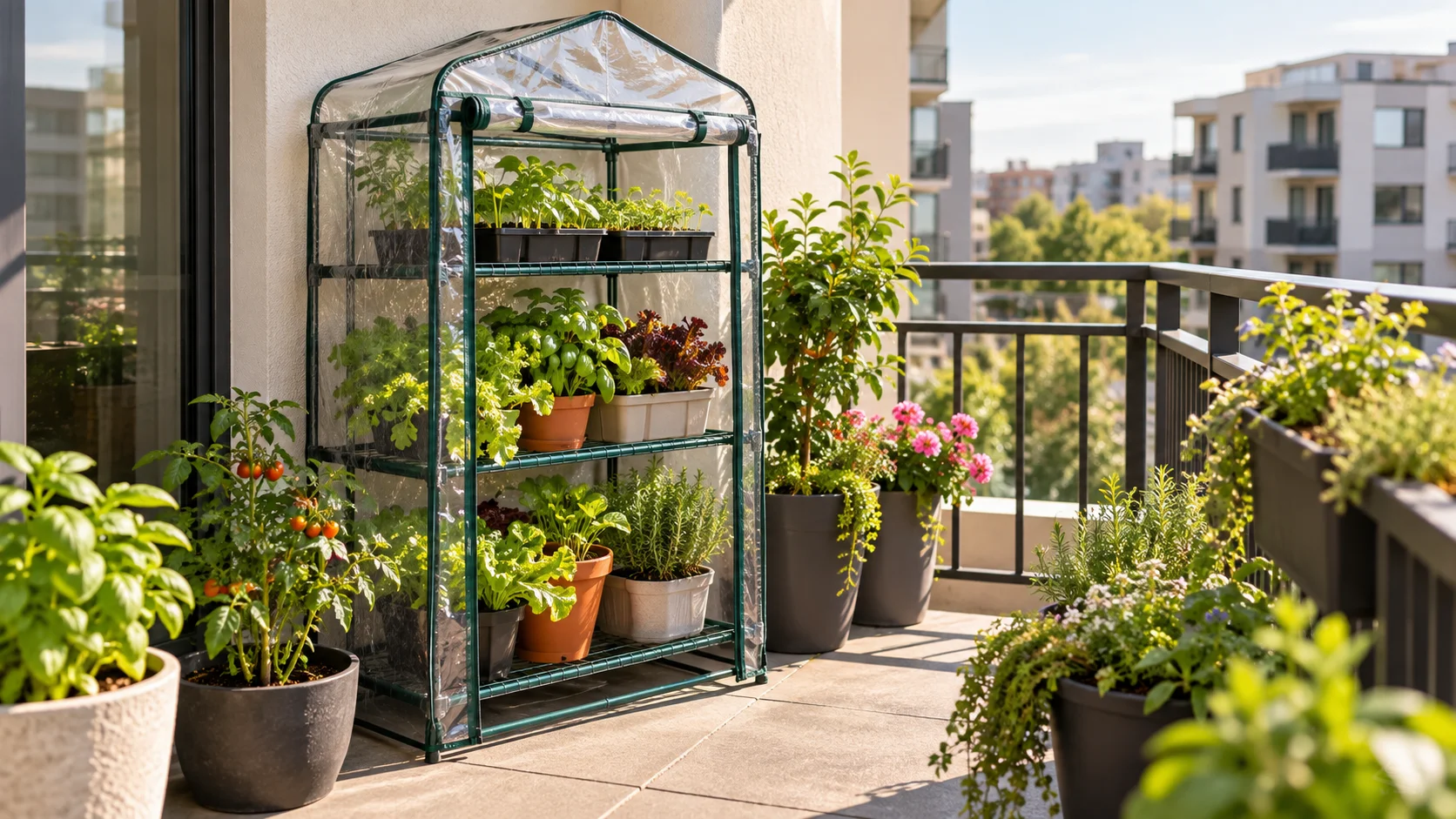
A tiered mini greenhouse typically consists of a narrow frame with several shelves surrounded by a clear plastic cover. Many have a zippered or roll-up front.
The small footprint can make this style useful for seedlings, herbs, and other compact plants when balcony space is limited.
The tradeoff is limited growing height. You also need to consider the greenhouse’s shelf-load limits, ventilation, and wind exposure.
Compact Walk-In Greenhouse
A compact walk-in greenhouse provides more growing room and easier access to multiple shelves of plants.
The additional space can be useful, but the larger structure also takes up considerably more balcony area and presents more surface area to wind.
Before considering one, measure the balcony carefully and account for the space required to open the greenhouse and move around it.
Lean-To or Wall-Side Greenhouse
A lean-to-style greenhouse uses space alongside a wall rather than standing completely on its own.
That can appear attractive on an apartment balcony where every square foot matters, but don’t assume that a structure described as a “lean-to” can be attached to your apartment’s exterior wall.
Renters and condo owners should check building rules before drilling, fastening, or making permanent modifications.
Cold Frame or Low Greenhouse
A cold frame is a low enclosure rather than a full-height greenhouse.
It can be useful for seedlings, young plants, and low-growing crops while requiring less vertical space than a traditional greenhouse.
The obvious limitation is plant height. It won’t provide the same growing space for tall or vining plants.
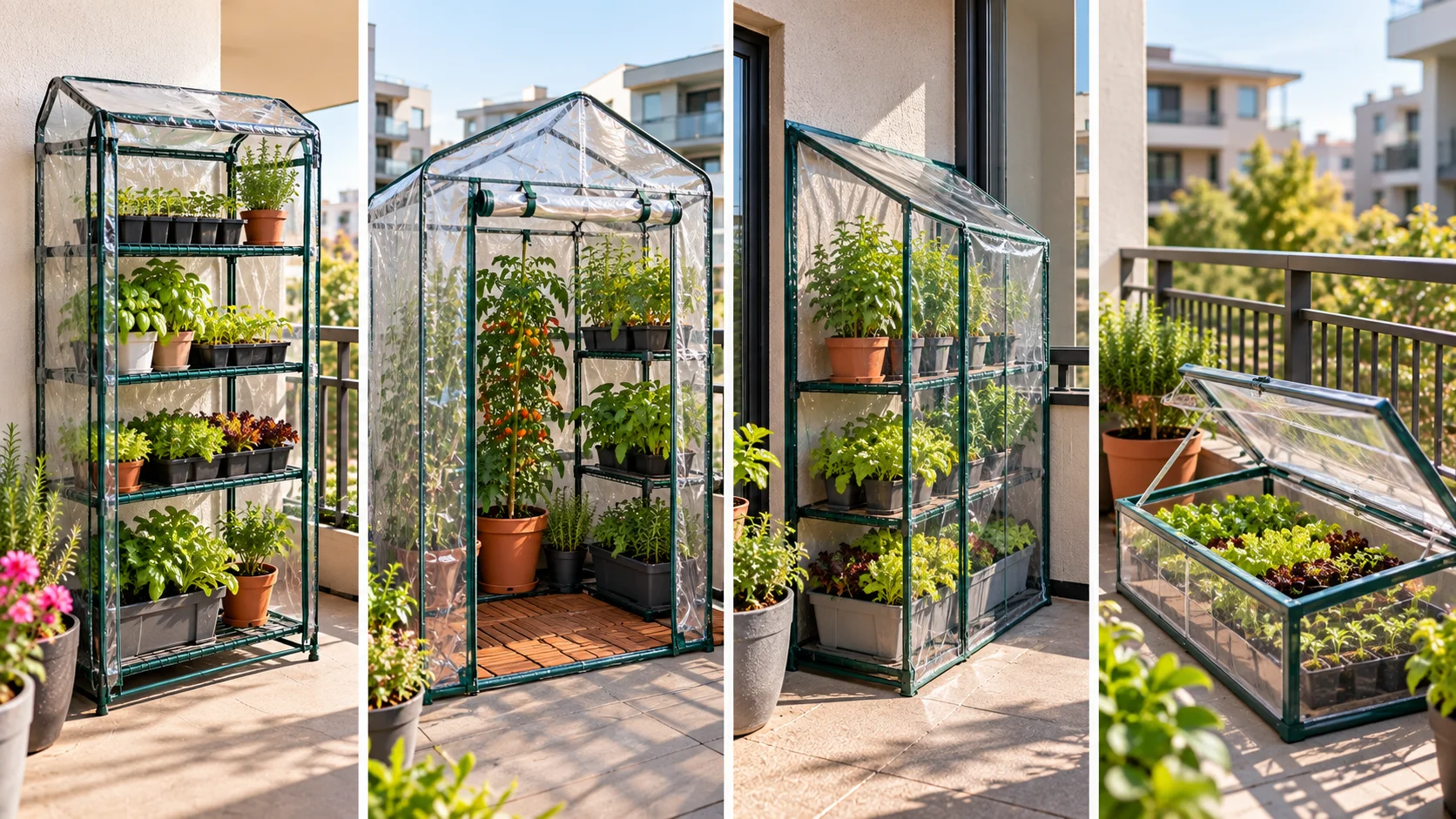
| Greenhouse Type | Space Needed | Best Fit For | Main Limitation |
|---|---|---|---|
| Tiered mini greenhouse | Small | Seedlings, herbs, compact plants | Limited plant height |
| Compact walk-in | Larger | More containers and easier access | More floor space and wind exposure |
| Lean-to or wall-side | Varies | Making use of space along a wall | Building and attachment restrictions |
| Cold frame or low greenhouse | Low, horizontal space | Seedlings and low-growing plants | Very limited vertical space |
There isn’t one best type for every apartment. The better choice is the design that fits your available space, growing goals, building rules, and balcony conditions.
How to Choose a Greenhouse for an Apartment Balcony
Choosing the right greenhouse starts with the balcony, not the product.
Measure Your Available Space
Measure the width, depth, and available height of the location you’re considering.
Then account for more than the greenhouse’s listed dimensions.
Ask yourself:
- Can its door or cover open fully?
- Can you reach every shelf?
- Can you water the plants comfortably?
- Is there still enough room to use the balcony normally?
- Does the greenhouse interfere with a doorway or necessary access?
A few inches of open floor space can be more valuable than squeezing the largest possible greenhouse onto the balcony.
Check Your Sun Exposure
A clear greenhouse can capture solar energy, but it can’t compensate for a balcony that doesn’t receive enough usable light for the plants you want to grow.
University of Maryland Extension’s container gardening guidance notes that exposure affects sunlight and temperature and that hard surfaces such as brick, stone, concrete, decking, and metal can absorb or reflect solar radiation, increasing temperatures around container plants.
Before buying a greenhouse, determine how much sun your balcony garden gets and compare those conditions with the light requirements of the plants you intend to grow.
A greenhouse can modify temperature and exposure, but it can’t replace sunlight that never reaches the balcony.
Consider Wind Exposure
Wind deserves more attention on a balcony than it often receives in greenhouse buying guides.
A lightweight frame surrounded by a large plastic cover can present considerably more surface area to wind than an uncovered collection of plant pots.
UConn Extension’s greenhouse wind guidance explains that wind forces on a greenhouse are influenced by factors including wind speed, exposure, structure height and shape, orientation, and whether doors or vents are open. Wind pressure can contribute to overturning or uplift.
Wind exposure doesn’t automatically determine whether a greenhouse will work, but it should influence the type of structure you consider and how closely you review its installation requirements.
Pay attention to the manufacturer’s installation and securing instructions and whether those instructions can actually be followed under your building’s rules.
Avoid assuming that an improvised railing attachment, drilling into the building, or a universal amount of ballast is an appropriate solution for every balcony.
Think About the Total Weight
Don’t judge a balcony greenhouse only by the weight printed on its shipping box.
Remember: total greenhouse weight includes the frame, shelves, containers, moist growing media, plants, water, and any permitted stabilization system.
That can add up quickly.
For perspective, the University of Maryland Extension notes that a single 20-inch container filled with moist potting mix and plants can weigh about 100 pounds.
That figure isn’t a balcony load limit. It illustrates how different the weight of a planted setup can be from the weight of empty containers and greenhouse components.
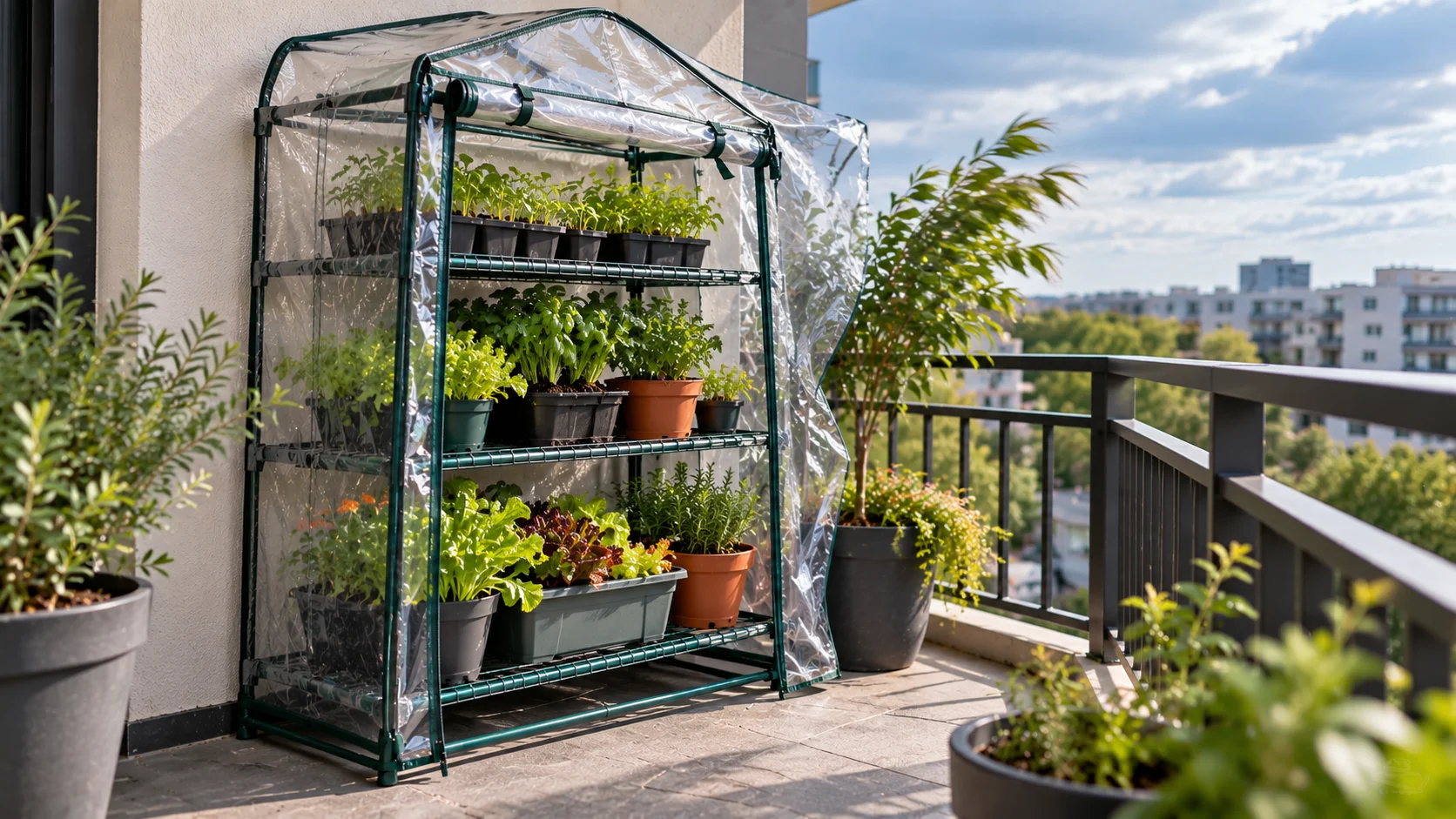
Check the greenhouse manufacturer’s shelf capacities, and don’t assume a lightweight greenhouse kit will remain lightweight once you fill it.
Before You Buy
Before purchasing an apartment balcony greenhouse, ask yourself:
- Does my building allow it?
- Does it fit without interfering with normal balcony access?
- Does the location receive enough usable sunlight?
- How exposed is the balcony to wind?
- Can I follow the manufacturer’s installation or securing instructions without violating my building’s rules?
- What will the entire setup weigh after adding containers, moist growing media, plants, and water?
- Can I ventilate it easily?
- Where will drainage water go?
If you can’t confidently answer one of those questions, solve that issue before choosing a greenhouse.
Ventilation and Overheating in a Balcony Greenhouse
One of the easiest mistakes to make is assuming that warmer is always better.
It isn’t.
Washington State University Extension’s greenhouse guidance explains that greenhouses are designed to capture solar heat and can overheat during warmer weather. Excessive heat can stunt or kill plants. Doors and vents can sometimes provide natural ventilation by allowing warm air to leave while cooler outside air enters.
This can be especially important on an apartment balcony.
Hard balcony surfaces may already increase temperatures by absorbing or reflecting solar energy. Put a clear greenhouse enclosure in that environment, and heat can build further.
That’s why ventilation should be part of your greenhouse decision from the beginning rather than something you think about after the plants become stressed.
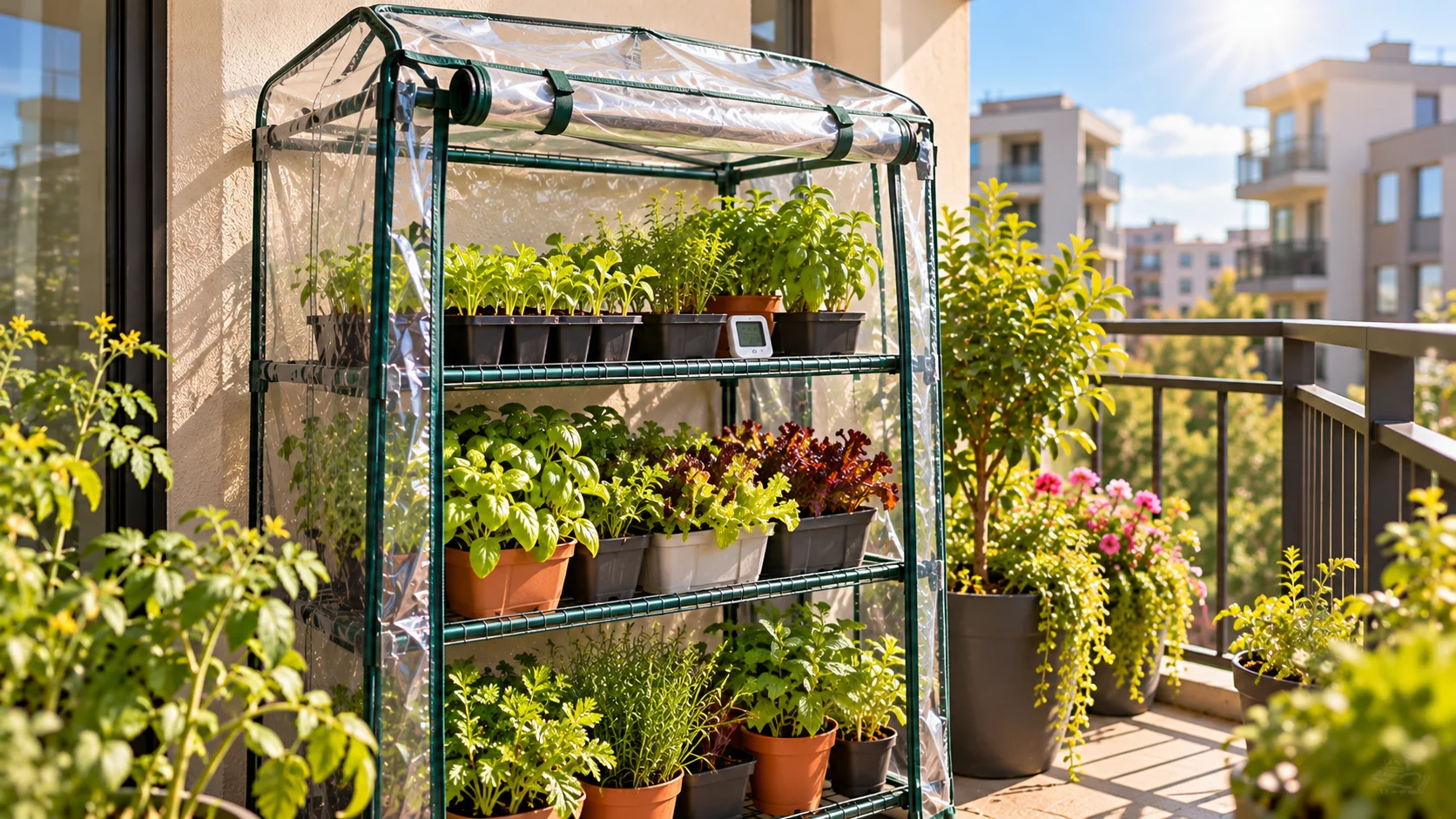
Look for a design that can be opened easily. Depending on the greenhouse, that might mean a roll-up front panel, door, vent, or another practical way to increase airflow.
It is also useful to monitor the temperature inside the greenhouse rather than assuming it matches the outdoor temperature.
On some sunny days, keeping the greenhouse from becoming too hot may be more important than keeping it warm.
Will an Unheated Greenhouse Keep Plants From Freezing?
Not reliably.
An apartment balcony greenhouse can capture solar energy during the day, but that doesn’t mean it will maintain a safe temperature throughout a cold night.
Washington State University Extension explains that greenhouse heat can be lost through the covering and through air movement and leakage. As warm air escapes, colder outside air can replace it.
The actual temperature inside an unheated mini greenhouse can depend on outdoor temperature, sunlight, greenhouse size and cover material, wind exposure, air leakage, thermal mass, and any supplemental heat.
For that reason, avoid assuming that a greenhouse will always remain a fixed number of degrees warmer than the outdoor air.
Think of an unheated mini greenhouse primarily as a season-extension tool, not a substitute for a heated growing space.
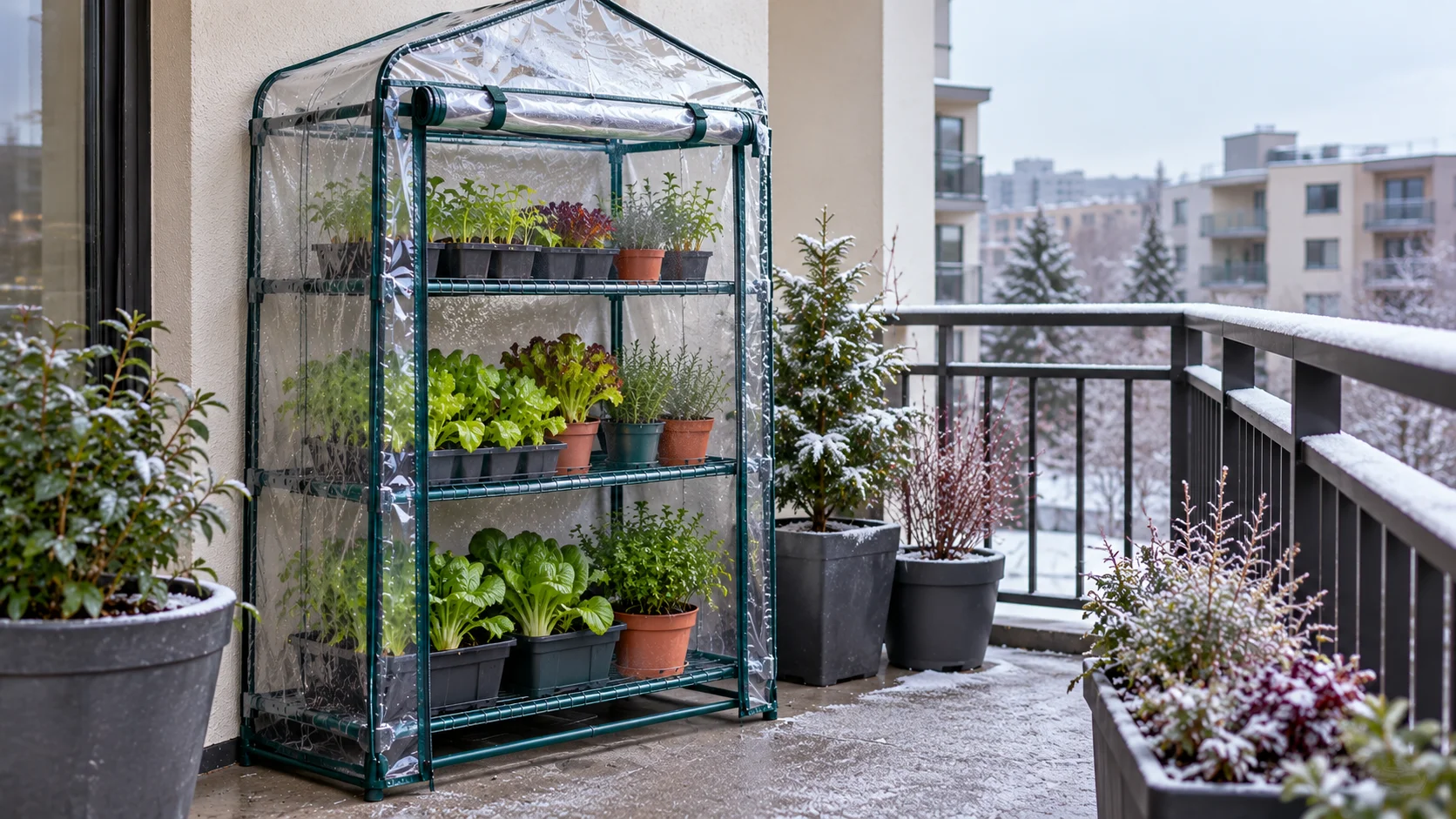
If cold protection is your main reason for buying one, monitor the actual temperature inside the apartment balcony greenhouse and consider the cold tolerance of the plants you’re trying to protect.
What Can You Grow in an Apartment Balcony Greenhouse?
What you can grow depends more on the greenhouse’s actual conditions than on the word “greenhouse” on the package.
A small balcony greenhouse may be useful for seedlings and transplants, herbs, leafy greens under appropriate conditions, compact vegetables, and temporarily protecting tender plants.
Plant selection still depends on light, temperature, container size, available height, and season.
Consider mature plant height as well as container size. Greenhouse shelf spacing can limit a crop long before the container itself becomes too small.
For container-grown plants, choose pots that provide enough room for mature root growth rather than simply choosing the smallest containers that fit on the shelves. Our apartment container gardening guide covers container size, drainage, potting mix, and other setup basics in more detail.
You also don’t need to fill every shelf. Leaving usable space around plants can make watering, inspection, and routine plant care easier.
How to Manage Water and Drainage
Putting containers inside a greenhouse doesn’t eliminate the need for drainage.
The University of Maryland Extension notes that container drainage water can stain concrete or wood decking and that saucers can be useful when gardening above a neighbor’s balcony. It also recommends emptying collected water regularly.
Before setting up the greenhouse, decide where excess water will go.
You don’t want routine watering to result in water flowing across the balcony, collecting underneath the greenhouse, or dripping onto a neighbor below.
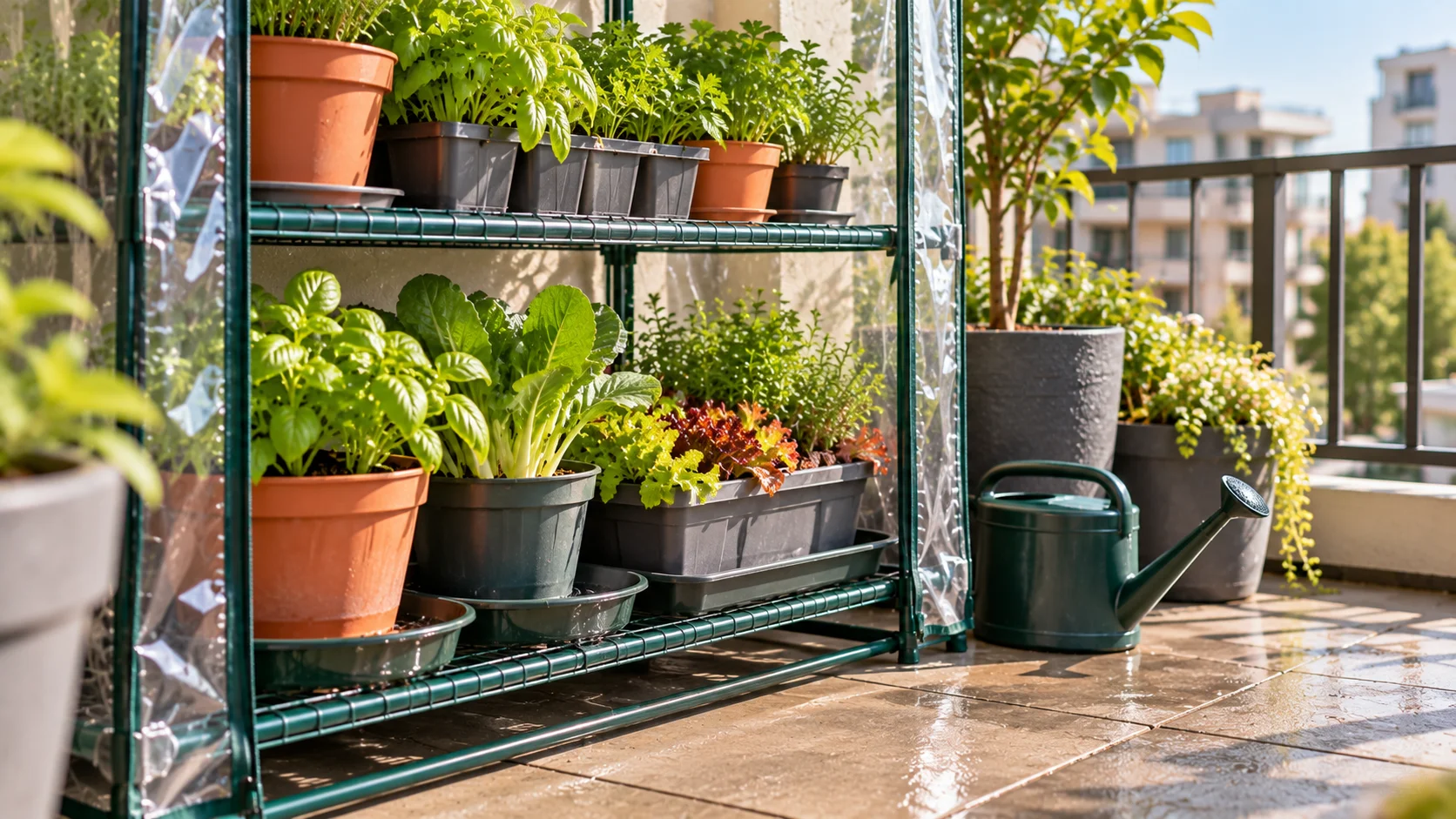
The greenhouse environment can also change how quickly containers dry. Enclosure, temperature, airflow, container size, plant size, and weather can all influence water use, so check the growing medium rather than automatically following an old watering schedule.
Our guide to how often to water balcony plants explains how to judge when balcony containers actually need water.
DIY Balcony Greenhouse or Greenhouse Kit?
You can purchase a greenhouse designed as a complete system or create a DIY enclosure for a balcony.
Neither approach is automatically better.
| Consideration | DIY Greenhouse | Greenhouse Kit |
|---|---|---|
| Size | Can potentially be customized | Predetermined dimensions |
| Assembly | Depends on your design | Usually follows manufacturer instructions |
| Ventilation | Must be planned into the design | Depends on the kit |
| Shelving | Can be customized | Usually fixed or manufacturer-designed |
| Installation | You are responsible for planning the setup | Follow manufacturer requirements while also checking building rules |
| Renter considerations | Avoid prohibited permanent modifications | Building restrictions still apply |
DIY can be attractive when you need unusual dimensions, but it also puts more responsibility on you to consider the structure, ventilation, weather exposure, and installation.
A greenhouse kit gives you a defined product with specified dimensions and components, but that doesn’t automatically make it appropriate for your particular balcony.
What to Look for in a Greenhouse Kit
If you decide to purchase a kit, evaluate the greenhouse based on your balcony conditions rather than marketing claims alone.
Dimensions: Check the assembled dimensions, not just the product photos.
Ventilation: Look at how the greenhouse actually opens and whether you’ll be able to adjust airflow conveniently.
Shelving: Check the manufacturer’s stated shelf capacities and whether the spacing works for the plants you intend to grow.
Cover: Determine whether the covering and structure are intended for the outdoor conditions in which you plan to use them.
Access: Make sure doors, zippers, or roll-up covers can operate in the available space and that you can comfortably reach the plants for watering, pruning, harvesting, and inspection.
Installation: Read the manufacturer’s instructions for assembling and securing the structure. Then make sure those methods are compatible with your building’s rules.
Replacement parts: For designs with removable covers or proprietary connectors, check whether replacement components are available. A damaged cover shouldn’t necessarily mean replacing the entire greenhouse.
These criteria will make it much easier to compare individual products if you later decide to shop for a greenhouse.
Are Mini Greenhouses Worth It for Apartment Balconies?
A mini greenhouse can be worth considering when your balcony receives useful light, has adequate space, building rules allow the structure, wind exposure can be appropriately addressed, and you want a protected area for seedlings or some degree of season extension.
It may be less practical when the balcony is extremely exposed to wind, receives very little useful sunlight, has limited floor space, or doesn’t provide a practical way to manage drainage.
A greenhouse is also a poor match if the main expectation is that a thin plastic enclosure will automatically keep plants warm throughout freezing winter weather.
Instead of simply asking whether mini greenhouses are worth it, ask:
What problem do I want the greenhouse to solve on my balcony?
If the answer is protecting seedlings, sheltering plants from some weather, or extending portions of the growing season, a small greenhouse may be useful.
If the answer is fixing inadequate sunlight or creating a guaranteed frost-free outdoor growing room, the greenhouse alone won’t solve the problem.
Frequently Asked Questions
Will a Mini Greenhouse Keep Plants Warm in Winter?
A mini greenhouse can capture solar heat and may create warmer conditions at certain times, but an unheated greenhouse shouldn’t be assumed to remain above freezing during cold nights. Heat can escape through the greenhouse covering and air leakage, so actual temperatures depend on the structure and weather conditions.
Does a Balcony Greenhouse Need Ventilation?
Yes. Practical ventilation is important because an apartment balcony greenhouse can overheat in sunny or warm weather. Washington State University Extension notes that excessive greenhouse heat can stunt or kill plants and that doors and vents can provide natural ventilation when conditions allow.
For a small balcony greenhouse, look for a design you can open and close easily as conditions change.
Can You Use a Mini Greenhouse on a Windy Balcony?
Wind exposure needs careful consideration before putting a greenhouse on a balcony. Greenhouse wind forces are affected by factors including wind speed, exposure, structure height and shape, orientation, and open doors or vents.
Follow the manufacturer’s installation requirements and make sure the permitted installation method is appropriate for your location and building rules rather than assuming an improvised attachment or a particular amount of ballast will make every greenhouse suitable.
Final Thoughts
An apartment balcony greenhouse can be useful for seedlings, weather protection, and extending parts of the growing season—but only when it fits the conditions of the balcony.
Before buying one, check your building rules, available space, sunlight, wind exposure, loaded weight, ventilation, and drainage. Then choose a greenhouse that fits those conditions rather than simply buying the largest model that fits the floor space.
For most apartment gardeners, the realistic goal isn’t creating a miniature year-round outdoor growing room. It’s creating a manageable protected space that makes part of your existing balcony garden more useful.