Best Grow Lights for Indoor Plants: A Beginner’s Guide
Natural window light is enough for many houseplants, but apartments do not always provide it where you want to grow. A north-facing room, a shelf several feet from a window, nearby buildings, or shorter winter days can leave plants with less light than they need.
That is where grow lights for indoor plants become useful. They can supplement natural daylight or provide light in spaces that otherwise would not support healthy plant growth.
For most apartment gardeners, LED grow lights are a practical place to start. They are available in compact designs, use less energy than many older horticultural lighting systems, and generally operate at relatively low temperatures. The Royal Horticultural Society notes that LEDs can be energy efficient, long lasting, and suitable for home growing setups.
The challenge is choosing the right one.
Grow-light listings can quickly become confusing with terms such as wattage, full spectrum, PPFD, Kelvin, coverage area, timers, and mounting distance. You do not need to become a lighting expert to grow healthy plants indoors.
The goal is simply to choose a light that fits your plants, your growing area, and your apartment.
This beginner’s guide explains what to look for, the main types of grow-light setups, how long to use them, how far to place them from plants, and how to tell when your plants are getting too little or too much light.
Affiliate Disclosure: This article may contain affiliate links. If you purchase through one of these links, we may earn a commission at no additional cost to you.
In This Guide
Do Indoor Plants Really Need Grow Lights?
Not every indoor plant needs a grow light.
If your plants already receive enough natural daylight from a suitable window, adding artificial lighting may be unnecessary. In fact, making better use of the light you already have is often the simplest place to start.
The RHS recommends making the most of available natural daylight before relying on artificial lighting. It also notes that many plants struggle when placed too far from windows or in locations where light levels are very low.
Grow lights may be useful when:
- your apartment has limited window space
- nearby buildings block much of the daylight
- plants sit several feet from a window
- winter daylight becomes noticeably weaker
- you want plants in a darker part of the apartment
- a plant shelf receives little natural light
- your plants show signs that their current light is inadequate
Window direction also makes a difference. The amount of direct light a window receives varies by direction and season. North- and east-facing locations generally receive fewer hours of direct sun than south- and west-facing locations.
Before buying a light, observe your apartment for a few days.
Look at where daylight reaches in the morning, afternoon, and evening. You may find that moving a plant closer to an appropriate window solves the problem.
If it does not, a grow light gives you much more flexibility over where you can keep plants.
If you are still planning your indoor growing area, our step-by-step guide to starting an indoor garden covers location, containers, watering, and other setup basics.
How Grow Lights Work
Plants use light to make food through photosynthesis. Without enough usable light, they cannot produce the energy needed for normal growth.
The RHS notes that low light can contribute to weak, pale, or spindly growth because plants are not receiving enough energy for healthy development.
A room can look bright to us while still providing relatively little useful light for a plant.
That is why ordinary household lighting should not automatically be treated as plant lighting. RHS guidance specifically distinguishes regular domestic lighting from artificial grow lamps designed to provide the intensity plants need.
For beginners, three things matter most:
Intensity: how much light reaches the plant.
Duration: how many hours the plant receives that light.
Spectrum: the wavelengths of light being produced.
These factors work together. A weak light does not necessarily become suitable just because it stays on longer, and a strong fixture can be excessive if it is positioned too close to a plant that prefers lower light.
The goal is not to buy the brightest fixture available. It is to match the light to the plant and growing area.
What to Look for When Choosing Grow Lights for Indoor Plants
When comparing grow lights for indoor plants, focus on the features that actually affect how well the light will work in your space.
Light Intensity
Different plants need different amounts of light.
A shade-tolerant foliage plant generally has lower light requirements than a succulent, flowering plant, seedling, or fruiting crop.
Light intensity affects photosynthesis and overall growth, and individual plants vary in how much they need.
This is one reason wattage alone is not enough to judge a grow light.
Some manufacturers provide PPFD measurements or coverage charts. These can be more useful than wattage when comparing fixtures because they give a better idea of how much usable light reaches a specific area.
Beginners do not need to memorize PPFD ranges, though.
Start by identifying:
- what type of plants you are growing
- how large the growing area is
- how much natural light is already available
Then look for a fixture intended for that situation.
Full-Spectrum Light
You will see the phrase full spectrum on many grow-light listings.
In simple terms, full-spectrum grow lights are designed to provide a broad range of wavelengths useful for plant growth.
Plants absorb light across different wavelengths, with blue and red light playing important roles. RHS guidance notes that blue light supports vegetative growth while red light contributes to growth and flowering.
Many apartment gardeners prefer white-appearing full-spectrum LEDs because they fit more naturally into a living room, office, or bedroom than strongly purple red-and-blue lighting.
Coverage Area
Coverage is easy to overlook.
A small light may appear bright but still illuminate only a narrow portion of your plants.
A clip-on fixture may work well for one or a few plants but may not evenly cover an entire shelving unit. Likewise, there is little reason to buy a large fixture if you only need to supplement one houseplant.
Think about the physical growing area, not just the number of plants.
Ten small plants may occupy less space than one mature floor plant.
Timer and Adjustability
A timer makes maintaining a consistent lighting schedule much easier.
Some fixtures have built-in timers. Others can be connected to an outlet timer or compatible smart plug.
Adjustability is also valuable.
Being able to raise, lower, angle, or dim a fixture makes it easier to respond as plants grow or as seasonal daylight changes.
This is especially useful for:
- seedlings
- young plants
- mixed plant collections
- adjustable plant shelves
- taller houseplants
Heat and Energy Use
Heat matters in apartments because grow lights are often positioned close to furniture, shelves, and plants.
LED horticultural lighting typically operates at lower temperatures than older high-intensity systems, which can make LEDs easier to use in smaller home growing spaces.
Always follow the fixture manufacturer’s instructions for installation, ventilation, mounting, and clearance.
Energy use matters too because grow lights may run for many hours a day.
A fixture that uses modest power can make more sense for a small plant collection than an oversized light designed for a much larger growing area.
Types of Grow Light Setups for Apartments
You do not need a professional-looking grow room to give houseplants additional light.
Several compact setups work well in apartments.
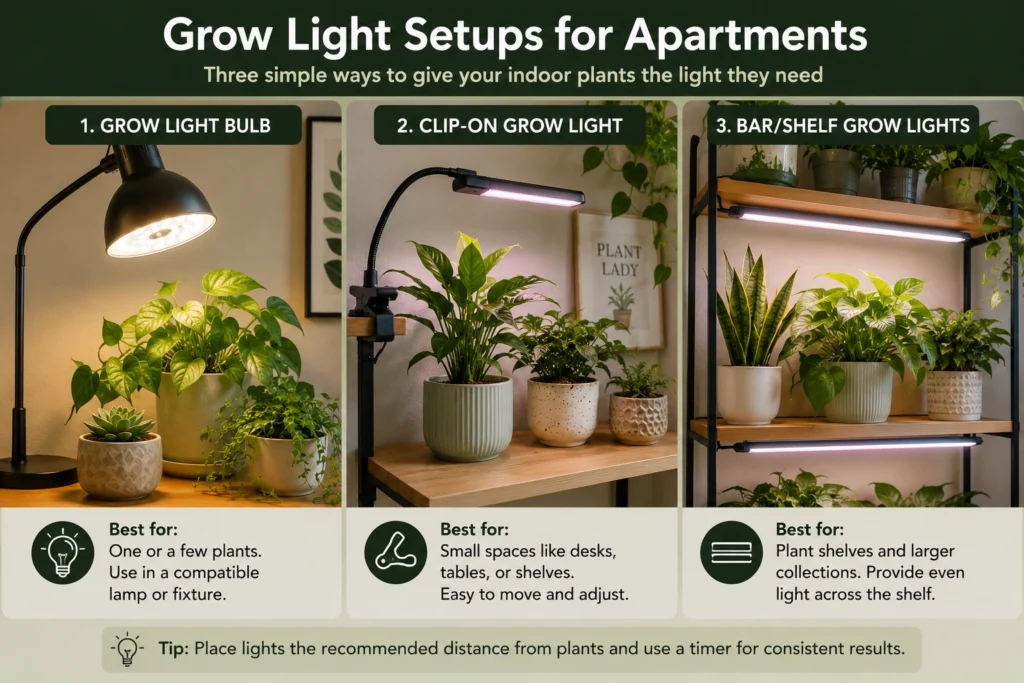
Grow-Light Bulbs
Grow-light bulbs are one of the simplest options.
Many use a standard screw base and can be used in compatible lamps or fixtures. That makes them convenient if you already have a directional lamp positioned near your plants.
They work especially well for:
- one large houseplant
- a small group of plants
- a darker corner
- a decorative plant display
- renters who want a movable setup
Make sure the fixture is rated for the bulb and can direct light toward the plant rather than simply lighting the surrounding room.
Clip-On Grow Lights
Clip-on lights are useful when floor space is limited.
Depending on the model, they may attach to a:
- shelf
- desk
- table
- plant stand
- sturdy ledge
Many include flexible arms, dimming controls, or built-in timers.
Their main limitation is coverage. A compact clip-on light may work nicely for a few plants but not for a large collection.
Standing Grow Lights
Standing fixtures can work well for floor plants or small groups of plants where there is no convenient shelf or table.
They are also easy to move.
The downside is obvious in a small apartment: they take up floor space.
Shelf and Bar Grow Lights
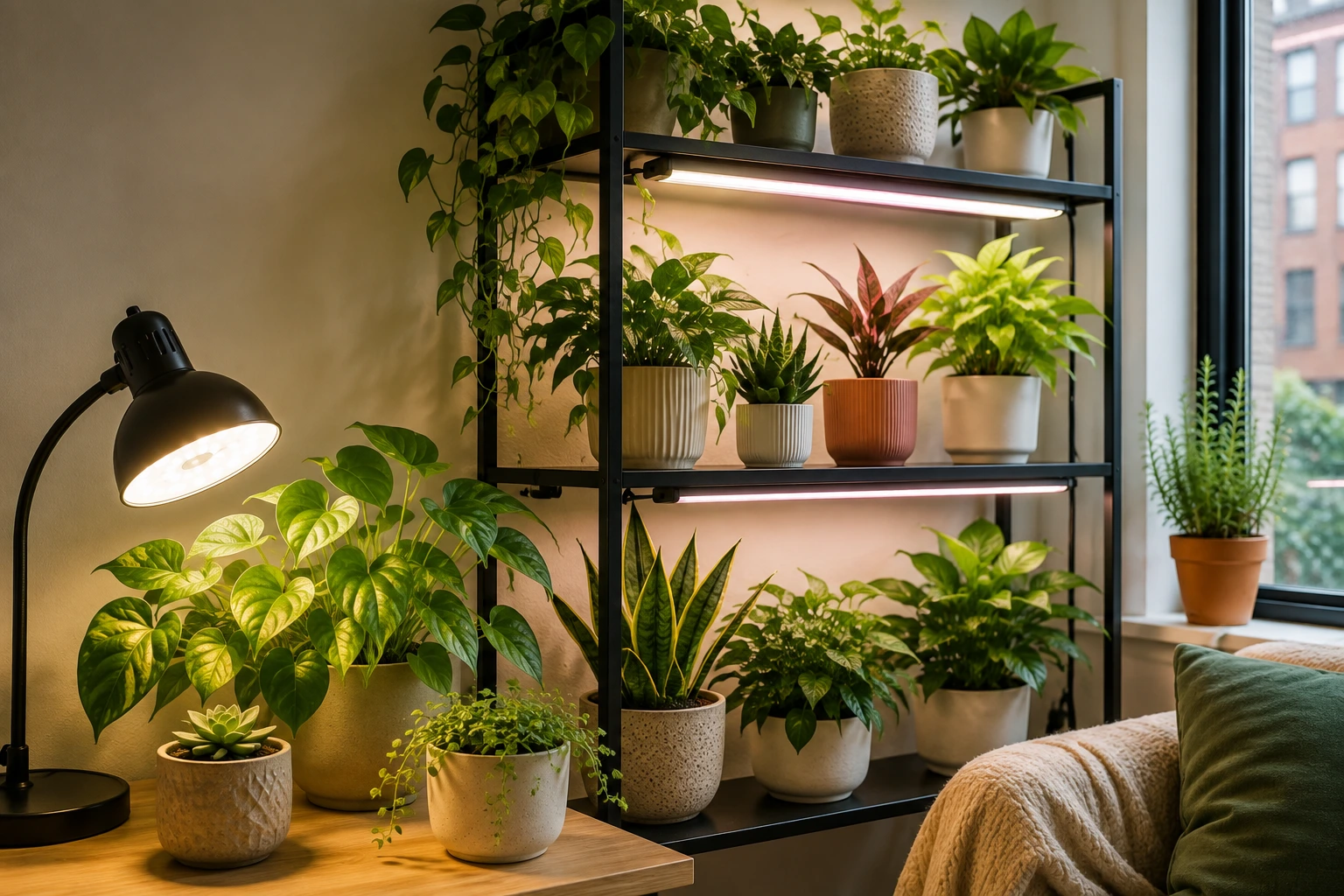
Bar-style or strip-style grow lights are especially useful for plant shelves.
Instead of trying to illuminate several plants from one bulb positioned off to the side, you can place lights above each shelf.
That can provide more even coverage across the growing area.
Hanging Grow Lights
Hanging fixtures can provide broader coverage, but they require an appropriate mounting location.
If you rent your apartment, check your lease before drilling into ceilings or walls.
A standing or shelf-mounted system may be a better choice if you want to avoid permanent installation.
3 Grow Light Options for Common Apartment Setups
The most useful grow light depends on where and how you grow.
Rather than recommending several nearly identical products, these three options represent three different apartment-growing situations.
We have not personally tested these products. They are included because their documented formats and features fit common indoor growing setups.
A Simple Bulb Option: SANSI 36W Full-Spectrum LED Grow Light Bulb
If you have one or a few plants and already own a compatible lamp, a screw-in grow-light bulb may be the simplest solution.
The SANSI 36W Full-Spectrum LED Grow Light Bulb is an example of this type of setup.
It allows you to use a compatible lamp instead of adding another floor stand or mounting an entire lighting system.
Best suited for:
- one or a few plants
- a plant in a darker corner
- an existing directional lamp
- renters who want a simple setup
The fixture matters as much as the bulb. It needs to safely support the bulb and allow you to position the light above or toward the foliage.
Check the SANSI 36W Grow Light Bulb on Amazon →
A Compact Clip-On Option: GooingTop Clip-On Grow Light
For a desk, small shelf, or compact plant stand, a clip-on fixture can be more convenient.
The GooingTop Full-Spectrum Clip-On Grow Light represents this type of setup.
Because the fixture and support are combined, you do not need a separate lamp or floor stand.
Best suited for:
- desk plants
- a small shelf
- a few compact plants
- limited floor space
- renters who want something movable
Coverage is the main consideration. A small clip-on fixture should not be expected to evenly light a large collection.
Want a closer look before buying? Read our GooingTop Clip-On Grow Light Review: Is It Worth It? for a detailed look at its design, ideal uses, strengths, limitations, and whether it is a good match for a small apartment plant setup.
Check the GooingTop Clip-On Grow Light on Amazon →
A Plant-Shelf Option: Barrina T5 2-Foot Grow Lights
Once several plants are arranged on a shelving unit, bar lights often make more sense.
The Barrina T5 2-Foot Grow Lights use a linkable bar-style design, which makes this type of fixture useful for plant shelves and other organized growing areas.
Best suited for:
- plant shelves
- several small or medium plants
- organized indoor growing areas
- expanding plant collections
The number of lights and the mounting distance still need to match the plants being grown. A linkable system gives you flexibility, but it does not eliminate the need to pay attention to intensity and coverage.
Check the Barrina T5 Grow Lights on Amazon →
Quick Comparison
| Option | Best For | Main Advantage | Main Consideration |
|---|---|---|---|
| SANSI 36W bulb | One or a few plants | Simple setup | Requires a compatible fixture |
| GooingTop clip-on | Small spaces | Compact and adjustable | Limited coverage |
| Barrina T5 bars | Plant shelves | Expandable coverage | Requires mounting |
Choose based on your plants and available space rather than simply choosing the product with the most features.
Best Grow Light Setup for Different Apartment Situations
Your growing location can often tell you which fixture style makes the most sense.
One Houseplant
A directional grow-light bulb may be enough.
Position the lamp so the light reaches the foliage instead of simply brightening the room.
A Few Plants on a Desk or Table
A clip-on light can work well because it requires little additional space and can usually be repositioned easily.
Check that the beam actually covers the entire grouping.
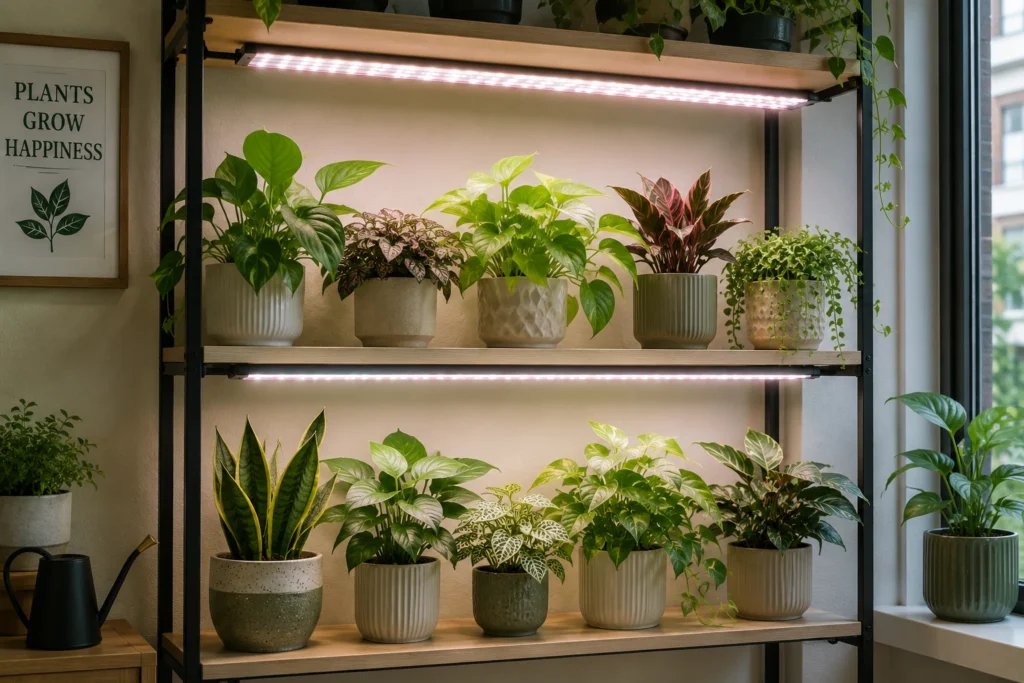
Plants on a Shelving Unit
Bar or strip lights are usually more practical.
Placing a light above each shelf can provide more even coverage than one small fixture positioned to the side.
A Large Floor Plant
A standing light or directional lamp with a compatible grow bulb may work better.
Make sure the fixture is tall enough to direct light toward the foliage.
A Window That Needs Supplemental Light
Grow lights do not always have to replace sunlight.
A window may provide useful natural light for part of the day but still benefit from supplemental lighting during darker months or shorter days.
For a broader look at indoor growing conditions, see our indoor apartment gardening guide.
How Far Should Grow Lights Be From Indoor Plants?
There is no single correct distance for every grow light.
The appropriate distance depends on:
- fixture output
- fixture design
- plant species
- plant maturity
- light requirements
- daily lighting duration
- available natural light
A stronger fixture may need to be farther from the foliage than a small low-output light.
Start with the manufacturer’s recommended mounting distance.
Then watch the plant.
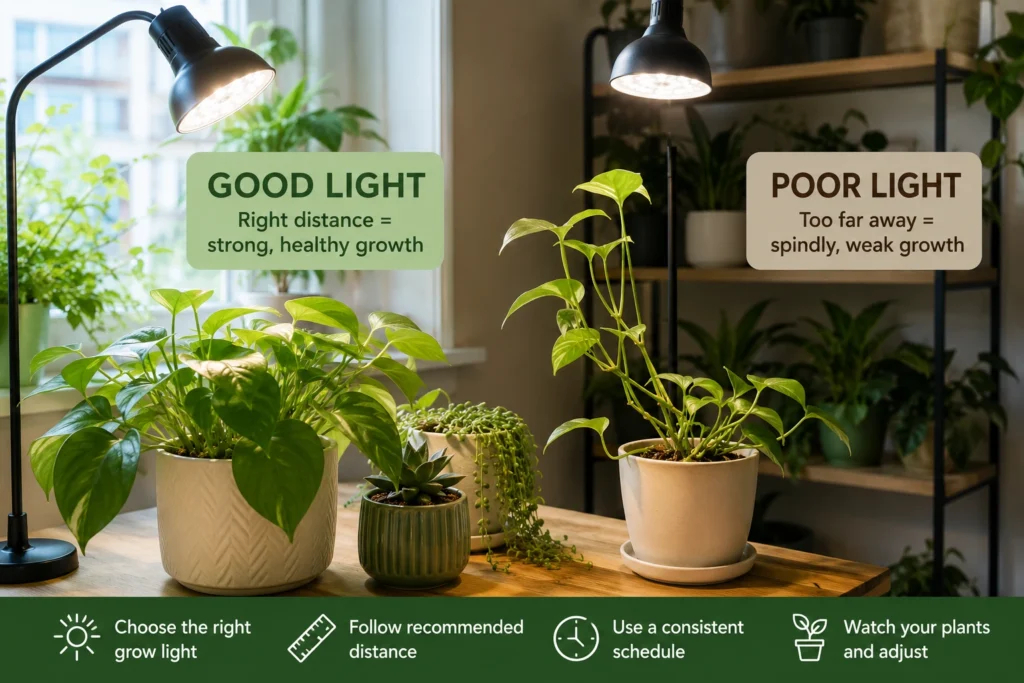
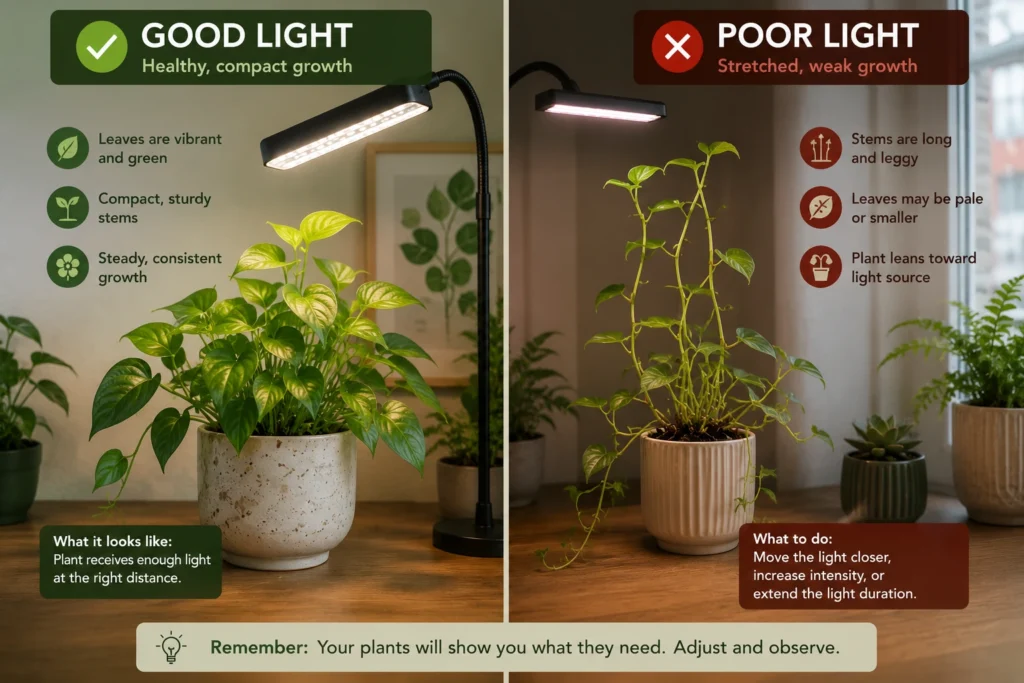
If growth becomes stretched or spindly, the plant may not be receiving enough light. RHS guidance notes that plants growing in low light can become tall and elongated as they try to reach a better light source.
If foliage nearest the fixture becomes pale, bleached, or stressed, the light may be too intense or too close.
Do not immediately move the light several feet in either direction. Make gradual adjustments and continue observing the plant.
The simplest rule is:
Use the manufacturer’s recommendations as your starting point and the plant’s response as feedback.
How Long Should Grow Lights Stay On?
There is no universal lighting schedule for every houseplant.
The right duration depends on:
- the plant species
- the intensity of the fixture
- how much natural daylight the plant already receives
- whether the light supplements daylight or provides most of the plant’s light
RHS guidance includes artificial-light setups that operate for extended daily periods, including around 16 hours in certain situations. That should not be treated as a universal requirement for every houseplant.
A plant beside a bright window and receiving supplemental light is in a different situation from one being grown primarily under artificial lighting.
Instead of copying one number from the internet:
- Check the plant’s light requirements.
- Account for natural daylight.
- Follow the fixture manufacturer’s guidance.
- Use a consistent schedule.
- Adjust based on plant response.
A timer makes consistency much easier.
Signs Your Plants Need More or Less Light
Plants often give you clues when their lighting conditions are not working.
Signs of Too Little Light
Possible signs include:
Weak or spindly growth.
Plants may produce elongated stems as they stretch toward available light.
Pale growth.
Leaves and shoots may look lighter or weaker than normal.
Leaning strongly toward the light.
Plants commonly grow toward a stronger light source.
Fewer flowers.
Flowering and fruiting plants often require more energy and therefore more light.
RHS guidance specifically identifies weak, pale, spindly growth and reduced flowering or fruiting as possible signs of inadequate light.
Signs of Too Much Light
Problems can also occur when a fixture is too intense or too close.
Watch for:
- bleaching
- unusually pale foliage near the light
- stressed-looking leaves
- damage concentrated on the side closest to the fixture
If symptoms appear primarily on foliage nearest the grow light, check the manufacturer’s distance guidance and consider raising or dimming the fixture.
Light is not the only possible cause of plant problems. Watering, temperature, pests, roots, and nutrition can produce similar symptoms.
Look at the plant’s entire growing environment before assuming the light is responsible.
6 Common Grow Light Mistakes
A grow light is useful, but it cannot fix every indoor gardening problem.
Avoid these common mistakes.
1. Putting the Light Too Far Away
Light intensity decreases as distance increases.
A lamp can make the room look bright without providing enough useful light at leaf level.
Follow the fixture manufacturer’s recommended distance.
2. Putting the Light Too Close
Closer is not always better.
Too much intensity can stress foliage, and some fixtures may also produce unwanted heat at close range.
Start with the recommended distance and adjust gradually.
3. Choosing a Light Based Only on Wattage
Wattage tells you how much electrical power a fixture uses. It does not tell you exactly how much usable light reaches the plant.
Coverage, fixture efficiency, distance, and output all matter.
Use manufacturer coverage information or light-output data when available.
4. Expecting a Tiny Light to Cover Too Much Space
This is common with small clip-on lights.
The plants directly beneath the fixture may receive enough light while plants around the edges receive much less.
Choose a fixture that matches the size and shape of your growing area.
5. Leaving Grow Lights On Continuously
More hours do not automatically mean better growth.
Plants have different light and dark requirements, and a 24-hour lighting schedule should not be assumed to be beneficial.
Use a consistent schedule that fits the plant and lighting setup.
6. Treating Every Plant the Same
A fern, succulent, foliage plant, seedling, and flowering plant may have very different light requirements.
Research the needs of the individual plant rather than placing everything under identical conditions.
How to Choose a Grow Light for a Small Apartment
A grow light has to work for your home as well as your plants.
Before buying one, consider five practical questions.
How Much Space Are You Lighting?
Measure the actual area occupied by your plants.
One pothos on an end table does not need the same lighting setup as a five-tier plant shelf.
Where Can the Fixture Go?
Look at the furniture and surfaces around your plants.
You may already have room for a compatible lamp. A shelf may be suitable for a clip-on light. A dedicated plant rack may work better with bars or strips.
Can You Adjust It?
An adjustable light is easier to reposition as plants grow or seasonal daylight changes.
Height, angle, and dimming controls can all add flexibility.
Can You Automate the Schedule?
A built-in timer is convenient, but it is not essential.
A compatible outlet timer can accomplish the same basic job for many setups.
Will You Be Comfortable Living With It?
This matters more in an apartment than it might in a greenhouse.
Think about:
- glare
- fixture size
- cord placement
- brightness in the evening
- how the light looks in the room
A grow light that works well but annoys you every time you walk into the room probably is not the best long-term choice.
Grow lights are only one part of creating a successful small-space garden. If you are new to the topic, our complete beginner’s guide to apartment gardening covers plant selection, containers, watering, light, and other fundamentals.
Grow Lights vs. Low-Light Plants: Which Is Better?
Sometimes the easiest solution to a darker apartment is choosing plants suited to the light you already have.
If a location receives usable but modest natural light, a low-light-tolerant plant may be simpler than installing another fixture.
But even shade-tolerant plants still need light. RHS guidance emphasizes that even plants adapted to shade require light for photosynthesis.
If a location is too dark, or you want to grow a plant with higher light requirements, supplemental lighting gives you more flexibility.
For plant choices suited to lower natural light, see our guide to low-light indoor plants for apartments.
Key Takeaways
Choosing grow lights for indoor plants does not have to be complicated.
Use natural daylight where it works and add artificial light where it does not.
Match the fixture to the plant and growing area rather than buying based on wattage alone.
For many apartment gardeners, LEDs are a practical option because they are available in compact, efficient formats.
Follow the manufacturer’s guidance for mounting distance and operation.
Most importantly, watch your plants. Their growth will tell you whether the lighting setup needs adjustment.
Frequently Asked Questions
What Type of Grow Light Is Best for Indoor Plants?
For many apartment gardeners, a full-spectrum LED grow light is a practical starting point.
The best fixture style depends on the growing area. A bulb may work for one or two plants, while bar-style lighting may be more appropriate for an entire shelf.
Can Regular LED Lights Grow Indoor Plants?
Ordinary household LEDs are not automatically equivalent to horticultural grow lights.
Plants need sufficient intensity and usable wavelengths at the foliage. RHS guidance distinguishes regular domestic lighting from artificial grow lamps intended to provide appropriate lighting for plants.
How Many Hours a Day Should Grow Lights Be On?
There is no universal schedule.
The appropriate duration depends on the plant, light intensity, and amount of natural daylight already available.
Some artificial-lighting setups operate for long daily periods, but that does not mean every houseplant should receive the same number of hours.
How Close Should a Grow Light Be to Indoor Plants?
Follow the manufacturer’s recommended mounting distance for the specific fixture.
Different lights produce different levels of intensity, so one universal distance cannot be applied to every product.
Watch for stretched growth when light is insufficient and bleaching or stress when the light is too intense.
Do Low-Light Plants Need Grow Lights?
Not necessarily.
If a low-light-tolerant plant receives enough natural light in its current location, supplemental lighting may not be needed.
Low-light tolerance does not mean the plant can grow indefinitely in darkness.
Can Grow Lights Replace Sunlight?
Artificial lighting can supplement natural daylight and can also support plants in locations where natural light is insufficient.
For most apartment gardeners, however, it makes sense to use suitable natural daylight first and add artificial light where needed.