Growell Hydroponics Growing System Kit Review
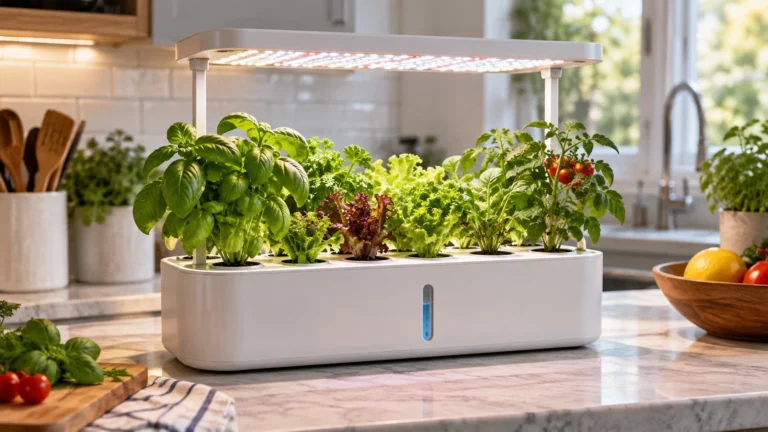
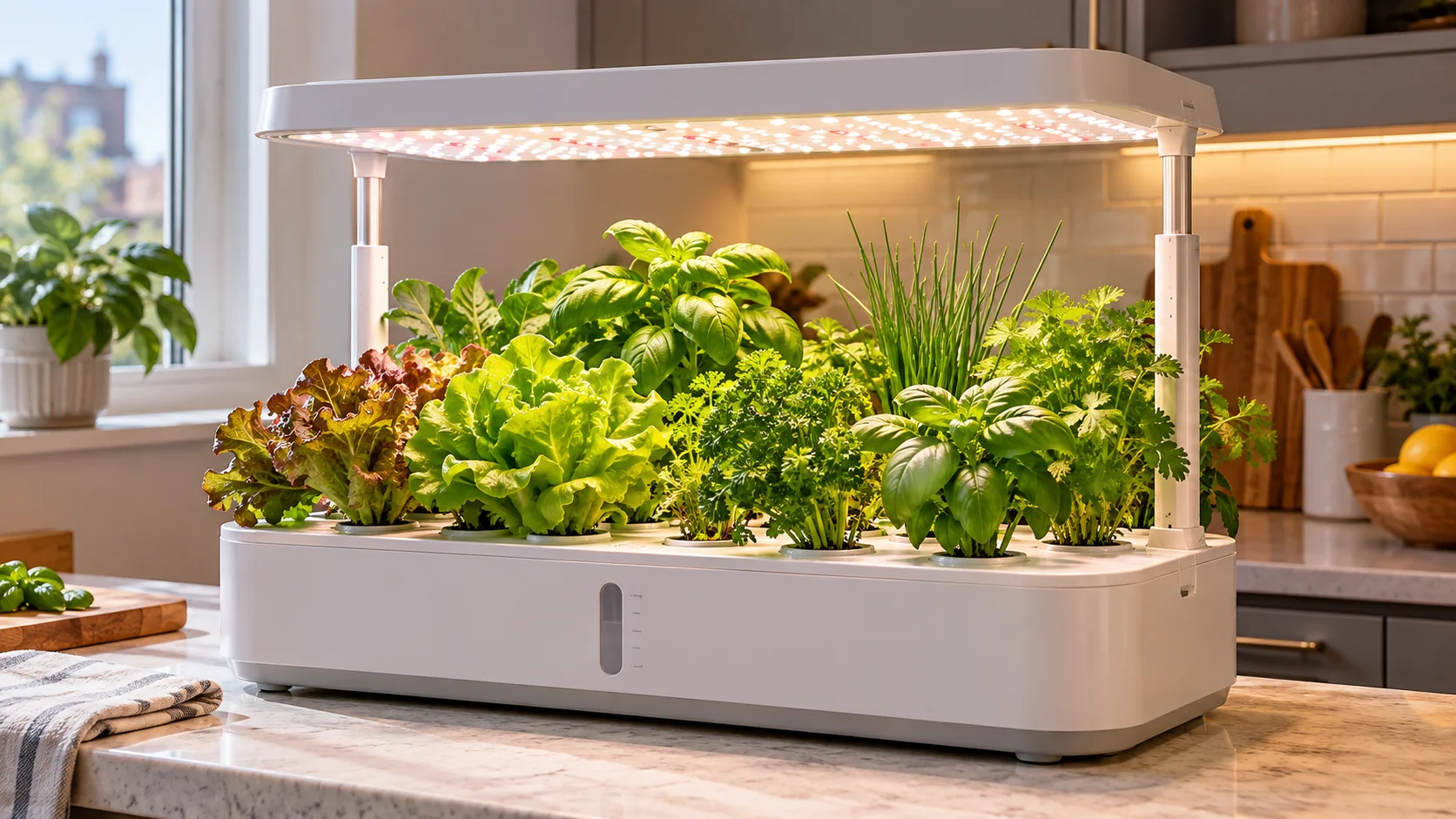
The Growell Hydroponics Growing System Kit HS02 is a 17-pod indoor hydroponic garden built around a 10L reservoir, integrated 28W LED grow light, water-circulation pump, and two built-in fans. It provides more planting positions than many smaller countertop herb gardens without requiring the floor space of a large vertical hydroponic system. Growell documents these core features for the HS02.
But the number 17 needs some context.
Seventeen planting positions do not necessarily mean there is enough light and physical space for 17 large mature plants. What you grow—and how large those plants become—matters just as much as the number of openings in the grow deck.
Apartment Garden Guide has not personally tested the Growell HS02. This review is based on manufacturer documentation, available owner evidence, horticultural guidance, and our editorial analysis of how the system’s design fits realistic indoor growing.
Disclosure: As an Amazon Associate, I earn from qualifying purchases.
Check the latest price and availability on Amazon
In This Review
Growell HS02 at a Glance
| Feature | Growell HS02 |
|---|---|
| Product type | Countertop indoor hydroponic garden |
| Planting positions | 17 |
| Reservoir | 10L / about 2.64 gallons |
| Grow light | 28W full-spectrum LED |
| LEDs | 102 |
| Light modes | Vegetable; Flowers & Fruits |
| Light cycle | 16 hours on / 8 hours off |
| Light adjustment | 7.6–23.8 inches |
| Fans | Two built-in, three-speed fans |
| Water circulation | Pump with a 30-minute cycle |
| Display | 5.4-inch screen |
| Child lock | Yes |
| Materials | Food-grade ABS and stainless steel, according to Growell |
| Model | HS02 / GWHS02GY |
| Wi-Fi/app control | Not documented for the HS02 |
These are manufacturer specifications rather than measurements performed by Apartment Garden Guide. Growell documents the HS02 with 17 planting positions, a 10L reservoir, 28W/102-LED fixture, two adjustable three-speed fans, two lighting modes, an adjustable 7.6-to-23.8-inch light pole, 5.4-inch display, child lock, and circulating pump.
Readers who want to compare those specifications with the manufacturer’s documentation can review the Growell HS02 product specifications.
Bottom Line
The Growell HS02 makes the most sense for indoor gardeners who want to grow multiple herbs, lettuce, and other relatively compact crops in one countertop system.
Its 17 planting positions provide useful flexibility, while the 10L reservoir, integrated lighting, water circulation, and dual fans put the basic growing hardware into one unit.
Its main limitation is space rather than pod count. Leafy greens and compact herbs can make good use of the grow deck, but larger herbs, strawberries, peppers, and tomatoes require progressively more room.
Think of the HS02 as a 17-position garden, not a promise that 17 mature plants of any type will fit comfortably.
How We Researched the Growell HS02
Apartment Garden Guide did not perform original hands-on testing of this system.
For this review, we examined Growell’s HS02 product documentation, researched available experiences involving the 17-pod Growell format, and compared the system’s design with university Extension guidance about indoor hydroponics, plant size, lighting, and crop selection.
We did not independently measure light output, operating noise, water consumption, growth rate, or crop yield. Manufacturer performance claims are therefore treated as manufacturer claims rather than Apartment Garden Guide test results.
That distinction matters. Growell, for example, advertises substantially faster growth compared with conventional soil cultivation. We have not found sufficiently strong independent testing of this exact model to present a specific growth multiplier as an established result.
What’s Included With the Growell HS02?
Growell lists a fairly extensive starter package for the HS02.
| Included component | Quantity |
|---|---|
| Hydroponic system | 1 |
| Planting baskets | 17 |
| Growing sponges | 17 |
| Germination covers | 17 |
| Plant tags | 17 |
| Hole covers | 9 |
| Tweezers | 1 |
| Rubber stopper | 1 |
| A+B nutrients | Included |
| A+B nutrient refill pack | Included |
| Power adapter | 1 |
| User manual | 1 |
Seeds are not listed among the standard included components, so plan on choosing your own.
That’s not necessarily a disadvantage. Selecting your own seeds allows you to prioritize varieties that actually fit the available growing space instead of simply planting whatever happens to come with a starter kit.
Because retail configurations and bundled accessories can change, check the current listing before purchasing if a particular accessory is important to you.
Realistic Planting Capacity: What Fits in 17 Pods?
This is where the Growell’s specifications require some interpretation.
A planting opening occupies very little space. A mature plant may occupy many times that amount.
As plants develop, they begin competing for canopy space, light, root-zone space, water, nutrients, and airflow. That means 17 lettuce plants and 17 tomato plants are completely different gardening propositions.
Crops That Make the Most Sense
Rather than treating every pod as equal growing capacity, consider the mature size and growth habit of each crop.
| Crop | Practical fit for this format | What to consider |
|---|---|---|
| Leaf lettuce | Strong fit | Compact growth and progressive harvesting |
| Baby greens | Strong fit | Harvested before reaching large mature size |
| Chives | Strong fit | Naturally compact |
| Cilantro | Strong fit | Suitable for regular harvesting |
| Parsley | Good fit | Mature foliage needs some space |
| Basil | Good fit | Regular pruning helps manage the canopy |
| Dill | Needs planning | Some varieties become tall |
| Kale/chard | Needs extra spacing | Large leaves can shade neighboring plants |
| Strawberries | More involved | Need spacing, adequate light, and pollination management |
| Micro-dwarf tomatoes | Possible with fewer occupied pods | Fruiting plants need considerably more space |
| Compact peppers | Possible with fewer occupied pods | Longer growing cycle and larger canopy |
| Standard tomatoes | Likely to outgrow the format | Height and canopy become limiting |
| Cucumbers/squash | Generally impractical | Vining growth requires substantially more space |
This emphasis on herbs and leafy greens isn’t arbitrary. University of Illinois Extension’s home hydroponics guidance specifically recommends leafy greens and herbs as practical indoor hydroponic crops because they grow quickly and take up relatively little space. The same guidance notes that larger fruiting crops such as tomatoes require more time and room.
If culinary herbs are your main goal, our guide to growing an indoor herb garden covers herb selection, lighting, and indoor growing considerations in more detail.
You Don’t Have to Fill Every Pod
An empty planting position isn’t necessarily wasted capacity.
Suppose you want to grow several basil plants alongside lettuce. Allowing additional room around mature basil may produce a more manageable canopy than filling every neighboring opening.
The included hole covers can be used over positions you aren’t using.
You can also stagger some plantings so that young greens, developing plants, and harvest-ready plants aren’t all reaching maximum size simultaneously.
The important point is to treat the 17 openings as flexible capacity rather than a target you must keep filled.
Lighting, Growing Height, and Airflow
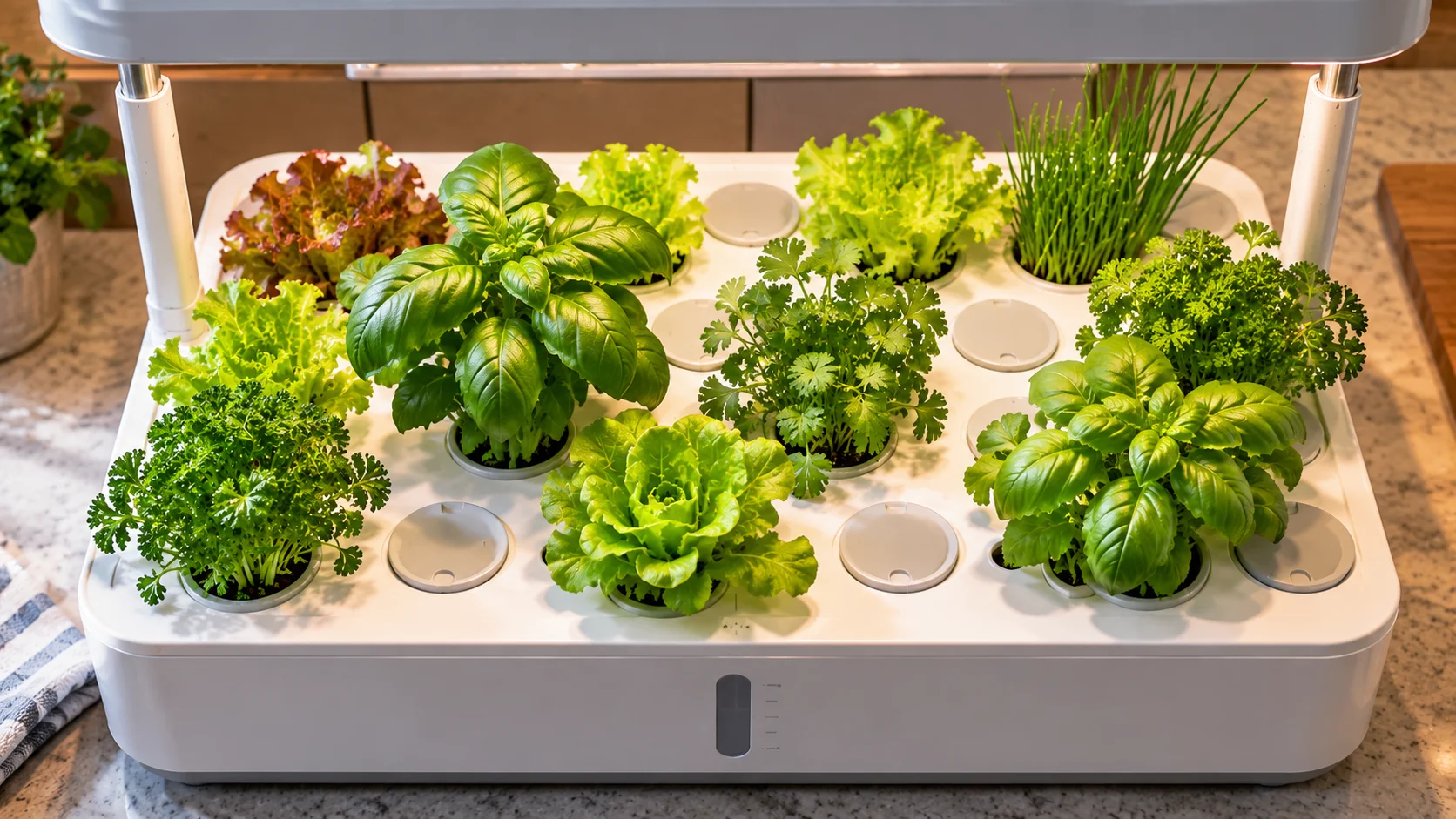
Three parts of the Growell work together above the reservoir: the adjustable LED fixture, the available vertical space, and the two built-in fans.
Understanding their limitations is more useful than looking at any one specification by itself.
How Much Growing Height Is Actually Available?
Growell lists the light pole as adjustable from approximately 7.6 to 23.8 inches.
That doesn’t mean a plant can necessarily grow 23.8 inches tall.
The specification describes the adjustable lighting hardware. Plants still need appropriate separation from the fixture, and the exact usable plant height depends partly on how the manufacturer measures that adjustment.
Once the fixture reaches its maximum position, taller plants have nowhere else to go. Broad plants can also extend beyond the main light footprint or shade their neighbors.
This is one reason plant variety matters as much as species.
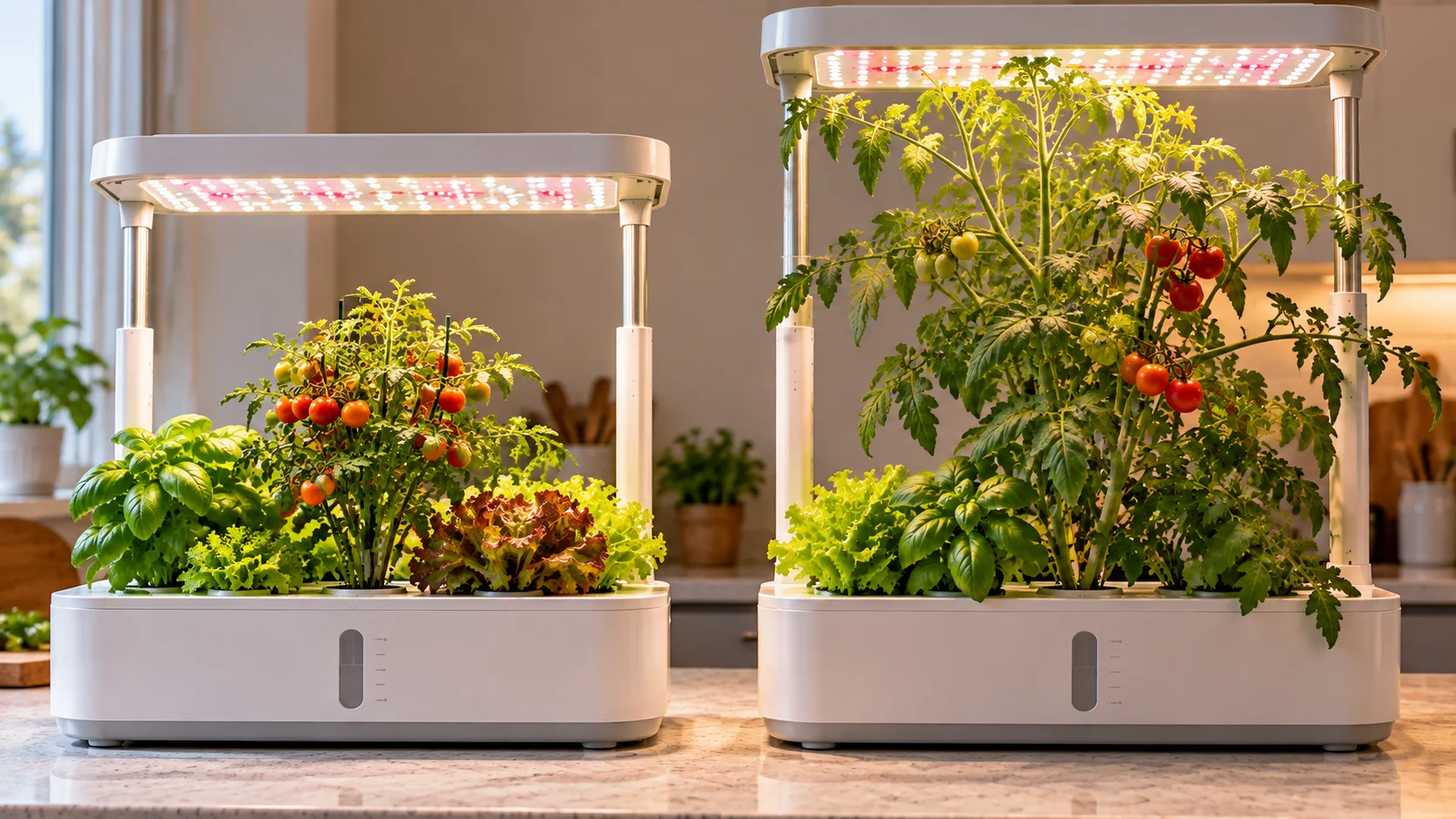
Cherry Tomatoes Aren’t Necessarily Compact Plants
A common beginner assumption is that cherry tomatoes remain small because the fruit is small.
They don’t necessarily.
Many cherry tomatoes develop vigorous vines. If you specifically want tomatoes for a compact countertop hydroponic garden, look for varieties described as micro-dwarf, dwarf, or compact/container tomatoes rather than relying on fruit size as an indication of mature plant size.
Even compact tomatoes should receive considerably more room than lettuce or chives.
Is the 28W Grow Light Enough?
Growell documents a 28W full-spectrum LED fixture containing 102 LEDs, with Vegetable and Flowers & Fruits modes. The manufacturer’s automatic lighting schedule runs for 16 hours followed by an eight-hour sleep period.
But wattage alone cannot tell us how much usable light reaches every plant.
Other factors include fixture efficiency, PPFD at canopy level, coverage, distance between the fixture and plants, plant species, canopy density, and photoperiod.
We have not found independent PPFD measurements or a verified coverage map for this exact Growell fixture. For that reason, we would not claim that every one of the 17 positions receives identical light or that the fixture provides enough intensity for every fruiting crop.
Our guide to choosing grow lights for indoor plants explains why wattage alone isn’t enough and goes deeper into PPFD, coverage, spectrum, mounting distance, and lighting duration.
This distinction also has support from Extension guidance. University of Minnesota Extension’s indoor-lighting guide emphasizes matching plants to their light environment and discusses spectrum and photoperiod rather than treating wattage as the sole measure of plant lighting. Its current guidance lists approximately 12–14 total hours of light per day for hydroponic lettuce and herbs, illustrating why crop needs matter when interpreting a manufacturer’s preset schedule. University of Minnesota Extension
That does not mean Growell’s 16-hour setting is inherently wrong. It means a manufacturer’s automatic schedule shouldn’t be interpreted as proof that every crop has identical lighting requirements.
What Do the Two Fans Add?
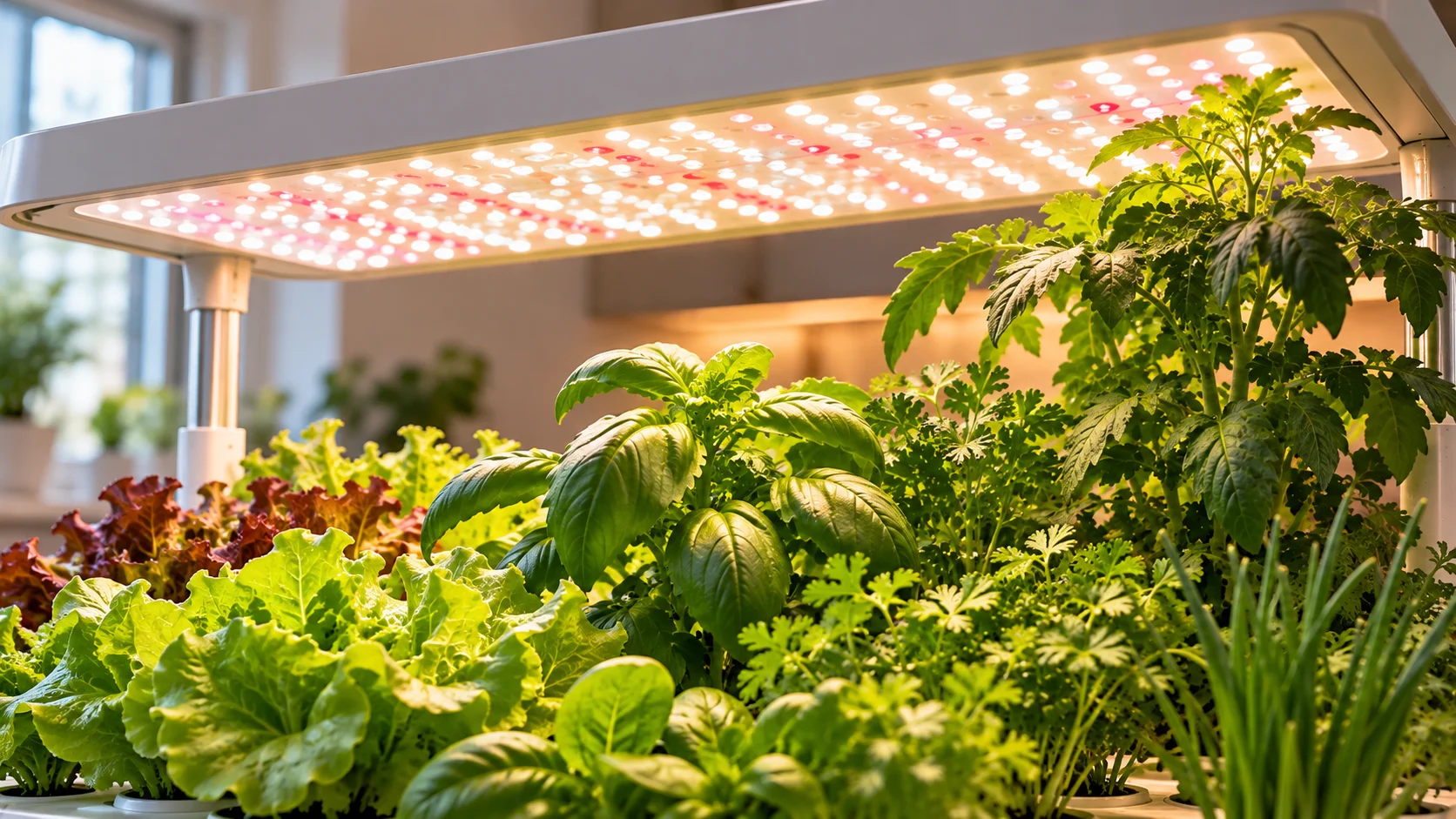
Growell equips the HS02 with two adjustable three-speed fans as part of the system’s ventilation design.
Their practical benefit is air movement around the plant canopy, which becomes increasingly relevant as foliage fills the growing area.
We would not go further and claim the fans guarantee mold prevention, eliminate plant disease, or automatically pollinate every flowering crop. Growell markets the fans partly around airflow and pollination, but actual pollination requirements vary by crop and growing conditions.
The fans also introduce another potential source of audible sound. That’s worth remembering if the system will operate in a bedroom, office, or other quiet area.
Reservoir, Nutrients, and Routine Maintenance
The 10L reservoir is one of the more appealing HS02 specifications, particularly compared with smaller countertop gardens. Ten liters is approximately 2.64 U.S. gallons.
But reservoir capacity shouldn’t be converted into a promised number of days between refills.
Water consumption changes as plants grow and varies with crop type, number of plants, temperature, humidity, airflow, and other conditions.
Don’t Rely on a Fixed Refill Schedule
A garden containing young lettuce seedlings may use relatively little water.
The same reservoir supporting several mature plants can behave very differently.
Rather than assuming the tank will last a specific number of weeks, monitor the water level and learn how quickly your particular plants use it.
Included Nutrients Don’t Make the System Maintenance-Free
Growell supplies A+B nutrients and an A+B refill pack with its documented HS02 package.
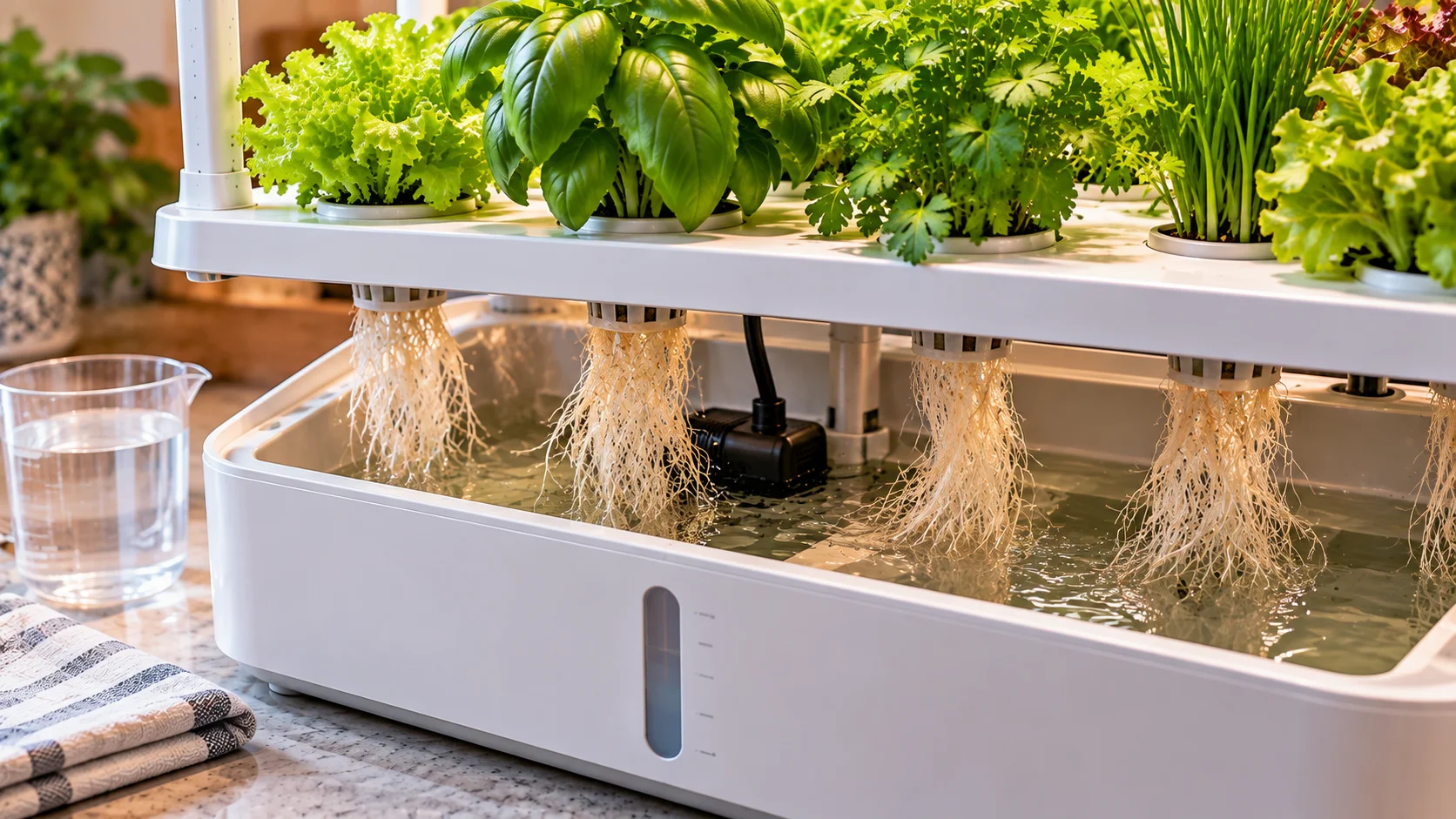
Hydroponic plants rely on their nutrient solution for elements they would otherwise obtain through soil and fertilizer. Simply adding water indefinitely isn’t the same thing as maintaining an appropriate nutrient solution.
Follow the product’s nutrient-mixing and maintenance instructions rather than improvising concentrations.
If you’re new to growing without soil, our beginner’s guide to indoor hydroponic gardening explains nutrients, pH, lighting, and routine system care in more detail.
A Simple Maintenance Routine
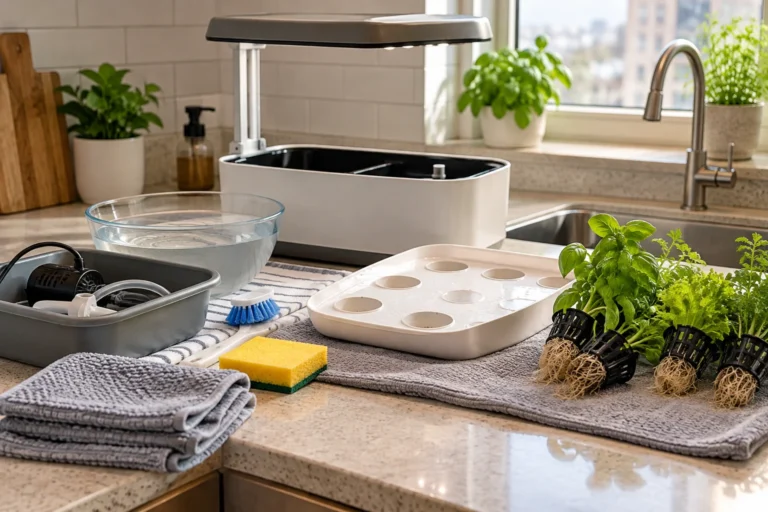
During normal use, periodically check the water level rather than waiting for plants to wilt. Look at plant roots for excessive growth around components and remove dead plant material when appropriate. Inspect the pump area to make sure roots and debris aren’t interfering with circulation.
Above the reservoir, monitor the plant canopy and prune or harvest plants that are heavily shading smaller neighbors. Adjust the light height as plants grow while maintaining appropriate clearance.
Finally, clean the reservoir and planting components according to the manufacturer’s instructions, particularly between crops or when refreshing the system.
These are general hydroponic maintenance principles, not evidence that the HS02 has a particular root, pump, or sanitation problem.
What Available Growell Owner Evidence Tells Us
Owner reports can reveal practical issues that specifications don’t, but they need to be treated cautiously.
A single customer’s experience does not establish how every Growell unit will perform, and reports from different Growell models should not be transferred to the HS02 as though they were the same product.
For that reason, owner evidence is most useful here for illustrating practical considerations rather than calculating failure rates or promising particular results.
Plant Size Is a Real Consideration
Available discussion involving Growell’s 17-pod format reinforces the physical issue already identified in this review: larger plants can consume substantially more growing space than the number of planting openings suggests.
That doesn’t mean the Growell cannot grow larger crops. It means a successful seedling isn’t the same thing as a plant that will remain appropriately sized through maturity.
This is particularly important with tomatoes, peppers, and other long-season fruiting crops.
Herbs and Greens Align Better With the Format
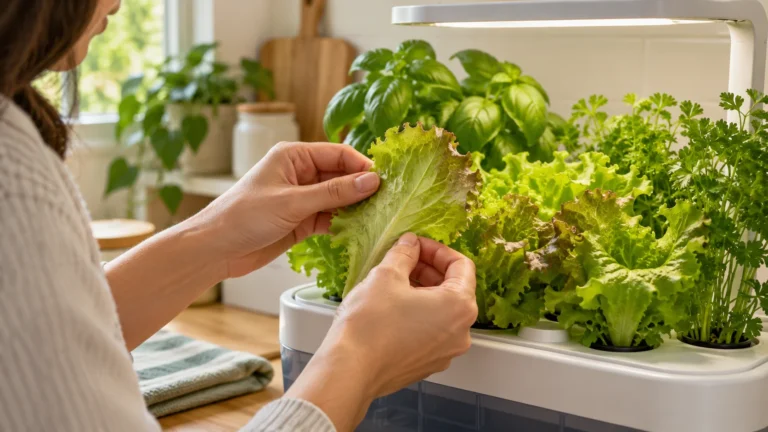
Compact herbs and leafy crops align more naturally with the Growell’s physical dimensions because they can be harvested regularly and generally demand less individual canopy space than large fruiting plants.
That conclusion also matches current Illinois Extension guidance, which specifically points beginners toward leafy greens and herbs for indoor hydroponics because of their relatively quick growth and modest space requirements.
What the Evidence Doesn’t Establish
We have not found strong enough independent evidence for this exact model to calculate a meaningful long-term pump failure rate, LED failure rate, fan failure rate, leak rate, exact operating noise level, or universal reservoir-refill interval.
That does not mean those components are unreliable.
It means the available evidence isn’t strong enough to quantify their long-term reliability, and we would rather leave those questions open than turn a small number of experiences into statistics.
Is the Growell HS02 Practical for an Apartment?
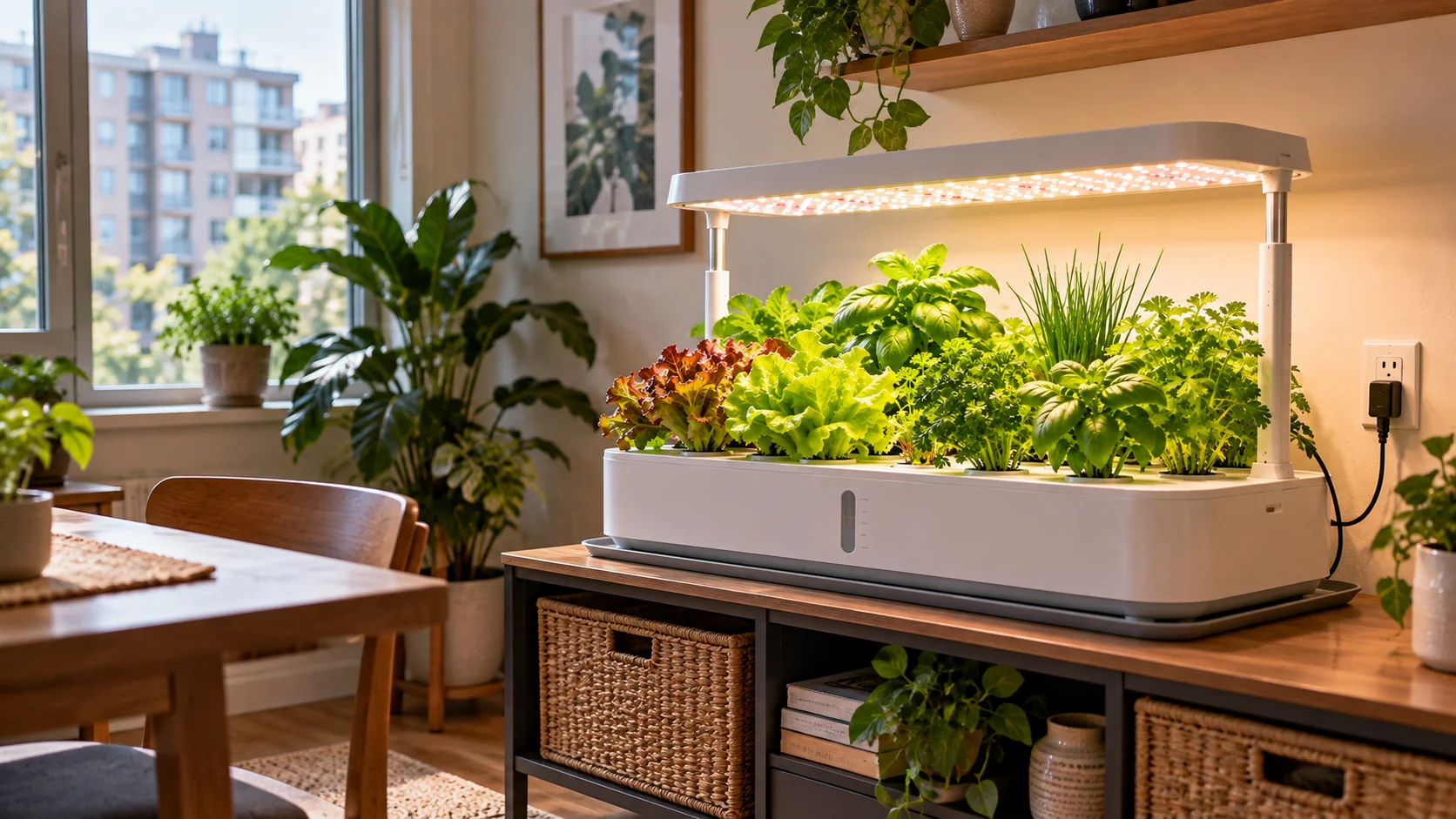
The countertop format makes the Growell particularly relevant for apartment gardeners, but the dimensions of an empty appliance aren’t the only space consideration.
Plan for the Operating Footprint
A hydroponic garden needs room around it.
Mature basil, lettuce, kale, strawberries, or fruiting plants can extend beyond the edges of the grow deck. You’ll also need access for raising the light, adding water and nutrients, pruning, harvesting, cleaning, and reaching the controls.
Make sure the location provides enough overhead clearance for the lamp to be raised as plants develop.
Think About Light Spill
The Growell’s automatic cycle operates its grow light for 16 hours before an eight-hour sleep period.
That’s worth considering in a studio apartment, bedroom, home office, or living room. A location that seems unobtrusive during daylight can become much more noticeable when the rest of the room is dark.
Protect the Surface Underneath
Hydroponic gardening involves water.
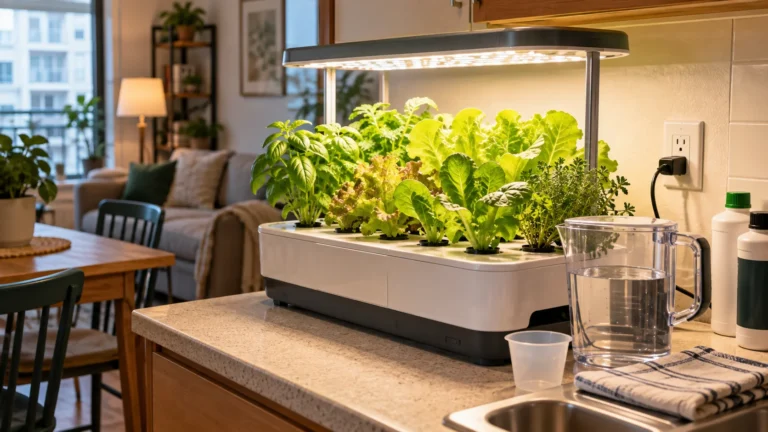
Place the system on a stable surface that can tolerate occasional splashes during refilling, harvesting, or maintenance. Be especially careful around unfinished wood furniture and electronics.
The system also needs convenient electrical access without placing plugs, power connections, or extension connections where spilled water could reach them.
Consider Noise Before Choosing the Room
Growell describes the HS02 pump as quiet, but we have not independently measured its operating sound. The system also uses two fans.
That doesn’t establish that the system is loud. It simply means room choice deserves consideration if you’re particularly sensitive to background noise.
For broader planning beyond one hydroponic appliance, our guide to gardening in an apartment covers additional space, lighting, and plant-selection considerations.
Alternatives for Different Indoor Growing Needs
Not every alternative to the Growell should be treated as a direct competitor.
A small countertop hydroponic garden, an enclosed grow tent, and a large vertical tower solve different growing problems. The most useful comparison is therefore based on what you want to grow, not simply which product has the largest number.
LETPOT LPH-Max: The Closest Countertop Alternative
Of the alternatives we researched, the LETPOT LPH-Max is the most relevant direct countertop comparison.
LETPOT documents the LPH-Max with 21 planting positions, a 7.5L tank, 36W grow light, app control, automatic water refilling, and automatic nutrient dosing.
That creates a meaningful difference in approach.
The Growell emphasizes a relatively large 10L onboard reservoir and built-in airflow. The LETPOT emphasizes greater automation and remote control.
Someone who values automated water and nutrient management may prefer the LETPOT’s approach. Someone who doesn’t need that degree of automation may find the Growell’s feature set more appropriate.
Check the latest price and availability for the LETPOT LPH-Max on Amazon
Spider Farmer 2×2 Kit: More Room for Fewer Plants
The Spider Farmer 2×2 Grow Tent Kit isn’t another countertop hydroponic garden.
That’s precisely why it can be a useful alternative.
A grow tent dedicates considerably more physical space to a much smaller number of plants. That approach can make more sense for someone whose primary goal is growing larger fruiting crops rather than maintaining many herbs and greens on a countertop.
The tradeoff is substantial: a 2×2-foot grow tent occupies considerably more apartment space and involves a more complex setup.
Check the latest price and availability for the Spider Farmer 2×2 Grow Tent Kit on Amazon
WooRoot: A Much Larger Vertical Approach
The WooRoot vertical hydroponic system moves in the opposite direction.
Rather than giving a few plants more individual room, it is designed around a much larger vertical growing format.
We haven’t found manufacturer-level documentation strong enough to independently verify all of the automation and capacity claims appearing in current marketplace descriptions. For that reason, we would compare the current listing carefully for overall dimensions, actual nursery versus grow-out capacity, lighting, maintenance requirements, and included equipment rather than assuming every advertised capacity figure represents mature plants.
Check the latest price and availability for the WooRoot hydroponic system on Amazon
What If 17 Pods Are More Than You Need?
The better alternative may simply be a smaller countertop system.
Our LETPOT LPH-SE review examines a 12-pod countertop garden for someone who doesn’t need Growell’s 17 planting positions.
You can also read our Ahopegarden Indoor Garden Hydroponics Growing System review if you’re comparing smaller all-in-one indoor gardens.
The goal isn’t to buy the system with the biggest number on the box. It’s to match the growing space and features to what you actually intend to grow.
Who Should Consider the Growell HS02?
The Growell makes the strongest case for someone who wants an all-in-one countertop hydroponic garden with room for multiple herbs or leafy greens, more planting flexibility than a small herb garden, a relatively large 10L reservoir, integrated lighting and water circulation, and built-in canopy airflow.
Its capacity can be especially useful if you plan to mix compact crops, stagger plantings, or intentionally leave additional space around larger plants.
If you’re trying to expand beyond a single countertop, our small-space gardening ideas cover additional ways to use shelves, windows, vertical areas, and other limited growing spaces.
Who May Be Better Served by Something Else?
Consider another approach if your main goal is growing large indeterminate tomatoes, sprawling cucumbers or squash, 17 large mature plants simultaneously, or one or two plants that need considerably more vertical and horizontal growing room.
Likewise, the Growell may not be the best match if app-based control, automatic nutrient dosing, and automatic reservoir refilling are high priorities.
The important question isn’t simply whether a particular seed can germinate in the Growell.
It’s whether that plant can realistically complete the part of its life cycle you care about within the available space.
Growell HS02 Pros and Cons
Pros
- 17 planting positions provide flexible capacity for herbs and greens
- Relatively large 10L reservoir for a countertop format
- Integrated 28W full-spectrum lighting
- Two adjustable built-in fans provide canopy airflow
- Adjustable light accommodates plants as they grow
- A+B nutrients and core starter accessories are documented as included
Cons
- Seventeen positions don’t equal room for 17 large mature plants
- Available vertical space limits taller crops
- No app or Wi-Fi control is documented for the HS02
- Fruiting crops require substantially more space and management
- Two fans create another potential source of operating sound
- Strong independent evidence about long-term component reliability is limited
Value, Ongoing Costs, and Support
The Growell’s value depends less on whether 17 is a bigger number than another garden’s pod count and more on whether you’ll actually use its combination of 17 planting positions, 10L reservoir, integrated light, circulating pump, and dual fans.
For someone primarily growing herbs and leafy greens, those features work together logically.
For someone who wants extensive automation, a system such as the LETPOT LPH-Max represents a different value proposition. For someone concentrating on one or two substantially larger plants, a grow-tent setup addresses a different set of priorities.
Remember that the purchase price isn’t the only ownership cost. Hydroponic gardening can require replacement growing sponges, nutrients, seeds, electricity, and eventually other consumable or replacement components.
How much those cost over time depends on how frequently you grow and which supplies you use, so we would not assign an artificial monthly ownership cost.
We also haven’t found warranty documentation clear enough for this exact HS02 configuration to make a specific warranty period part of our assessment. If warranty coverage is an important purchase factor, confirm the current terms with Growell or the seller before ordering.
Check the latest price and availability for the 17-pod Growell on Amazon
Final Verdict
The Growell Hydroponics Growing System Kit HS02 is most compelling as a relatively high-capacity countertop garden for herbs, lettuce, leafy greens, and other compact crops.
Its 17 planting positions offer flexibility, while the 10L reservoir, integrated 28W lighting, circulating pump, adjustable lamp, and two fans put the essential growing hardware into one appliance. Those core specifications are documented by Growell.
The key limitation is that planting capacity isn’t the same thing as mature-plant capacity.
Someone growing lettuce, chives, parsley, and regularly pruned basil can make very different use of those 17 positions than someone trying to grow tomatoes or peppers in every opening.
That isn’t necessarily a weakness unique to the Growell. It’s a physical reality of compact hydroponic gardens—and one buyers should understand before choosing a system based primarily on pod count.
For an apartment gardener who primarily wants compact edible crops and is comfortable managing water, nutrients, pruning, and plant spacing, the HS02 occupies an interesting middle ground between a small countertop herb garden and a much larger indoor growing system.
Frequently Asked Questions
How many plants can the Growell HS02 grow?
The Growell HS02 has 17 planting positions, according to Growell.
How many plants can comfortably remain in the garden through maturity depends on what you’re growing. Compact lettuce and herbs use much less canopy space than tomatoes, peppers, kale, and other larger crops.
Treat 17 as the number of available planting positions rather than a guarantee that 17 mature plants of every type will fit.
Does the Growell HS02 include a grow light?
Yes. Growell documents a 28W full-spectrum fixture with 102 LEDs, Vegetable and Flowers & Fruits modes, and an automatic 16-hour-on/8-hour-off cycle.
Wattage alone doesn’t establish how much usable light reaches every plant, however, so crop type, canopy density, coverage, and distance from the fixture still matter.
Can you grow tomatoes in the Growell HS02?
Tomatoes can be grown hydroponically, but variety selection matters considerably in a countertop system.
Look specifically for micro-dwarf, dwarf, or compact/container varieties rather than assuming a cherry tomato plant will remain small. Larger tomato plants will also require more canopy space, meaning fewer neighboring planting positions may remain practical.
How often does the 10L reservoir need refilling?
There isn’t a reliable universal interval.
Water use depends on the number of plants, crop type, plant maturity, temperature, humidity, airflow, and other growing conditions.
Check the reservoir regularly rather than relying on a promise that it will last a particular number of weeks.
Does the Growell HS02 have Wi-Fi or app control?
We have not found Wi-Fi or app control documented for the HS02. Growell instead describes the system’s onboard 5.4-inch display and button controls.
If remote app control and additional automation are priorities, that is one reason to compare the Growell with a system such as the LETPOT LPH-Max.
Are seeds included with the Growell HS02?
Seeds are not listed among the standard package contents in the Growell documentation we reviewed.
Plan to supply your own seeds. That also lets you choose compact varieties better suited to the HS02’s available growing space.