Indoor Hydroponic Garden: A Beginner’s Guide for Apartments
Growing fresh lettuce or basil in an apartment without a garden bed—or even a bag of potting soil—may sound complicated at first. But an indoor hydroponic garden can be surprisingly compact. Some setups fit on a countertop, while others use little more than a reservoir, plant support, water, and nutrients.
The catch is that hydroponics is not as simple as putting a plant in water and waiting for it to grow. Without soil, you take more direct control over the plant’s environment. Water, nutrients, oxygen, light, and pH all play a role.
That doesn’t mean you need to become a plant scientist before getting started. For a beginner, the bigger decision is choosing a system that matches your available space and how much maintenance you actually want to do.
This guide walks through the major types of indoor hydroponic systems, beginner-friendly crops, nutrients, pH, lighting, maintenance, and the differences between buying an all-in-one garden and building your own.
Affiliate Disclosure: This article may contain affiliate links. If you purchase through one of these links, we may earn a commission at no additional cost to you.
In This Guide
What Is an Indoor Hydroponic Garden?
Hydroponics is a way of growing plants without conventional soil. Instead of relying on soil to hold water and nutrients around the roots, a hydroponic system supplies water and dissolved mineral nutrients more directly.
That doesn’t always mean the roots are floating freely in water. Depending on the system, plants may be supported by materials such as perlite, coconut coir, rockwool, or expanded clay. The important distinction is that the plant isn’t depending on garden soil or ordinary potting soil for its nutrition.
Oklahoma State University Extension explains that hydroponic plants receive the nutrients needed for growth through a liquid nutrient solution.
This changes your role as the gardener. Soil normally provides some buffering against changes in moisture, nutrients, and pH. In hydroponics, you have more direct control over those conditions—but you also have more responsibility for maintaining them.
A basic system usually needs a few things: plants, a reservoir or container, water, nutrients, a way to support the plants, and adequate light. Some systems also require pumps, air stones, tubing, timers, or other equipment.
Penn State Extension explains that plants require essential nutrients for normal growth and that, in hydroponics, nutrients normally obtained from soil are supplied through the nutrient solution.
Learn more about hydroponic plant nutrition from Penn State Extension.
Is Hydroponic Gardening a Good Fit for an Apartment?
One of hydroponics’ biggest advantages is that you don’t need a backyard.
The University of Minnesota Extension describes hydroponics as a space-efficient option for people with little or no gardening space. It can also be used indoors throughout the year when suitable lighting is available.
The University of Minnesota Extension’s guide to small-scale hydroponics provides additional guidance for home growers working with limited space.
That makes it particularly interesting for apartment gardeners.
A countertop garden may hold several herbs or heads of lettuce in a relatively small area. A simple bucket system can occupy a corner near a window or grow light. Vertical systems can make use of height instead of spreading across the floor.
There are trade-offs, though.
Hydroponic gardening can involve more equipment than growing a plant in a regular container. Depending on the system, you may need to monitor water levels, nutrient concentration, pH, pumps, lighting, and root health.
Some systems also depend on electricity. Others don’t.
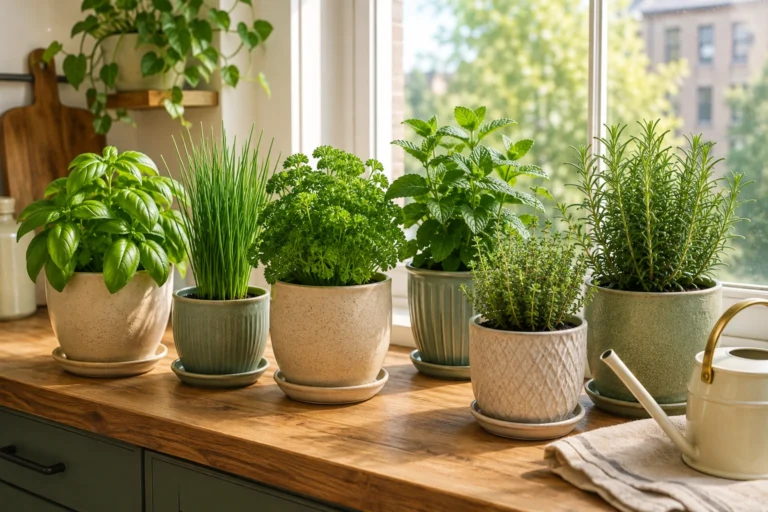
If you mainly want a couple of pots of basil, parsley, or chives on a sunny windowsill, hydroponics may be more system than you need. A traditional indoor herb garden may be the simpler choice.
But if you’re interested in growing several edible plants in a small footprint—and don’t mind learning how the system works—hydroponics becomes much more appealing.
How Does an Indoor Hydroponic Garden Work?
Although hydroponic systems can look very different, the basic idea is straightforward.
The plant needs access to:
- water
- essential mineral nutrients
- oxygen around its roots
- adequate light
- suitable temperatures
- physical support
A reservoir typically holds water mixed with hydroponic nutrients. The system then makes that solution available to the roots.
How that happens depends on the design.
In some systems, roots remain in the nutrient solution. In others, a pump continuously moves a thin layer of solution past the roots. Some periodically flood a growing area before draining the solution back into the reservoir.
Passive systems can work without a pump at all.
The plant absorbs water and nutrients as it grows, so the solution doesn’t remain unchanged. Water levels can fall, nutrient concentrations can shift, and pH can move over time.
That’s why a successful hydroponic garden is really about maintaining the root environment rather than simply keeping a reservoir full of water.
Types of Indoor Hydroponic Systems
You may encounter an intimidating number of hydroponic designs when you start researching them. Fortunately, an apartment beginner doesn’t need to master every one.
Here are the major types worth understanding.
Oklahoma State University Extension provides a useful overview of different types of hydroponic systems, including wick, water culture, ebb-and-flow, drip, NFT, and aeroponic systems.
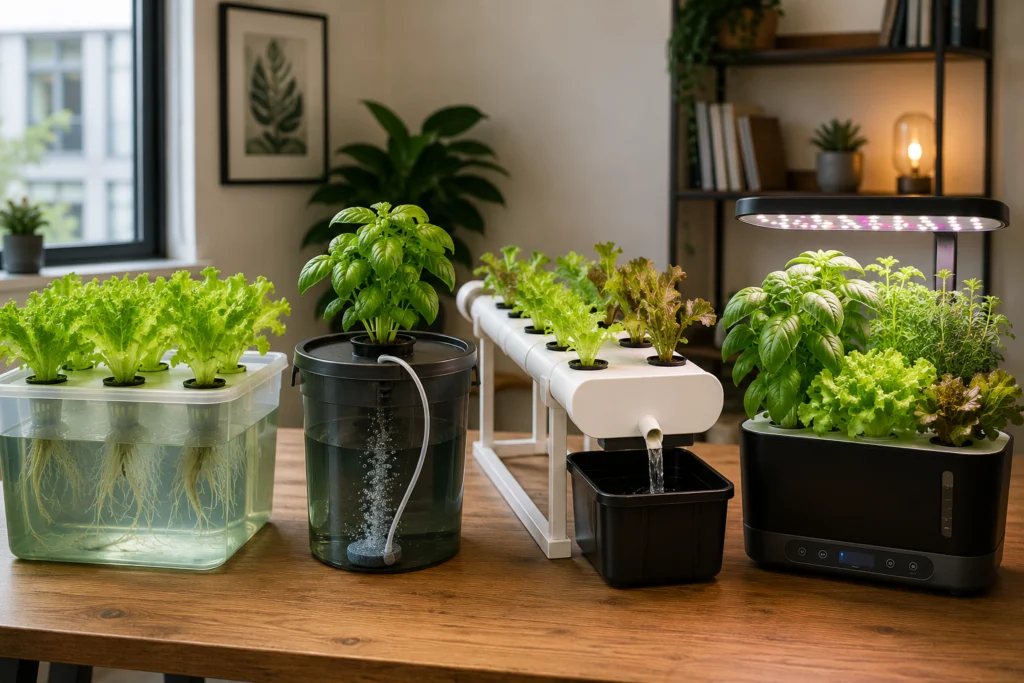
Kratky Method
The Kratky method is appealing because it removes much of the equipment associated with hydroponics.
It is a passive system. There is no water pump, air pump, timer, or continuously moving nutrient solution.
The plant is positioned above a reservoir with its roots initially reaching the nutrient solution. As the plant consumes water, the solution level gradually drops. This creates an air space between the plant and the remaining solution, allowing part of the root system access to oxygen.
UF/IFAS Extension has a helpful beginner’s guide to the Kratky hydroponic method if you’d like to see the method explained in more detail.
That simplicity can make Kratky particularly attractive in an apartment.
Leafy greens and herbs such as lettuce, spinach, kale, basil, and mint are better candidates than large, demanding fruiting plants.
One detail matters: the reservoir should block light. Light reaching nutrient-rich water can encourage algae growth.
Wick System
A wick system is another simple passive option.
Instead of putting the roots directly into a reservoir, a wick draws nutrient solution upward toward the growing medium through capillary action.
There are no water pumps or complicated plumbing components.
The downside is capacity. A wick can only move so much water, which makes the design better suited to smaller plants with modest water demands than large, thirsty crops.
For someone who values simplicity more than maximum production, that’s not necessarily a problem.
Deep Water Culture
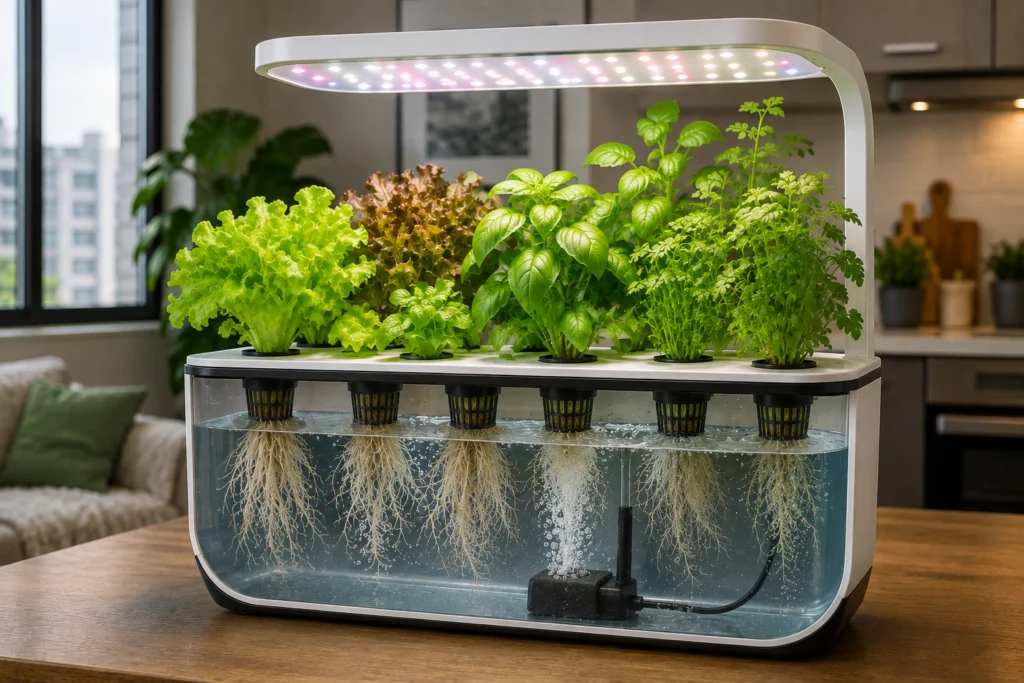
Deep water culture, usually shortened to DWC, places plant roots directly into a reservoir of nutrient solution.
The plants are commonly held above the water in net pots or another support. Their roots extend down into the solution.
Unlike the Kratky method, DWC normally uses an air pump and air stone to add oxygen to the water.
The University of Minnesota Extension describes DWC as one of the simplest approaches for small-scale home hydroponics and notes that a basic container can be as simple as a bucket or plastic storage bin made from an appropriate material.
DWC can work especially well with leafy greens and other relatively compact plants.
Its main trade-off is equipment. Once an air pump becomes important to keeping the root zone oxygenated, you have a system that depends on that equipment continuing to work.
Nutrient Film Technique
Nutrient film technique, or NFT, takes a different approach.
Instead of submerging the roots in a large reservoir, a pump continuously sends a shallow stream of nutrient solution through channels containing the plant roots. The solution then returns to the reservoir and circulates again.
NFT is commonly associated with lettuce, herbs, and other leafy crops.
It can make efficient use of space, but it’s more mechanically dependent than a passive system. Because there isn’t a large volume of water surrounding the roots, a pump failure can become a problem more quickly.
For a first apartment hydroponic experiment, NFT isn’t necessarily where you need to begin.
Ebb-and-Flow
Ebb-and-flow is also called flood-and-drain hydroponics.
A pump periodically sends nutrient solution into a grow tray or growing area. Once the growing medium has been flooded, the solution drains back into the reservoir.
That draining period is important because it allows air back around the roots and growing medium.
Ebb-and-flow can accommodate a variety of plants, but pumps, timers, trays, plumbing, and drainage make it more involved than Kratky, wick, or a basic DWC system.
Drip Systems
A hydroponic drip system delivers nutrient solution near the base of individual plants through small tubing or emitters.
This provides more control over where the solution goes and can work with larger plants.
The trade-off is additional equipment. Pumps, tubing, and emitters create more components to maintain, and small emitters can clog.
For an apartment beginner growing a few heads of lettuce, that extra complexity may not provide much benefit.
All-in-One Countertop Hydroponic Gardens
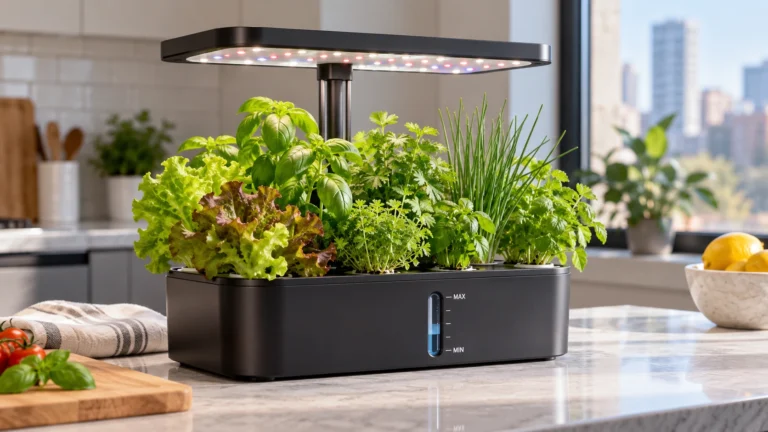
Then there are the systems you’re most likely to encounter while shopping online: self-contained countertop hydroponic gardens.
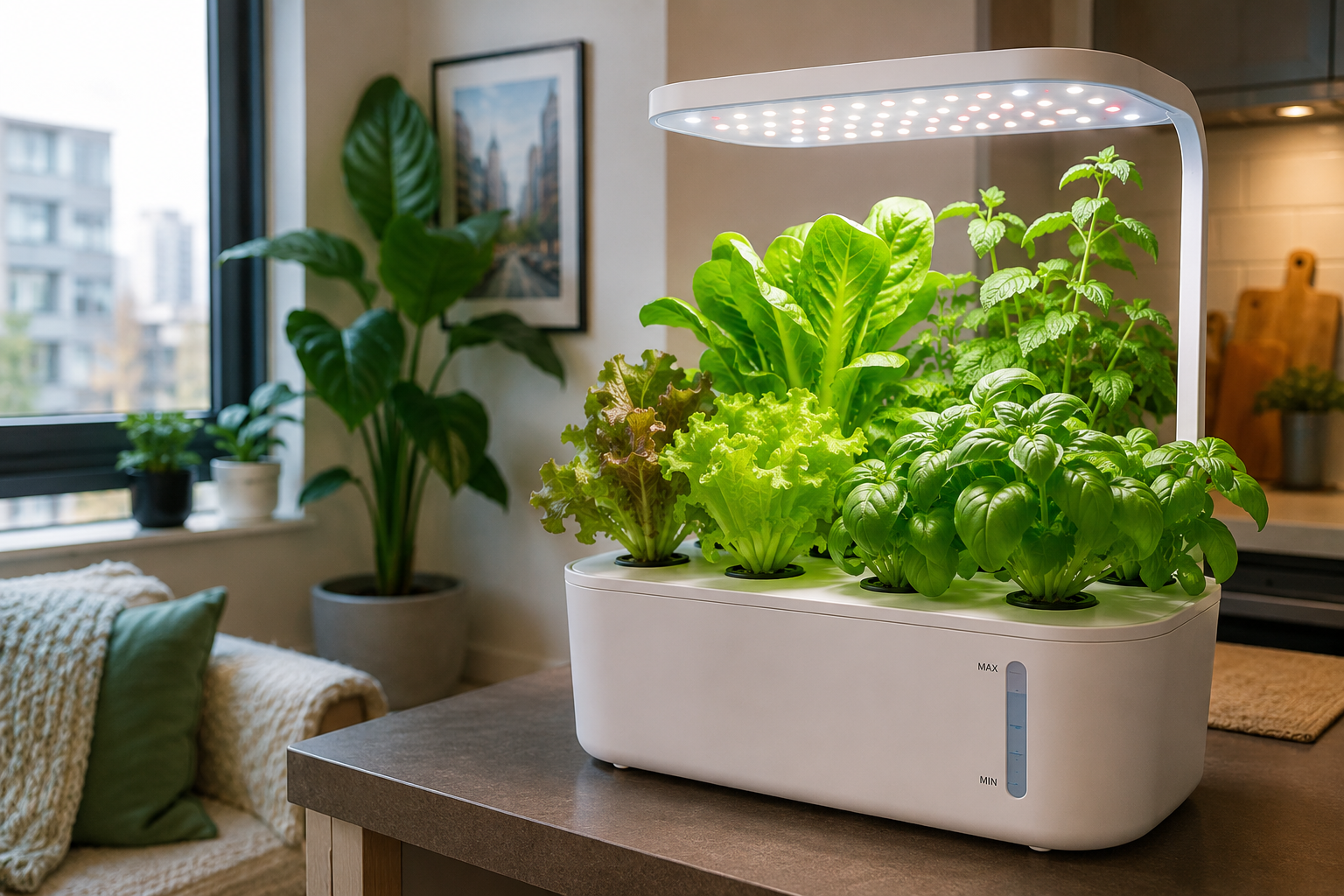
These commonly combine several components into one unit, such as:
- a water reservoir
- plant pods or baskets
- an LED grow light
- a pump
- a light timer
- water or nutrient reminders
Their appeal is convenience. Instead of choosing a reservoir, pump, light, timer, and plant support separately, much of the system has already been designed for you.
The compromise is flexibility. Some units use proprietary pods, nutrients, replacement parts, or accessories. Growing height can also be limited by the distance between the planting deck and light.
So an all-in-one garden may be easier to start with, but that doesn’t automatically make it the best choice for every apartment.
Which Hydroponic System Is Best for a Beginner?
There isn’t one system that wins for everybody.
A better question is: How involved do you want to be?
| System | Complexity | Powered Water/Aeration | Space Needed | Beginner Fit |
|---|---|---|---|---|
| Kratky | Low | No | Small | Very good |
| Wick | Low | No | Small | Good |
| DWC | Low–moderate | Yes | Small–medium | Good |
| NFT | Moderate | Yes | Medium | Fair |
| Ebb-and-flow | Moderate | Yes | Medium | Fair |
| All-in-one countertop | Low setup / moderate maintenance | Usually | Small | Very good |
If you want to learn more about active hydroponics without building something elaborate, a small DWC setup is another reasonable starting point.
If you’d rather avoid assembling individual components, a countertop system can remove much of the setup work.
There’s no prize for beginning with the most sophisticated system. Starting simple gives you a chance to learn how plants respond before adding more pumps, plumbing, and controls.
What Can You Grow in an Indoor Hydroponic Garden?
Technically, hydroponics can support a wide range of plants. That doesn’t mean every crop makes sense in a small apartment system.
Good Beginner Crops
For a first grow, leafy plants are hard to ignore.
Good possibilities include:
- lettuce
- spinach
- basil
- other leafy greens
- compact herbs
The University of Minnesota Extension specifically points to herbs and leafy greens as good choices for indoor hydroponic production.
These plants make practical starting crops because you aren’t waiting for them to develop large fruit. Their size is also more compatible with countertop gardens and smaller reservoirs.
Crops That Need More Space and Care
Hydroponic tomatoes, peppers, cucumbers, and strawberries are certainly possible.
They simply raise the difficulty.
A tomato plant doesn’t stop needing space because its roots aren’t in soil. Fruiting plants can require stronger lighting, larger root zones, physical support, more water, and closer nutrient management.
A compact tomato in a purpose-built system is very different from trying to squeeze a full-size indeterminate tomato under a countertop grow light.
For a first attempt, getting comfortable with lettuce or basil is usually a much gentler introduction.
Crops That May Not Make Sense in a Small System
Very large plants, sprawling vines, and crops with extensive root systems can quickly overwhelm a compact indoor garden.
That doesn’t make them impossible to grow hydroponically. It simply means the system needs to be designed around the crop rather than expecting the crop to fit whatever system you already own.
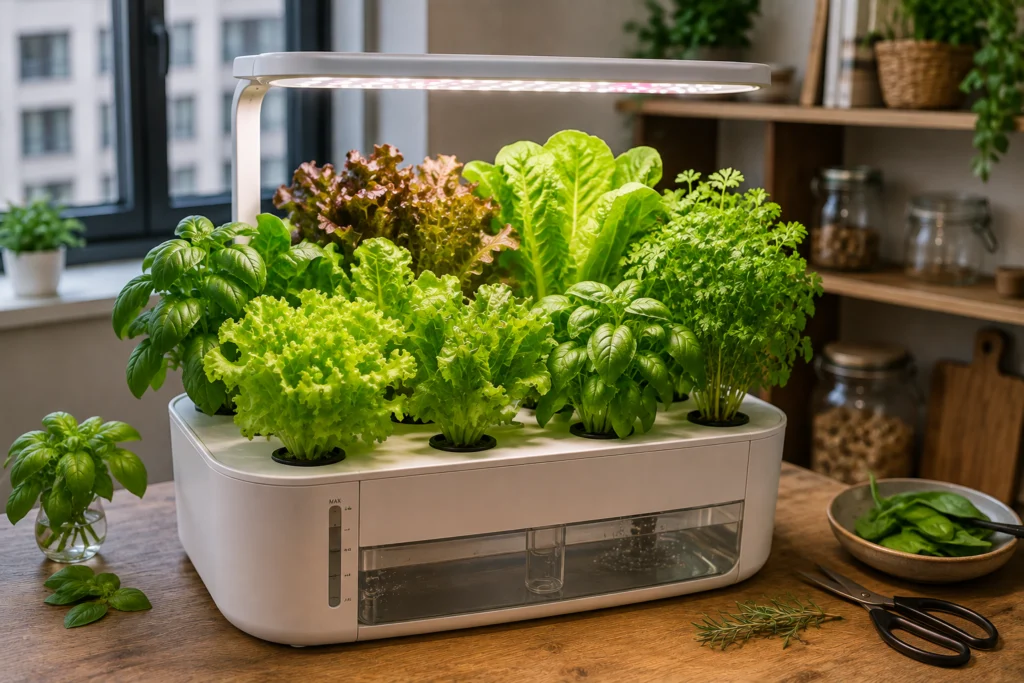
What Do You Need to Start an Indoor Hydroponic Garden?
The exact equipment depends on the system, but you don’t need every hydroponic gadget sold online.
The essentials usually include:
- a reservoir or suitable container
- plant support or net pots
- water
- complete hydroponic nutrients
- seeds or seedlings
- adequate light
- a growing medium if your system requires one
A powered system may also require:
- an air pump
- air stone
- water pump
- tubing
- timer
You’ll also need some way to check pH.
An EC meter can become useful if you want more precise information about nutrient concentration, but it doesn’t necessarily need to be the first thing you buy for a small beginner garden.
The key is buying equipment that solves a real need in your system instead of assembling a collection of tools before you’ve grown your first plant.
How to Start an Indoor Hydroponic Garden Step by Step
1. Choose a System
Start with the amount of space you actually have.
Measure the countertop, shelf, table, or floor area where the garden will sit. Remember to account for plant height and the grow light—not just the reservoir.
For a first system, simpler is usually better.
2. Choose a Crop
Choose the plant before fine-tuning the system.
Lettuce, leafy greens, or a compact herb can help you learn the basics without immediately dealing with the additional demands of a large fruiting plant.
3. Set Up the Reservoir and Plant Support
Follow the instructions for your particular system.
The reservoir needs to be stable, clean, and suitable for holding the nutrient solution. Plants should be securely supported while still allowing their roots to reach the water or growing medium as intended.
Keep light out of the reservoir as much as the design allows.
4. Prepare the Nutrient Solution
Hydroponic plants depend on the nutrient solution for the mineral nutrients they would otherwise obtain from their root environment.
Use a complete nutrient product intended for hydroponic growing and mix it according to its instructions.
Don’t assume that doubling the fertilizer will double plant growth. A nutrient solution that is too concentrated can cause its own problems.
5. Check the pH
Once your nutrient solution is prepared, check its pH according to the needs of your crop and system.
For many hydroponic crops, you’ll commonly encounter recommendations around the mildly acidic range. We’ll look more closely at pH below.
6. Add Your Plants or Seedlings
How you start plants will depend on your system.
Some setups begin with seeds in plugs or another starter medium. Others accept established seedlings after their roots have developed enough to reach the appropriate part of the system.
Avoid burying stems or forcing roots into a configuration they aren’t ready for.
7. Provide Adequate Light
Hydroponics changes how plants receive water and nutrients. It doesn’t remove their need for light.
A bright window may help, but many indoor edible crops perform better with supplemental lighting.
If you’re unsure about fixture types, positioning, or schedules, our guide to grow lights for indoor plants covers those topics in detail.
8. Observe the System
Once everything is running, resist the temptation to constantly change it.
Instead, observe.
Check:
- water level
- leaves and new growth
- root appearance
- pH
- pumps and air stones, if used
- signs of algae
- unusual odors or debris
Hydroponics becomes much easier when you learn what normal looks like in your own system.
How Much Light Do Hydroponic Plants Need?
Hydroponics doesn’t make plants less dependent on light.
A lettuce plant grown in water still needs enough light for photosynthesis. Basil grown hydroponically doesn’t suddenly become a low-light plant.
How much light you need depends on what you’re growing, the intensity of the light, its distance from the foliage, and how long it operates.
Many countertop systems simplify this by integrating an LED fixture directly above the plants. With a DIY system, you’ll usually need to provide the light separately unless the garden receives enough useful natural light.
Rather than choosing an arbitrary number of hours and applying it to every plant, match the lighting setup to the crop you’re growing.
For more detail on fixture types, placement, schedules, and signs of insufficient or excessive light, see our guide to grow lights for indoor plants.
Understanding Hydroponic Nutrients
This is one of the biggest differences between hydroponics and growing in a regular pot.
With soil or potting mix, the root environment can provide or retain some nutrients. In hydroponics, you are deliberately supplying the plant’s mineral nutrition through the solution.
That means the nutrient formula matters.
A complete hydroponic fertilizer is designed to provide essential plant nutrients in forms that can be used in a soilless system.
An ordinary houseplant fertilizer may not provide the complete nutrient profile expected in a hydroponic system, so use a product formulated for hydroponics unless its label clearly supports that use.
For beginners, there’s usually little benefit in trying to formulate a nutrient recipe from individual fertilizer salts. A complete commercial hydroponic nutrient gives you a much simpler starting point.
Beginner nutrient option: If you’d rather start with a packaged hydroponic nutrient instead of mixing nutrients from individual fertilizer salts, the General Hydroponics FloraSeries is one commonly available option. Follow the manufacturer’s mixing instructions for your crop and system.
Check the General Hydroponics FloraSeries on Amazon →
Follow its mixing directions rather than assuming stronger is better.
Nutrient conditions also change as the plant grows. Plants take up water and individual nutrients at different rates, which means a reservoir won’t maintain exactly the same chemistry indefinitely.
This is where two terms begin appearing frequently in hydroponics: EC and pH.
Missouri Extension’s guide to managing hydroponic nutrient solutions explains the relationship among nutrients, water quality, pH, EC, dissolved oxygen, and temperature.
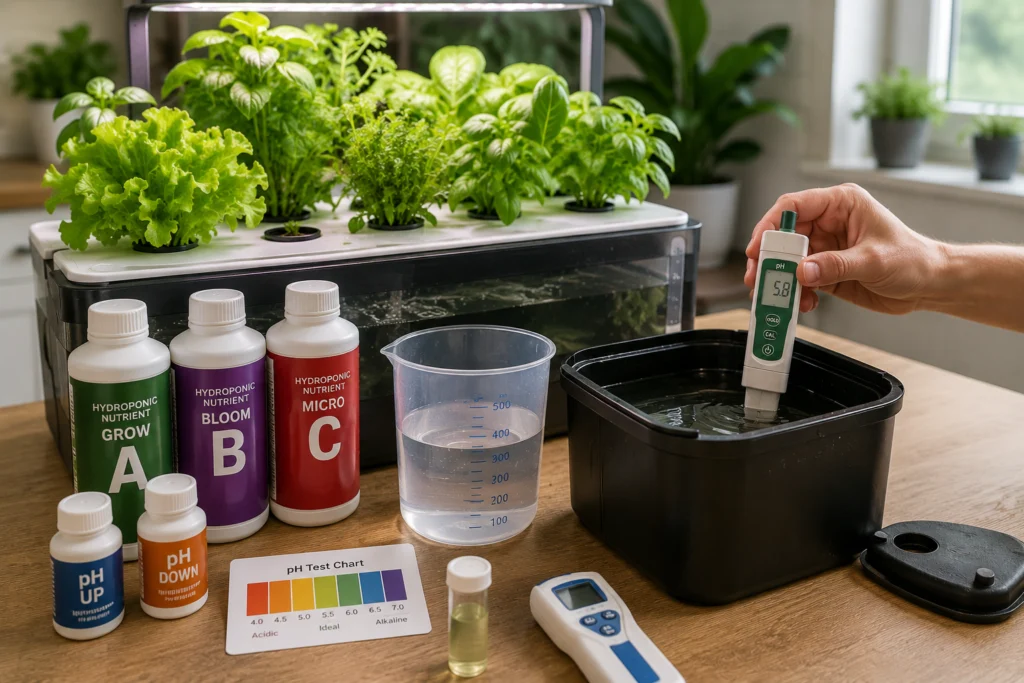
What Is EC, and Does a Beginner Need to Measure It?
EC stands for electrical conductivity.
It sounds technical, but the basic concept isn’t difficult.
Dissolved fertilizer salts form ions in water, and those ions conduct electricity. Measuring electrical conductivity gives you an indication of how much dissolved salt is present in the solution. Oklahoma State Extension notes that higher EC generally corresponds to a higher salt concentration.
What EC doesn’t tell you is exactly which nutrients are present.
A solution could have a seemingly appropriate EC while individual nutrients are out of balance. Think of EC as a useful measurement of overall dissolved ions, not a complete nutrient report.
Do you need an EC meter on day one?
Not necessarily.
A beginner using a small system and a commercial hydroponic nutrient can start by following the manufacturer’s mixing instructions. As you become more interested in controlling the system precisely—or start growing more demanding crops—an EC meter becomes more useful.
If you do monitor EC, use crop-specific targets rather than assuming every plant wants the same concentration.
Why pH Matters in Hydroponics
You can have nutrients in the reservoir and still create problems for the plant if the pH moves too far outside a useful range.
That’s because pH affects nutrient availability.
Oklahoma State Extension recommends nutrient-solution pH around 5 to 6 for soilless culture, with the root environment maintained around 6 to 6.5. Its crop-specific recommendations vary: basil is listed at pH 5.5–6.0, while lettuce is listed at 6.0–7.0.
For a beginner guide, roughly 5.5–6.5 is a useful general reference range for many hydroponic crops, but it should not be treated as a universal target.
For more detailed crop-specific values, see Oklahoma State University Extension’s hydroponic pH and EC guidance.
Check the recommendations for the crop you’re actually growing.
Water quality matters too. Oklahoma State notes that alkalinity can push nutrient-solution pH upward, which is one reason two people using the same nutrients can see different pH behavior.
The important lesson isn’t to obsess over a perfect decimal point. It’s to understand that pH matters, measure it consistently, and make adjustments carefully when needed.
Optional pH tool: If you plan to monitor your nutrient solution regularly, a digital pH meter is more convenient than repeatedly using disposable strips. The Apera Instruments PH20 is one example of a digital pH tester designed for water-based measurements.
Check the Apera Instruments PH20 on Amazon →
Why Hydroponic Roots Still Need Oxygen
This surprises some first-time hydroponic growers.
If roots are growing in water, why do they need oxygen?
Because roots still respire.
In soil, air occupies some of the pore spaces between particles. Hydroponic systems have to provide root-zone oxygen in other ways.
That’s why DWC systems commonly use an air pump and air stone. The bubbles and water movement help maintain oxygen in the root environment.
Research guidance from Missouri Extension places desirable dissolved oxygen above about 6 ppm, while University of Kentucky guidance for DWC lettuce uses approximately 6–8 ppm.
Missouri Extension’s hydroponic nutrient-solution guidance
You don’t need to run out and buy a dissolved-oxygen meter for your first countertop garden.
The more useful beginner lesson is understanding why the aeration system matters.
Water temperature also affects oxygen availability. As water becomes warmer, its ability to hold dissolved oxygen decreases. That gives you another reason not to place a reservoir somewhere that becomes excessively hot.
Passive Kratky systems solve the oxygen problem differently. As the water level falls, an air gap forms and part of the root system remains exposed to air.
Different design, same plant requirement: the roots still need oxygen.
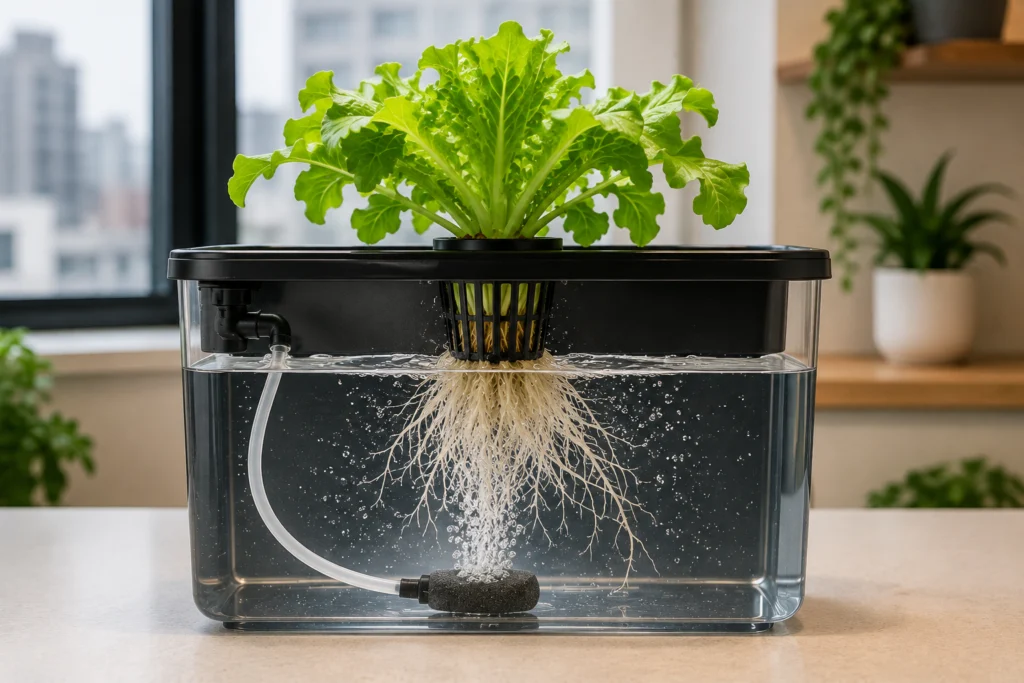
How to Maintain an Indoor Hydroponic Garden
Hydroponics doesn’t have to become a daily science experiment, but it isn’t maintenance-free.
A simple routine can prevent many problems.
Check the Water Level
Plants remove water from the reservoir as they grow.
How quickly that happens depends on plant size, temperature, system volume, and other conditions. A mature crop can use water much faster than a tiny seedling.
Follow the instructions for your particular system when topping up the reservoir.
Watch pH and Nutrient Conditions
pH can change over time, so check it according to the needs of your system.
If you’re using EC measurements, look at trends rather than reacting to every tiny change.
Oklahoma State’s technical guidance recommends frequent pH and EC monitoring in managed hydroponic production and notes that nutrient ratios can drift as water and nutrients are repeatedly added.
For a small home garden, follow the nutrient and system manufacturer’s instructions rather than assuming that every reservoir follows an identical schedule.
Check the Roots
Roots can tell you a lot.
Look for changes in appearance, texture, or odor, especially if the plant above the reservoir begins declining.
Don’t assume every slightly discolored root is diseased—some nutrient solutions and growing media can stain roots—but a sudden change combined with poor plant growth deserves attention.
Make Sure Pumps and Air Stones Are Working
If your system depends on a water pump or air pump, check that it is actually operating.
This matters particularly in systems such as NFT, where roots depend on circulating solution, and DWC, where aeration helps maintain the root environment.
Remove Dead Plant Material
Don’t let fallen leaves, damaged roots, or other plant debris accumulate in the reservoir or growing area.
Removing dead material also makes it easier to see what’s happening inside the system.
Clean Between Crops
Once a crop is finished, take the opportunity to clean the reusable components before starting again.
It’s much easier than trying to deal with accumulated roots, algae, mineral deposits, and residue several growing cycles later.
Cleaning, Algae, and Food Safety
A hydroponic garden contains water, nutrients, plant roots, and wet surfaces—exactly the kind of environment where cleanliness deserves attention.
Two terms are useful here:
Cleaning means physically removing roots, algae, deposits, dirt, and other debris.
Sanitizing is a separate step used after cleaning to reduce microorganisms on a cleaned surface.
The University of Vermont/NECAFS hydroponic food-safety guidance makes an important distinction: a surface needs to be cleaned before it can be effectively sanitized.
UVM/NECAFS provides a more detailed resource on cleaning and sanitizing hydroponic systems.
For a home system, good habits include:
- removing old roots and plant debris
- cleaning reusable trays and reservoirs between crops
- keeping tools clean
- preventing unnecessary light from reaching the nutrient reservoir
- dealing with algae rather than letting it accumulate
- following the label directions for any cleaning or sanitizing product used around food crops
Don’t assume indoor hydroponic produce is automatically free of food-safety concerns simply because it never touched garden soil.
The system still needs to be kept clean.
7 Common Indoor Hydroponic Garden Problems
Hydroponics becomes less intimidating when you realize that many problems come back to a handful of variables.
1. pH Drifting Out of Range
If pH continually moves up or down, don’t just keep adding adjusters without considering the cause.
Your source water, nutrient concentration, alkalinity, and plant activity can all affect pH.
2. Nutrient Solution That Is Too Strong or Too Weak
Adding extra fertilizer because a plant looks weak can make matters worse.
Follow the nutrient instructions and, if you’re using an EC meter, compare the result with appropriate guidance for your crop.
3. Roots Not Getting Enough Oxygen
This is particularly important when roots remain submerged.
Check the air pump, air stone, water movement, and reservoir conditions if you’re using DWC or another system that depends on active aeration.
4. Reservoir Water Becoming Too Warm
Warm water can hold less dissolved oxygen.
Also pay attention to where your system sits. A reservoir beside a hot appliance or in intense sun may behave differently from one in a more stable indoor location.
5. Algae Growth
Algae needs light.
If your nutrient solution is exposed to light, blocking that light can address part of the problem. An opaque reservoir is preferable to a clear container for many hydroponic setups.
6. Pump or Circulation Failure
A failed pump doesn’t affect every system equally.
In NFT, where roots depend on a continuous flow of nutrient solution, a circulation failure can become serious relatively quickly. A passive Kratky garden doesn’t have that particular failure point because there is no pump.
7. Trying to Grow Too Much Plant in Too Little System
A tiny countertop garden may look spacious when seedlings are two inches tall.
A month later, it can be another story.
Think about mature plant width, height, roots, water demand, and light coverage before filling every available planting position.
Sometimes fewer plants perform better than a crowded garden.
What to Look for in an Indoor Hydroponic Garden System
Shopping for a hydroponic garden becomes easier when you stop comparing long feature lists and start asking practical questions.
How much space does it actually need?
Check width, depth, and maximum height.
Don’t forget the light at its highest position.
How many plants can it realistically support?
Six planting holes don’t necessarily mean six mature plants will comfortably fit together.
Large basil plants may crowd one another long before the system reaches its advertised capacity.
Is the grow light included?
If it is, check whether the height can be adjusted as plants grow.
If lighting isn’t included, account for the space and cost of a separate fixture.
How easy is the reservoir to access?
Eventually you’ll need to add water, nutrients, clean the system, or inspect the roots.
A clever-looking design isn’t much fun if routine maintenance requires dismantling half the garden.
Does it use proprietary supplies?
Look at whether the system requires brand-specific:
- plant pods
- baskets
- nutrients
- growing sponges
- replacement pumps
- accessories
Proprietary supplies aren’t automatically bad. You simply want to know what you’re committing to before buying.
Can you get replacement parts?
Pumps and other mechanical components don’t last forever.
A system that can be repaired may be more useful over the long term than one built around difficult-to-replace components.
How much control do you want?
Some gardeners want to plant seeds, fill a reservoir, and follow prompts.
Others enjoy choosing their own pump, light, nutrients, reservoir, and growing medium.
Neither approach is inherently better. They’re different kinds of gardening experiences.
Compare Ready-Made Hydroponic Growing Systems
Ready-made hydroponic systems vary substantially in size, growing capacity, lighting, and the amount of floor or counter space they require. Our Growell Hydroponics Growing System Kit review takes a closer look at another packaged hydroponic option, while our Sjzxuv Vertical Hydroponics Growing System Kit review examines a 36-site vertical tower for growers who want more planting positions without spreading the garden across as much floor space.
All-in-One Hydroponic Garden vs. DIY Setup
This is one of the most useful decisions to make before spending money.
| Factor | All-in-One System | DIY System |
|---|---|---|
| Initial setup | Usually easier | More assembly |
| Lighting | Often included | Usually separate |
| Flexibility | Lower | Higher |
| Number of initial decisions | Fewer | More |
| Replacement parts | May be proprietary | Often generic |
| Customization | Limited | High |
| Beginner learning curve | Usually lower | Usually higher |
| Initial cost | Often higher | Can start lower |
You don’t have to determine which pump matches which reservoir or how to mount a grow light. That integration has value, especially for someone who simply wants to start growing.
Example of an all-in-one system: The AeroGarden Harvest is a countertop hydroponic garden that combines the growing area, water reservoir, LED grow light, and other basic components into one unit. A system like this can reduce the number of individual components a beginner has to choose and assemble.
Check the AeroGarden Harvest on Amazon →
DIY makes more sense if you want flexibility.
You can choose the reservoir size, lighting, aeration, plant spacing, and other components. You can also replace individual parts instead of being tied to one manufacturer’s ecosystem.
But DIY only saves money if you build what you actually need. It’s easy to turn an inexpensive bucket garden into an expensive hobby by continually adding equipment.
How Much Does an Indoor Hydroponic Garden Cost?
There’s no useful single price for hydroponics because the systems are too different.
A passive Kratky setup may require little more than a suitable container, plant support, growing medium, nutrients, and light.
A DIY DWC garden adds an air pump, air stone, tubing, and potentially more monitoring equipment.
An all-in-one countertop system combines many of those components into a finished product, which usually means paying more for integration and convenience.
And the purchase price isn’t the entire cost.
Depending on your setup, ongoing expenses can include:
- seeds or replacement pods
- nutrients
- growing media
- electricity for lighting and pumps
- pH testing supplies
- replacement pumps or air stones
- other replacement components
This is why the cheapest system isn’t necessarily the one with the lowest advertised price.
Before buying, consider what you’ll need to keep purchasing after the first crop.
Is an Indoor Hydroponic Garden Worth It?
For some apartment gardeners, absolutely.
For others, probably not.
Hydroponics makes the most sense when limited outdoor space is a real constraint and you want to grow more than a couple of decorative houseplants. It’s particularly appealing if you enjoy herbs and leafy greens and like the idea of learning how water, nutrients, roots, and light work together.
It’s also a good fit for people who enjoy a little experimentation.
But if checking water levels, mixing nutrients, testing pH, and occasionally cleaning a reservoir already sounds like a chore, a regular container garden may suit you better.
There’s nothing wrong with that.
Our indoor apartment gardening guide covers a broader approach to growing indoors without requiring a hydroponic system.
Hydroponics isn’t a better version of every kind of gardening. It’s another way to grow, and for the right apartment and the right gardener, its compact footprint can be a real advantage.
Key Takeaways
- An indoor hydroponic garden grows plants without conventional soil by supplying water and mineral nutrients directly to the root environment.
- Kratky, wick, and simple DWC systems are easier places for beginners to start than more mechanically complex designs.
- Lettuce, leafy greens, basil, and other compact herbs are practical first crops.
- Hydroponic roots still need oxygen, even when they’re growing in water.
- Nutrient concentration and pH matter because the system doesn’t have soil providing the same buffering effect.
- A general pH range around 5.5–6.5 is useful for many hydroponic crops, but crop-specific recommendations vary.
- All-in-one gardens provide convenience, while DIY systems generally offer more flexibility.
- Hydroponics still requires maintenance. Water levels, roots, nutrients, lighting, equipment, and cleanliness all need attention.
Frequently Asked Questions
Is hydroponics good for an apartment?
It can be. Hydroponic systems can use relatively little floor or counter space, and some are specifically suited to indoor growing. The University of Minnesota Extension identifies hydroponics as an option for people with little or no gardening space. The best choice depends on your available space, lighting, crop, and willingness to maintain the system.
What is the easiest hydroponic system for a beginner?
Kratky, wick, simple DWC, and all-in-one countertop gardens are all reasonable beginner options. Kratky has the advantage of requiring no pumps or electricity for water circulation, while an all-in-one garden simplifies setup by combining several components into one unit.
What can I grow in a small indoor hydroponic garden?
Lettuce, spinach, basil, and other leafy greens and compact herbs are good places to begin. Larger fruiting crops such as tomatoes, peppers, and cucumbers can also be grown hydroponically, but they generally require more space, support, light, and management.
Does hydroponics need sunlight?
Plants grown hydroponically still need adequate light for photosynthesis. That can come from natural sunlight, artificial grow lights, or a combination of the two. Many countertop hydroponic systems include their own LED lighting.
If you’re considering a compact countertop system, our Ahopegarden Indoor Garden Hydroponics Growing System review looks at its 10 growing positions, approximately 14.5-inch growing height, automatic lighting, and the types of plants that realistically fit.
Do I need to test pH for hydroponics?
pH is important because it affects nutrient availability. Oklahoma State Extension notes that appropriate pH varies by crop and provides crop-specific recommendations for hydroponic production. A simple pH testing method is therefore a useful part of a home hydroponic setup.
Does a hydroponic garden use a lot of electricity?
It depends on the system. Passive methods such as Kratky don’t require electricity for water pumps or aeration. DWC normally uses an air pump, while NFT and other active systems use water pumps. Indoor gardens may also require grow lights, which can account for additional electricity use.